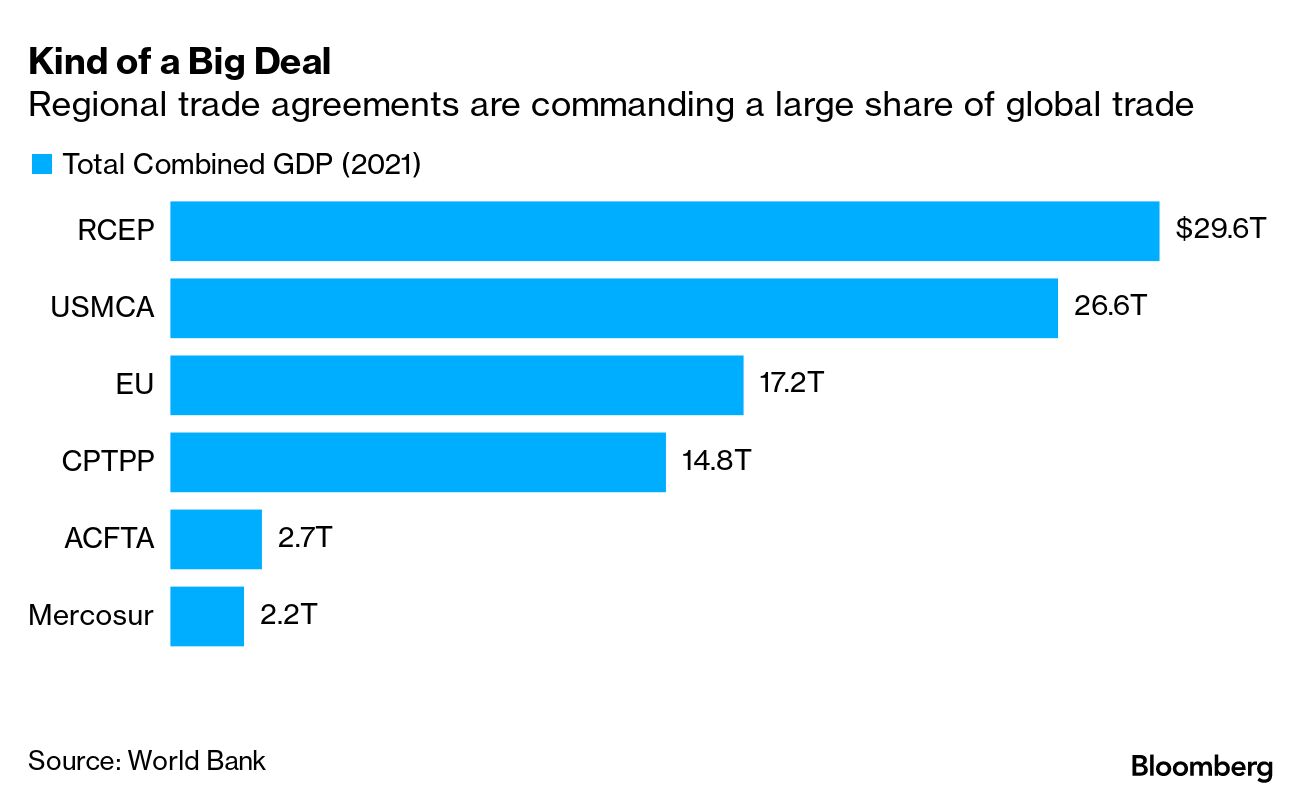
| When Joe Biden ran for the White House in 2020 he tweeted a warning: If the US didn't write the global rules for trade, "they may be written by China or other nations that don't share our values." Now, as President Biden begins to campaign for a second term, some businesses lobby groups want to see more tangible progress inking trade deals that open foreign markets to US exports. "The Biden administration's agenda is incomplete without more of a focus on more formal trade agreements," said Jake Colvin, president of the Washington-based National Foreign Trade Council, an association that lists multinationals such as Amazon.com, Caterpillar and Walmart on its board of directors. "Some 40 million US jobs depend on trade and if we want to do right by them and compete with China, the US government needs to be firing on all cylinders," Colvin said in an interview. Read More: Biden's Made-in-USA Push Sparks Global Subsidies Race To date, Biden's trade officials have not engaged in any traditional free-trade negotiations because they argue that such deals have made the nation's economy more vulnerable. "We are not pursuing traditional fully liberalizing trade agreements, because we see those as part of the problem that we are trying to correct for," US Trade Representative Katherine Tai told lawmakers in March. Farm Exports Some business groups see it differently for sectors like farming. "The US agriculture sector is frustrated with the relative lack of ambition of the administration on seeking market access abroad," said John Murphy, a senior vice president for international policy at the US Chamber of Commerce. "That frustration is palpable." In March, a group of more than 50 agriculture groups warned that the US is "falling badly behind on global economic influence" at a time when China is eroding US market access in Asia, Europe, Latin America and Africa. In 2020, China marked a major win with the signing of the Regional Comprehensive Economic Partnership — a free-trade pact including China and 14 other Pacific nations that was originally envisioned as an economic counterweight to the US-led Trans-Pacific Partnership. Since then, China has initiated talks to join the Comprehensive and Progressive Agreement for Trans-Pacific Partnership, or CPTPP. QuickTake: How US and China Jockey for Economic Sway Across Asia Meanwhile, Biden has declined to join the 11-nation trade pact and has instead focused on more limited negotiations like the Indo-Pacific Economic Framework for Prosperity (IPEF), which aims to reduce non-tariff barriers to trade. That falls short for American businesses that are eager to sell their goods to the 95% of the global population that lives outside of the US, Murphy said. 'Hungry for More' "This community is hungry for more," he said. "It is really striking that there is a bipartisan chorus saying the same thing." Colvin agrees, saying an "immediate win" would be a free-trade agreement with the UK, a bilateral trade relationship worth around $273 billion a year that currently trades according to terms set in 1995 at the World Trade Organization. "The UK's accession to the CPTPP should be a wakeup call for the US government," Colvin said. "It's frustrating for US businesses to see one of our closest trading partners join this agreement. We are looking for more." Additional Reading: —Bryce Baschuk in Geneva | 










No comments:
Post a Comment