| Biden calls debt-ceiling meeting, Morgan Stanley cuts jobs and ChatGPT causes a stir. — Liza Tetley President Joe Biden has invited congressional leaders for a May 9 meeting as the US barrels closer to a potential debt default in what is the first sign of progress since the White House said it would not negotiate with Republicans over extending the debt ceiling. Still, it's too soon to declare the end of the impasse. While House Speaker Kevin McCarthy has agreed to attend the meeting, according to a GOP aide, Senate Minority Leader Mitch McConnell has yet to confirm his plans. A White house official emphasized the invitation should not be interpreted as a sign that Biden is ready to negotiate over the debt ceiling. Morgan Stanley and Citigroup have joined the chorus of companies announcing job cuts as cost pressures rise. Morgan Stanley says the move is necessitated by the slump in dealmaking, which spurred a profit decline in the first quarter. Just months after the bank trimmed about 2% of its workforce, it plans to slash a further 3,000 jobs globally. Citigroup CEO Jane Fraser cited similar pressures, saying the company is willing to adjust staffing levels inside its investment bank as they cope with the dealmaking drop that's cut into fees across Wall Street. OpenAI's ChatGPT has sparked a rout in the stock of homework-help firm Chegg, after the company warned the tool threatens the growth of its services. The market reaction is yet another sign of how generative AI is upending industries. Chegg's CEO Dan Rosensweig said: "Since March we saw a significant spike in student interest in ChatGPT. We now believe it's having an impact on our new customer growth rate." Meanwhile, other companies see it as a potential security threat. Samsung has banned employee use of generative AI tools after discovering staff uploaded sensitive code to the platform. US stock futures are slightly lower today, with S&P 500 futures down 0.2% as of 5:30 a.m. in New York, while the tech-heavy Nasdaq treads water, as investors digest earnings. Treasuries are higher, with traders clearly expecting a debt-ceiling resolution to avoid a default. Meanwhile, gold prices are edging higher after a session in the red on Monday, while oil is slipping. The US dollar is showing gains. In the US, job openings data for March will be published at 10:00 a.m., along with factory orders and durable goods. April light vehicle sales will also be reported, and the FOMC begins its two-day meeting.
Among companies reporting earnings are DuPont, Ford, Uber, Marathon Petroleum, Pfizer, AMD, Starbucks, ITW, Ecolab, Clorox, Howmet Aerospace, Marriott, T. Rowe Price, Gartner, Sysco and Prudential.
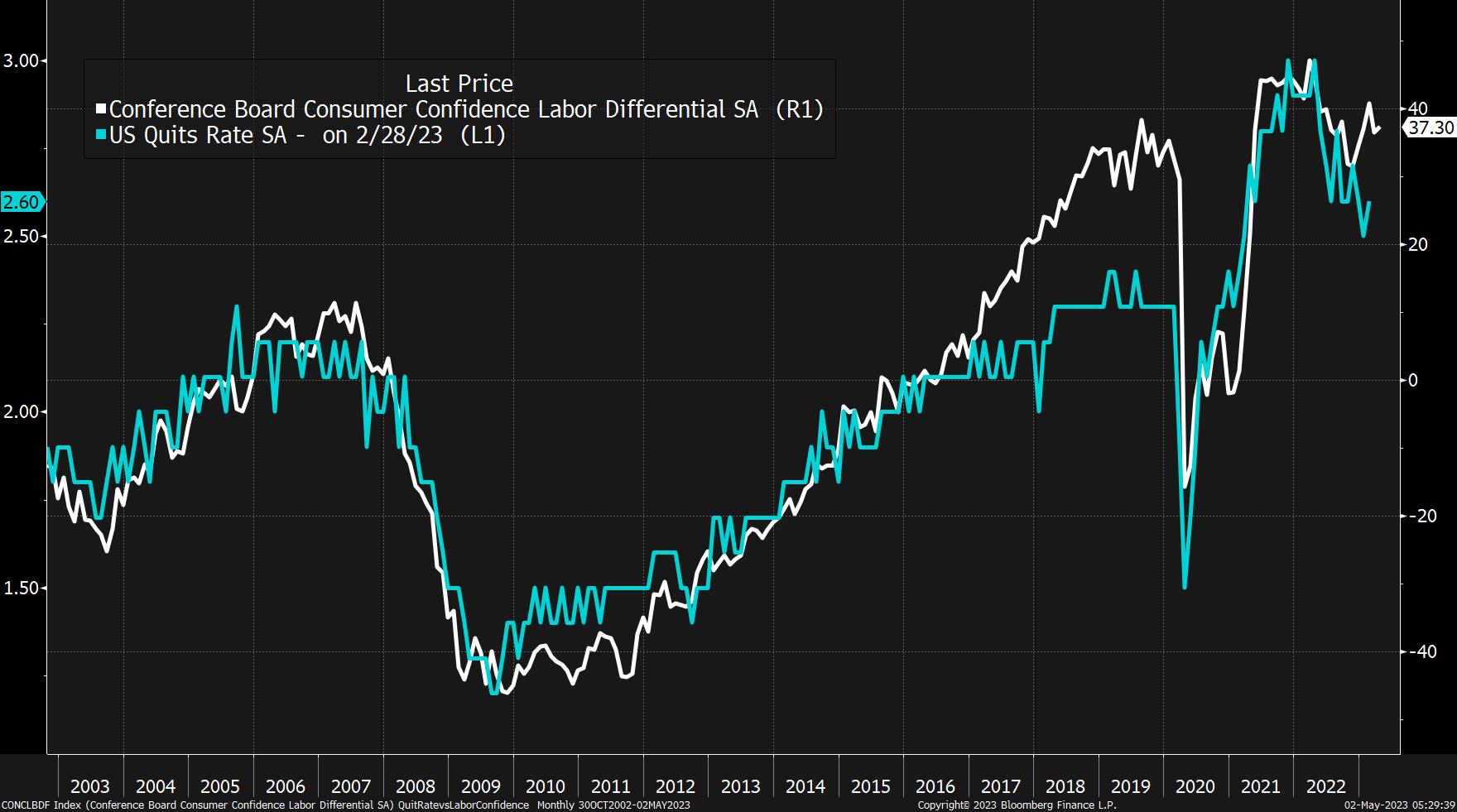
Which European city will become the region's dominant stock exchange? Among the world's most advanced economies, which will see the biggest decline in standard of living this year? Share your views in the latest MLIV Pulse survey. Here's what caught our eye over the past 24 hours: I mentioned this yesterday in here, but in reading through some of the corporate earnings calls last week, a number of companies suggested that labor conditions have eased significantly in some way. This is, of course, in the category of "things the Fed wants to see." Whether that's good for the economy more broadly is a separate question. Speaking of labor market data, today we get the March JOLTS report. Given how much Powell has been talking about the number of job openings (relative to available workers), this measure has become a market mover. So watch for that, when it comes out at 10 AM. ET. Expectations are for 9.73 million job openings, down a bit from the 9.99 million openings in February. That being said, I'm more interested in seeing what happens with the Quit Rate. With a job opening, you still can't be entirely sure how intensely a company is seeking to actually fill that opening. When an employee quits a job, that's a substantive thing that happens. And historically, the quit rate goes up when the economy is good, because people feel less pressure to hold onto their employment. In fact, a chart of the Quit Rate has long matched the trajectory of the Consumer Confidence survey's question about the public's perception of the labor market. Both have come down a bit, but both quits and labor market confidence are still at very strong levels. Quits in particular are still way above pre-pandemic levels.
Here's the latest look at the two lines: Obviously this Friday's Jobs Report is going to be the main course of the week data-wise. But today should be a nice appetizer.
Follow Bloomberg's Joe Weisenthal on Twitter @TheStalwart. | 










No comments:
Post a Comment