Monday, February 27, 2023

Brussels Edition: Brexit complete

The EU and UK may have finally settled their biggest differences

Welcome to the Brussels Edition, Bloomberg's daily briefing on what matters most in the heart of the European Union.

Three years after the hard-fought Brexit deal was originally approved, the EU and UK may have finally settled their biggest differences. Commission President Ursula von der Leyen and British Prime Minister Rishi Sunak struck a deal that adds some new flexibility for Northern Ireland trade — and a complicated mechanism for the region to challenge amendments to existing EU law. Sunak dubbed it a veto, while EU officials called it a method of last resort. Either way, the compromise moves them beyond London's earlier objections to the role of the European Court of Justice. The deal still needs to be formally approved by both sides, but it could bring the EU-UK relationship in from the cold. Here are five key takeaways

Kevin Whitelaw

What's Happening

Funds Fight | Hungary's top diplomat accused Finland and Sweden of "spreading lies" about the erosion of democracy and said lawmakers in Budapest were justified in delaying approval of the Nordic nations' NATO membership. "How can they expect a quick and fair decision?" Peter Szijjarto said. 

Arming Kyiv | Estonia is urging the EU to focus on speedily acquiring  ammunition for Ukraine to jump-start industrial production, instead of sending existing stocks as the bloc's top foreign policy chief has suggested, we're told. The country's defense minister argues that procurements could be conducted by an EU body but also by a member state acting on behalf of the bloc if this were a quicker solution. 

Nuclear Croissants | French Energy Minister Agnes Pannier-Runacher is inviting 12 of her counterparts for breakfast today on the sidelines of an EU meeting in Stockholm to discuss how nuclear power can help safeguard energy security while lowering carbon emissions. She's trying to build support for hydrogen produced using nuclear to be classified as renewable under the bloc's rules.

Appeal Rebuffed | German Defense Minister Boris Pistorius will get at most half the extra €10 billion he wants in his budget for next year to help modernize the military after decades of underfunding, we've been told. The finance ministry, run by the fiscally hawkish Christian Lindner, would be open to an increase of €3 billion, which could potentially be raised to €5 billion if tax revenue was higher than expected. 

Network Revamp | The EU must consider new ways to improve the continent's data networks, even if that means getting big tech companies to pay for it, according to Commissioner Thierry Breton. "We will need to find a financing model for the huge investment, fairly distributed, that respects and preserves the fundamental elements of our European acquis," he said.

In Case You Missed It

Green Boost | The European Investment Bank urged member states to support an expansion of its green financing as the continent considers how to respond to the US's green subsidy program. Bank President Werner Hoyer called for an increase in the RePowerEU initiative by 50% to €45 billion, which he said would mobilize €150 billion over five years on top of existing lending.

Persistence Needed | The European Central Bank must push on with monetary-policy tightening while price pressures endure, according to Governing Council member Boris Vujcic. "We should persevere" as long as core inflation remains significantly higher than targeted, he told Bloomberg Television.

Renewed Fight | Poland's president accused Brussels of interfering in his country's internal affairs and warned that the ruling party shouldn't stake this year's election campaign on securing access to EU funds. The barbed comments by Andrzej Duda mark a return to tougher rhetoric after the head of state threw Warsaw's plan to access some €35 billion into turmoil.

Housing Gloom | Poland's mortgage market is set to shrink to the lowest level since 2005 as banks restrict loans over concerns about potential defaults and mounting legal risks. New mortgages this year are expected to drop 33%, continuing the downturn from 2022 when the market halved due to the steepest series of rate hikes in the country's history. 

Gas Comeback | As prices fall, power producers in western Europe are expected to switch to gas from coal to generate electricity. Gas plants with an efficiency of 55% — meaning the proportion of fuel that is directly converted to power — are able to out-compete 40% efficient hard-coal units in some markets, according to an analyst. Learn more

Chart of the Day

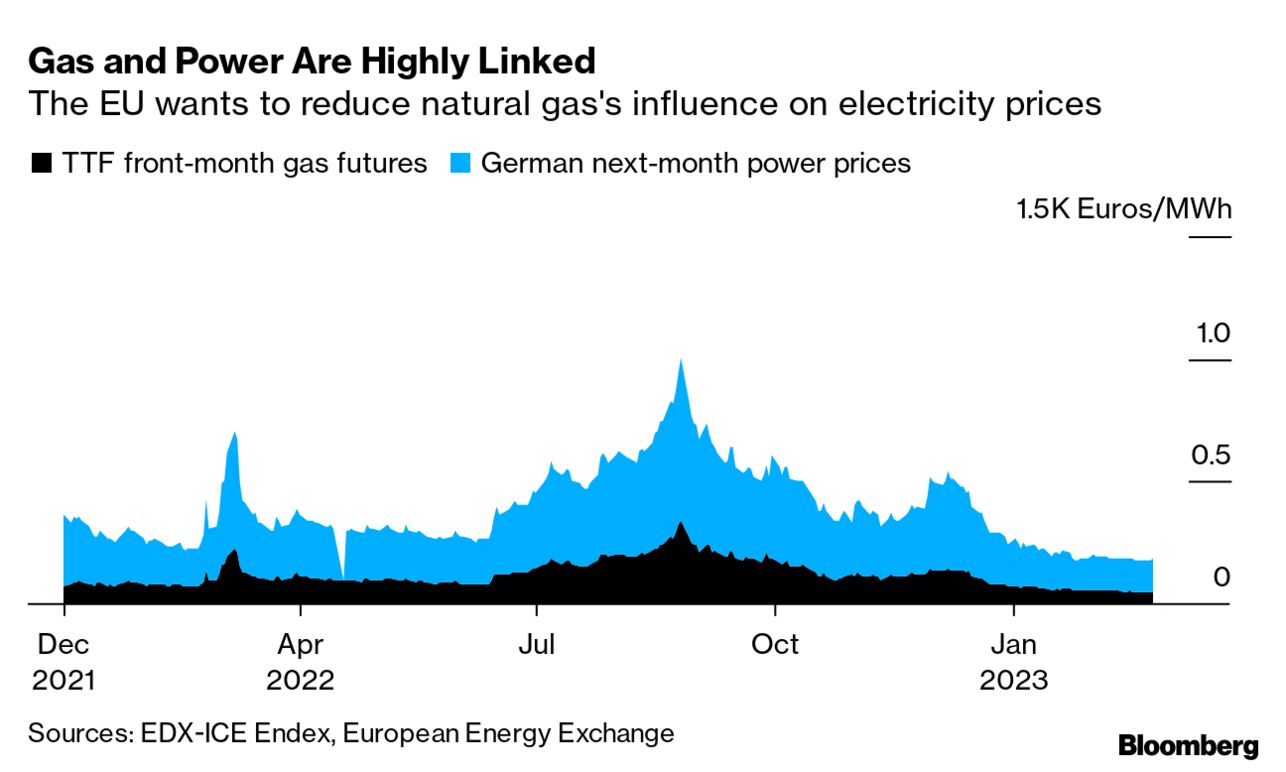
The Commission is trying to weaken the link between electricity and natural gas when it unveils its reform plan for the power market on March 14. Under the current EU electricity market design, gas sets the price for all power that's sold into the market. That means consumers are bearing the brunt of Russia's supply cuts to the continent after its invasion of Ukraine, and their bills don't reflect the growing share of low-cost renewables like wind farms that get to sell at big margins. 

Today's Agenda

All times CET.

  • 9 a.m. Economy Commissioner Paolo  Gentiloni speaks at inter-parliamentary forum
  • 12:15 p.m. NATO General Secretary Jens Stoltenberg holds opening speech at SAMAK Nordic Summit in Helsinki 
  • Competition Chief Margrethe Vestager, Commission Vice President Valdis Dombrovskis speak at EIB Forum in Luxembourg
  • EU energy ministers meet in Stockholm

Like the Brussels Edition?


Don't keep it to yourself. Colleagues and friends can sign up here.

How are we doing? We want to hear what you think about this newsletter. Let our Brussels bureau chief know.

No comments:

Post a Comment

The Market's Compass US Index and Sector ETF Study

Week #595 / Is a Correction in The Cards? ͏     ­͏     ­͏     ­͏     ­͏     ­͏     ­͏     ­͏     ­͏     ­͏     ­͏     ­͏     ­͏     ­͏...