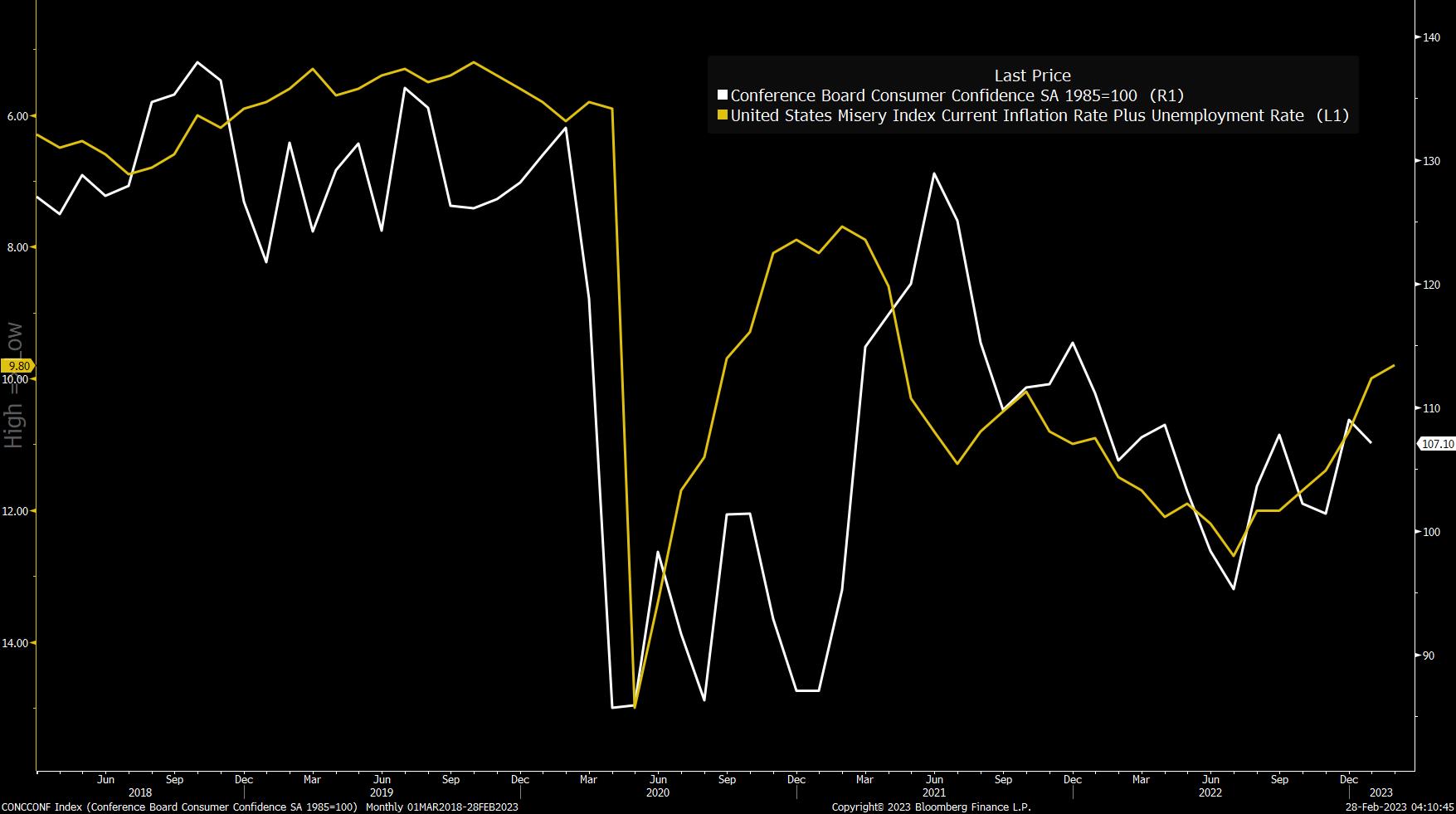
| Hot inflation data sees investors boost bets on the peak of ECB rates, Hong Kong drops one of the world's longest-standing mask mandates and banker bashing is back. — David Goodman To catch up on the trading day in the UK and Europe, check out Markets Today. Inflation reports from both France and Spain came in unexpectedly hot on Tuesday, prompting investors to boost bets on the peak for European Central Bank interest rates to 4% for the first time. The stronger readings — a record 7.2% in France and 6.1% in Spain — will cement the half-point rate move the ECB is planning for March and bolster those officials who say more big moves are needed beyond that to get inflation under control. Any moves higher could prove sticky. Chief Economist Philip Lane said in remarks to Reuters published Tuesday that officials may hold borrowing costs at a high level for some time once they hit the peak. Hong Kong will stop requiring masks to be worn in public places from Wednesday, drawing to a close the prolonged Covid era that damaged its economy and standing in the world. Masks will no longer be needed outdoors, indoors or on public transport, Hong Kong leader John Lee announced Tuesday, saying "from tomorrow we are completely returning to normalcy — this year and the next year, we will focus on the economy and development." The mandate, which lasted 945 days, required people to wear masks in all public places, including outdoors, from July 29, 2020. The rule was enforceable by fines of up to HK$10,000 ($1,275), with police regularly handing out HK$5,000 penalties on the spot for transgressors. After being branded public enemies for eviscerating billions of dollars and tanking the global economy during the financial crisis, bankers in many parts of the world are back in the hot seat. This time, though, they're being blamed for making too much money instead of losing it. As interest rates soar on seemingly everything except deposits, banks are scoring big profits on the widening gap between what they charge borrowers and pay to savers. That's attracting the ire of politicians from London to Seoul at a time when rampant inflation is stoking cost-of-living crises and forcing central banks to constrict economic growth. In other news that may infuriate some in the industry, senior investment bankers at HSBC in Hong Kong could be set to lose their private offices as the firm moves toward open-plan desks for the financial hub. That's causing angst among some executives who've complained about potential confidentiality risks. European bond yields surged and stocks fell after the hot inflation reports on Tuesday. The yield on two-year German government bonds jumped to the highest since 2008. Treasuries also fell, with the 10-year benchmark yield climbing toward 4%, while US equity futures pointed to a lower open. The dollar was little changed and an index of commodities slipped. There's a slew of confidence and manufacturing surveys due in the US today, while Chicago Fed President Austan Goolsbee is the lone central bank speaker before the pace picks up towards the end of the week. Meanwhile, Target, JM Smucker and HP are among firms reporting earnings, while Goldman Sachs and Chevron hold annual investor days. A huge amount of money has flowed into passive index funds over the past decade. Is the growth of passive management a bubble? What are the chances that actively managed mutual funds outperform a passive fund tracking the S&P 500 this year? Share your views in our latest MLIV Pulse survey. Here's what caught our eye over the past 24 hours: You don't really hear a lot about the 'Misery Index' these days. And to be fair, as far as measures of the economy go, it's about as crude as it gets. You just add the unemployment rate to the year-over-year change in CPI and voila, there's your index. Talking about it seems kind of quaint, but something I've noticed a few times over the course of the last few years is that this extremely simple measure actually tracks pretty well with surveys of consumer sentiment. The white line in this chart is the Conference Board Consumer Confidence index, and the yellow line is the Misery Index (but flipped over, so that higher means less misery). As you can see, in spring of 2020, when the unemployment rate surged, this measure of misery surged as well. And then it rebounded throughout 2020. And then it worsened again throughout 2021 and 2022 as inflation gathered steam, swamping the improvement in the unemployment rate. And then you see in the middle of last summer that the index started improving again as the inflation readings started to peak and the unemployment rate continued to trend lower. And again, it tracks Consumer Confidence fairly well, with both having formed a bottom in July of last year. Where things stand now is that even with the concerns that disinflation has stalled, the Misery Index has improved to its best level since spring of 2021. Today at 10 AM ET we get the latest Conference Board number, and we'll see if it improves commensurately. | 







No comments:
Post a Comment