| Good morning. Markets are now understanding the Fed's message, political crisis for UK's new PM and chancellor, reorganization is knocking on Meta's front door and Ukraine troops are advancing. Here's what people are talking about. Federal Reserve officials reiterated that they will keep raising interest rates to restrain high inflation and that markets are now understanding the message. St. Louis Fed President James Bullard told a virtual emerging-market forum that volatility in financial markets reflected spillovers from recent events in the UK -- where the new government's fiscal measures have seen the pound plummet -- but made clear that these would not cause the Fed to pause its tightening campaign. His hawkish stance was in line with the message from Cleveland Fed chief Loretta Mester, who said that officials are resolute in their quest to increase rates to a level seen as restrictive. Kwasi Kwarteng privately pleaded with his angry colleagues in the UK's ruling Conservative Party to support the government's economic policies, warning that any division would play into the hands of the poll-leading opposition Labour Party. Groups of Tory MPs have spent two days in frantic discussions following a dramatic £65 billion ($72 billion) intervention from the Bank of England to avert a meltdown in the bond market. The fallout represents a political crisis for both the chancellor and the prime minister as it undermines the Tories' typical claim to be the party of sound economic management. The pound, meanwhile, rallied early Friday and briefly erased all of the losses it made since Kwarteng began his speech last week.  | Meta Platforms CEO Mark Zuckerberg outlined sweeping plans to reorganize teams and reduce headcount for the first time ever, calling an end to an era of rapid growth at the social media giant. In what would be the first major budget cut since the founding of Facebook in 2004, Zuckerberg said the company will freeze hiring and restructure some teams to trim expenses and realign priorities. Meta will likely be smaller in 2023 than it was this year, he said. The further cost cuts and hiring freeze are Meta's starkest admission that advertising revenue growth is slowing amid mounting competition for users' attention. Russian President Vladimir Putin may not have long to wait for the first major test of his decision to annex a swathe of Ukraine, with Kyiv's forces threatening to encircle a pocket of the Donbas region he set out to conquer. The Kremlin said Putin will on Friday sign what it called treaties with the Moscow-anointed leaders of four partially occupied provinces in Ukraine's east. Ratification of their absorption into Russia would soon follow. Yet even as Putin prepares for a significant escalation of the conflict, Ukrainian, Western and Russian military analysts say Russian units are at risk of being enveloped in the Donetsk town of Lyman. European equity futures fluctuated amid declines across Asia as the prospect of higher interest rates and turmoil in Europe stoked fears of global recession. EU energy ministers meet in Brussels on the power crisis. Tesla hosts an AI day, designed in part to lure more engineering talent. ECB Executive Board member Isabel Schnabel takes part in a panel discussion in Spain. Fed Vice Chair Lael Brainard and New York Fed President John Williams speak at a conference. There's a flurry of economic data ahead, including CPI and PPI inflation for France, Spain retail sales and UK GDP. Carnival and Cineworld report earnings. This is what's caught our eye over the past 24 hours. There's some talk that this week's volatility has been exacerbated by the approach of the end of the quarter adding to the strains in financial markets as balance sheets need to be adjusted and positionings shifted to account for some of the swinging gains or (mostly) losses across assets. That may well be so, but the message from the cross-currency swaps market seems to be the year-end could be far more prone to such outcomes. Three-month costs for European and Japanese traders wanting to fund into dollars are blowing out this week to levels rarely seen outside of the pandemic. That's mostly got little to do with funding strains at the end of this quarter, rather it's tied to nervousness about the end of 2022. There were similar gaps lower in the six-month swaps at the end of June as they went through the same situation, but the moves just now for the shorter tenors have been substantially larger. That gives investors little reason to relax should the current storms ease as October opens. 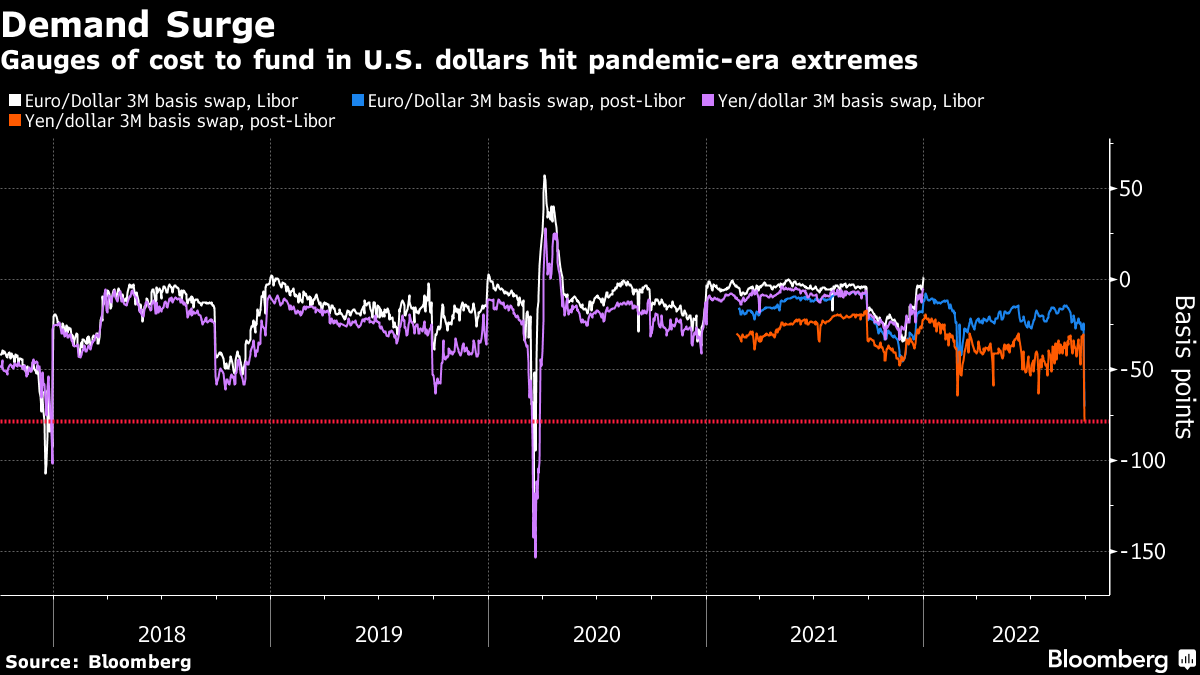 Garfield Reynolds is Chief Rates Correspondent for Bloomberg News in Asia, based in Sydney. New from Bloomberg UK. Sign up here for The Readout with Allegra Stratton, your end-of-day guide to the stories that matter. | 






No comments:
Post a Comment