| The financial consequences for most asset managers and banks from all the anti-ESG rhetoric coming out of the mouths of Republican politicians in the US is almost certain to be minimal—at least for now. Even if money managers who consider ESG criteria were banned from handling public pension funds in states such as Florida, Texas, Oklahoma, and West Virginia—where ESG skepticism is high—a back of the envelope review supports the notion that any business losses would be insignificant relative to the firms' overall bottom line. Take Florida for example. Governor Ron DeSantis has arguably been the most outspoken basher of environmental, social and governance investing. He said last week that the state's pension funds will no longer consider ESG criteria when seeking to generate the highest returns possible. While DeSantis didn't single out any companies, BlackRock Inc., the world's largest asset manager, has received criticisms from several GOP-run states who contend the New York-based firm is pursuing ESG investment policies to the detriment of their state pension funds. BlackRock oversaw about $7.2 billion for the Florida Retirement System Pension Plan as recently as June. Given BlackRock's business model, it's safe to assume that most of those assets were in index-tracking funds that charge fees equal to less than 10 basis points, said Jon Hale, director of sustainability research for the Americas at Morningstar Inc.'s Sustainalytics unit. Presuming these figures are accurate, BlackRock would be earning about $7.2 million of annual fees from the Florida pension. That's a tiny amount when compared with the firm's total net revenue of $19.4 billion in 2021. In other words, Florida's business probably isn't enough to cause BlackRock to rethink its ESG policies. And BlackRock isn't alone. Examples like this indicate that the financial repercussions from the GOP's prognostications about other large asset managers and banks will be very little, Hale said. "And I doubt these efforts will have much long-term impact," he said. "For now, they're mostly being used as political talking points." Hale said the Florida rule simply reflects DeSantis's rage at corporations for becoming more focused on issues such as climate change and societal inequities.  Calling all podcast lovers. Yes to a world with zero emissions… but how do we get there? On Zero, a new podcast from Bloomberg Green, we're introducing listeners to the people making that world possible — from scientists building physics-defying batteries to politicians passing successful climate laws. Subscribe now on Spotify and Apple to get the first episode in September. Still, there is business beyond state pension plans to consider. Financial firms also provide municipal bond underwriting and other services—and states may want to think twice before blocking these companies from offering their expertise. It could end up backfiring. One example where this already may be the case is Texas. The state introduced two laws last year that bar banks that "boycott" oil and gas companies or "discriminate" against firearms entities from government contracts. The gun ruling resulted in lower municipal bond market share for banks such as Goldman Sachs Group Inc., JPMorgan Chase & Co., Bank of America Corp. and Citigroup Inc. that sought to limit financing for certain retailers and manufacturers, said Rob Du Boff, senior ESG analyst at Bloomberg Intelligence. However, the decision to exclude major banks on the basis of their ESG policies also made the market less competitive and probably led to higher coupon payments for Texas entities in the order of $303 million to $532 million in the first eight months under the new laws, Du Boff said, citing a study from Daniel Garrett of the University of Pennsylvania and Ivan Ivanov of the Federal Reserve Board of Governors. Still, what if politics outweigh the financial downsides for states and all this anti-ESG bluster leads to more boycotts? Andrew Poreda, senior ESG research analyst at Sage Advisory Services, said the longer-term effects for the financial-services industry may be greater than generally perceived. What's happening in states like Florida and Texas highlights "a bigger fear that appears to be playing out," he said in a telephone interview from his office in Austin, Texas. "Are asset managers ultimately going to be forced to pick a side and be 'red' or 'blue' managers? If you asked us six months ago, we would have thought that very notion to be far-fetched. Now, it sure looks like we are headed that way." This may end up having serious implications for asset managers, municipal bond underwriters and investment bankers in the country's biggest states, Poreda said. It never used to be the requirement of a fiduciary to align ideologically in lockstep with their client, "but that appears to be our new future, unless cooler heads prevail," he said. 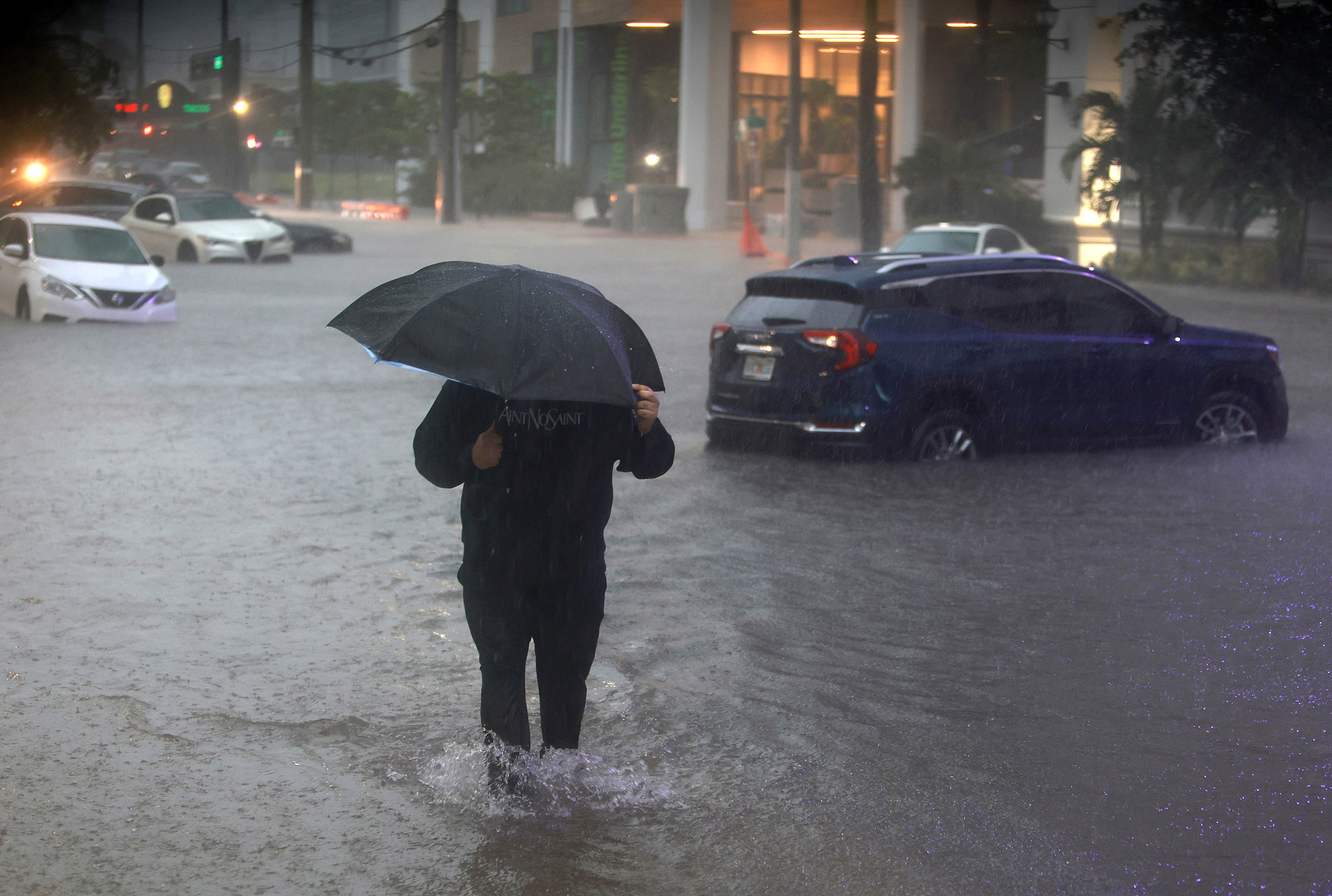 A pedestrian walks through a flooded street caused by a deluge of rain from a tropical storm in Miami, Florida — a state particularly vulnerable to climate change. Photographer: Joe Raedle/Getty Images North America - Politicians from Florida and Texas are going on the attack against investment firms that weigh risks tied to climate change.
- Florida's governor passed a resolution that bans fund managers of pensions from using ESG strategies to invest state funds.
- A senior BlackRock Inc. executive blasted a finding by Texas officials that the firm boycotts the fossil-fuel sector.
- Asset managers that just reclassified hundreds of ESG funds should brace themselves for backlash from regulators and investors.
- Some managers are making surprising fine-print disclosures, including PIMCO, which says it has no abortion-related holdings.
Calling all filmmakers. Bloomberg Green Docs is accepting submissions for one more month. We want to see your short documentaries on climate change. Submit your film by September 16 and compete to win a $25,000 grand prize, plus the opportunity to showcase your work at a special screening in Los Angeles on October 26. Like getting the Green Daily? Subscribe to Bloomberg.com for unlimited access to breaking news on climate and energy, data-driven reporting and graphics and Bloomberg Green magazine. Read and share this story on the web here. | 









No comments:
Post a Comment