| Welcome to today's edition of Navigator, CityLab's Saturday newsletter. Asian American Pacific Islander Heritage (AAPI) month came to an end this week with some exciting news amid the sobering statistics about the continued rise of anti-Asian sentiment in the US. Yes, the K-Pop supergroup BTS graced the White House press briefing room last week to call out the surge in hate crimes. But also, New York City announced a pilot program to teach AAPI history in the largest public school system in the US. The curriculum in NYC will launch in the fall of 2024, as part of the city Department of Education's Hidden Voices Project, which aims to teach students about communities that have been overlooked in traditional history classes. Lessons will center around Asian Americans' contributions to the shaping of America, as well as prominent figures like Representative Patsy Mink, the first Asian-American woman (and woman of color) to be elected into Congress. The pilot reflects a growing number of Asian-American New Yorkers, whose population doubled in NYC from 490,000 in 1990 to 1.2 million in 2019, and the fact that AAPI kids make up 6.5% of the city's student population. The program is also a direct response to the alarming rise in xenophobia, fueled in no small part by persistent stereotypes of Asian Americans as both perpetual foreigners and the model minority. "And the reason we get blamed, and therefore hated and attacked, is because of ignorance," State Senator John Liu said during a press conference, according to Gothamist. New York isn't the first to emphasize AAPI education. Last year, amid debates over teaching critical race theory and LGBTQ issues in schools, Illinois became the first state to mandate that Asian-American history be taught in public elementary and high schools, as Amy Yee reported. For the broader Asian-American community — whose histories in the US span centuries but may not get more than a few paragraphs in American textbooks — It's, at the very least, a small win. At my school, Japanese internment camps got a mention during World War II, but lessons rarely delved into the impacts of the Chinese Exclusion Act or Asian Americans in the civil rights movement. It wasn't until I took a special history course in my third year of college that I learned about Vincent Chin, whose murder in 1982 sparked one of the largest Asian-American protests. And it's not just me. A few weeks ago at the Eaton Hotel in Washington, D.C., director Curtis Chin screened his 2009 documentary "Vincent Who," which looks at that crucial moment. The film opens, memorably, by asking young AAPI adults if they had heard of Vincent Chin. The answer was a resounding no. Maybe the answer will be different in this upcoming generation of students. —Linda Poon What we're writing 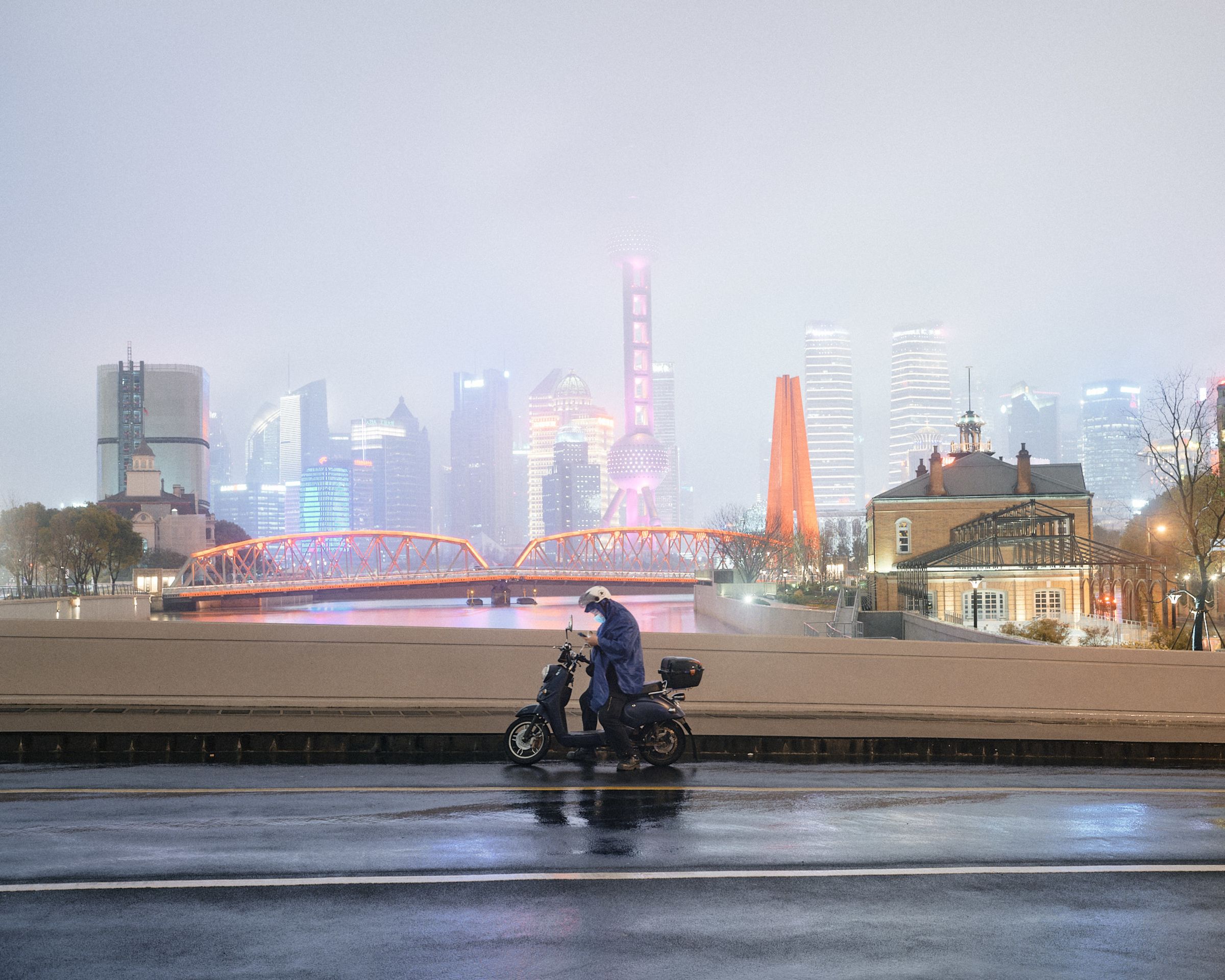 A lone motorcyclist on Sichuan Bridge on March 20. Photographer: Anthony Reed - An architectural photographer spent his final days in China capturing the emptiness of the normally bustling Shanghai, just days before the city locked down to combat Covid outbreaks.
- The toilets of Tokyo are getting their own movie. German director Wim Wenders' new film looks at The Tokyo Toilet art project, which employed 16 world-famous designers to revamp 17 public restrooms in the capital.
- A wave of modernist architecture swept India, Pakistan and other South Asian states after independence. The fate of these post-colonial projects reveals much about the region's political transformation.
- It's the end of an era in New York City as officials removed its last freestanding public phone booths. Many are being replaced with Wi-Fi kiosks.
- The return of Dublin's modest terraced houses as desirable places to live points to the city's longstanding aversion to building tall, even in the midst of a housing shortage.
- Germany is offering a summer of cheap travel, with monthly tickets for all subways, buses, trams and regional trains costing just 9 euros ($9.56). It's the country's bid to save fuel and speed decarbonization, but will it work?
-
What we're following - Rick Caruso, the mall king who could be L.A.'s next mayor (New York Magazine)
- A licensing company has ordered Las Vegas chapels to stop holding Elvis-themed ceremonies, but with "The King" so closely tied to the city's wedding industry, some say the move could decimate their businesses. (Associated Press)
- The age-old struggle between the city and street vendors, explained (Gothamist)
- How refugees are revitalizing American cities: A journalist's immersive book (Los Angeles Times)
- One of the most prolific slave trading ports in the US will finally open as a museum (CNN)
- Casinos pled poverty to get a huge tax break. Atlantic City is paying the price. (ProPublica)
- Barcelona prepares climate shelters to keep residents cool during the summer months (Arch Daily)
| 








No comments:
Post a Comment