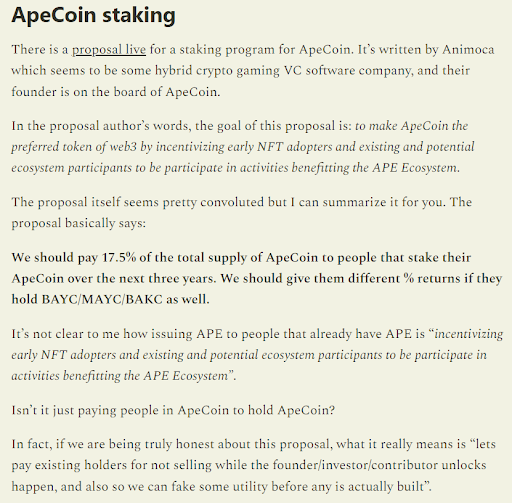
Leaving aside the concept of staking, which Cobie tackles extensively in his post, it struck me that this concept is exactly backwards.
Remember for companies, the goal is to share equity as far and wide as possible to both investors and contributors.
Equity does not, and has never, been distributed to early shareholders simply because they bought early.
And that's essentially what's happening with ApeCoin. Let's issue new equity (ApeCoin, which is somehow different from Yuga Labs / BAYC NFTs??) and use some of the funds to compensate early adopters.
Just think about how weird that would sound in a TradFi setting. Like imagine if a CEO issued new equity, and part of the funds from that raise would be allocated to… existing shareholders?
Like they just were granted shares because they were early investors and believed in it earlier than some other investors.
Or imagine if you're a founder trying to raise a series B and your series A investors demand some part of the new tranche of shares you're issuing… just because?
It's exactly the opposite of how it should be. These systems incentivize passive rent seeking at best, and unsustainable economics at their worst.
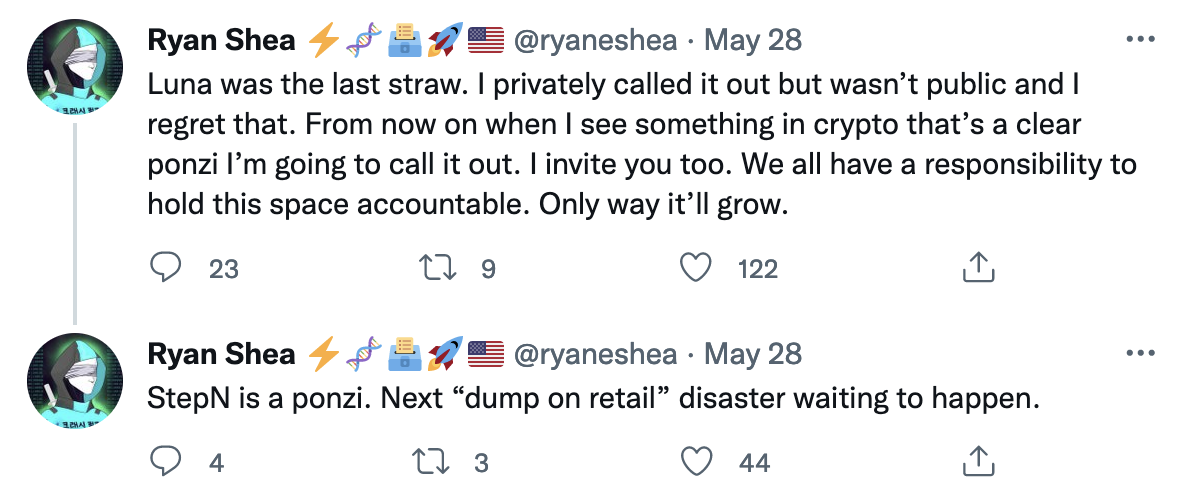
If you take this assumption (early adopters should be rewarded), you can actually kind of see how some of these ponzi like systems got created.
Crypto vs TradFi
I think there are a couple of ways you could interpret these ponzi like structures we currently have.
The most charitable version is that crypto is a playground for rapid financial innovation. Founders are navigating a complicated and opaque web of regulations that sometimes force them to make weird decisions, and mistakes were made.
The less charitable version is that projects got greedy, felt that they could get away with rent seeking behaviors, and are looking to cash out on the mania that was the past 18 months.
As always, the truth is probably somewhere in the middle.
My personal mental model for understanding crypto cycles is that the most speculative part of the bull cycle is directionally right, but early.
In 2017, that was ICOs. The idea that you could bootstrap network growth by selling future ownership was directionally correct.
In 2020, that model was moderately improved on by giving away network equity in exchange for contributing liquidity.
In 2022, I think there's a strong chance that protocols figure out what they really need is a base of skilled workers actively contributing to their project.
Protocols that figure out how to achieve this will likely be the ones that succeed.
The ongoing joke in crypto is that we keep rediscovering lessons from TradFi.
Well, now it looks like crypto is learning one of the most basic lessons of corporate america. If you want equity, you need to work for it.








No comments:
Post a Comment