| A giant gas field in North Africa that Europe is banking on to make up for its shortfall in Russian imports risks complicating the bloc's climate goals. The Algerian facility has been leaking methane, a powerful greenhouse gas, for nearly four decades, according to an analysis of satellite data by scientists at Spain's Valencia Polytechnic University that was funded by Greenpeace. The findings highlight the global warming impact of a country that provides about 8% of Europe's gas imports and is the continent's biggest supplier after Russia and Norway. The most potent and persistent emissions were traced back to a compressor station at Hassi R'Mel, which helps transport gas to Europe and elsewhere. Algeria has the third-highest methane intensity of production among selected global oil and gas suppliers, according to the International Energy Agency, and the Hassi R'Mel basin is acknowledged as a global methane hotspot by scientists who study satellite data. But the new analysis adds to pressure on European Union lawmakers who have been looking to tighten controls of leaks from within the bloc and from key sources outside the continent. 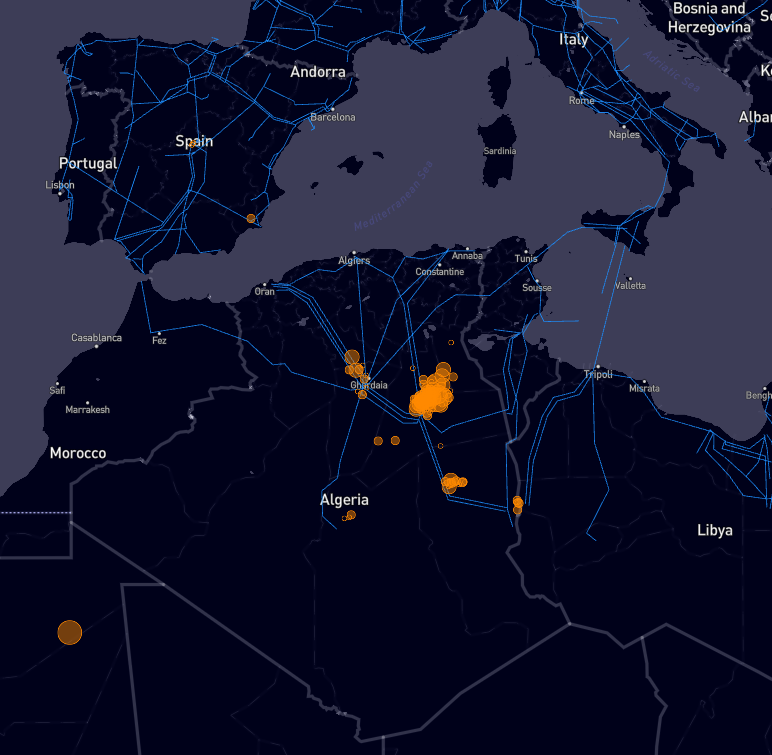 Clouds of methane observed by satellite over Algeria since 2019. Source: Kayrros SAS "The danger now is that Algeria holds more of the cards" because of the EU's efforts to cut its reliance on Russian fossil fuels makes it more dependent on other suppliers, said Antoine Vagneur-Jones, head of trade and supply chains at clean energy research group BloombergNEF. "Pressuring it to act would be a lot harder than before." Methane has 84 times the warming power of CO₂ in the short term if released directly into the atmosphere, and stopping leaks has become a priority for some governments. Algeria didn't join more than 100 countries in signing a pledge in November at COP26 in Glasgow to reduce emissions by 30% by 2030. Sonatrach, the Algerian state oil and gas company that operates the Hassi R'Mel gas field, said its own emissions estimates are "much lower than what is announced elsewhere." "We have reduced flared gas emissions from 9 billion to 3 billion cubic meters per year," said Toufik Hakkar, chief executive officer of Sonatrach. "I would also like to specify that we impose in all contracts with our partners the recovery of flared gases." Hakkar said Sonatrach had a meeting with the World Bank and "they told us that our estimates and methodology are good." Sonatrach will soon publish, in partnership with the Algerian Space Agency, new results that back up their on-the-ground estimates, he said. Estimating the total amount of emissions from fossil fuel basins can be tricky because the frequency of satellite observations over a given geographic area can be 24 hours or longer. The researchers at Valencia Polytechnic University estimated emissions rates up to 4.5 metric tons of methane an hour from the compressor station. 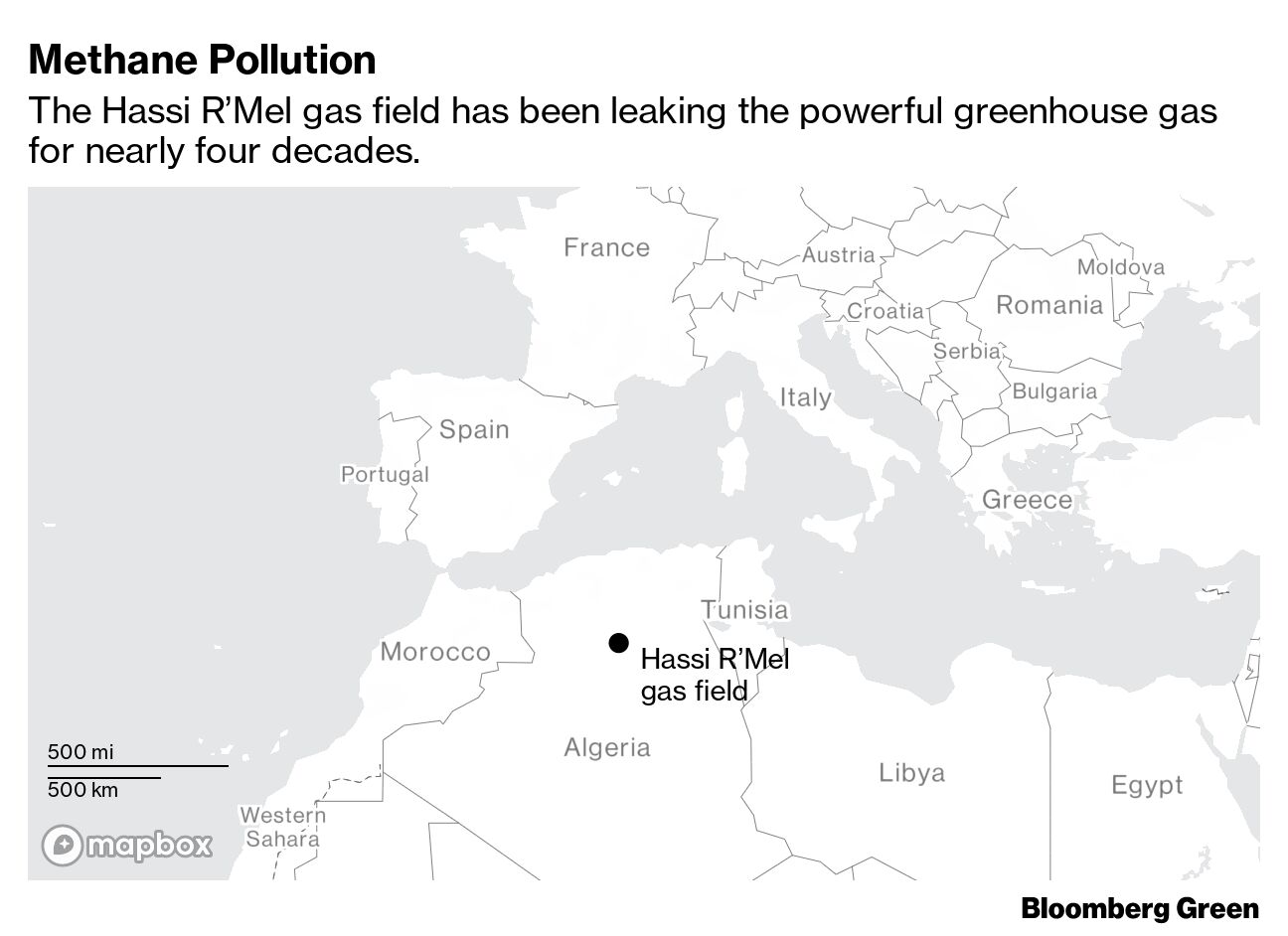 The basin spewed an estimated 939,000 tons of methane last year, up 67% from the previous year, according to estimates from geoanalytics company Kayrros SAS, which used an inversion model to measure total emissions from all sources in the basin. That amount of methane has roughly the same short term climate impact as the annual emissions from about 17 million US cars.
The EU signaled earlier this month that it would pursue decarbonization efforts with Algeria, with a focus on cutting methane emissions. One plan is to set up a "you collect, we buy" program with partner countries, where the bloc would purchase gas that would otherwise be intentionally released or burned off.
The arrangement would incentivize gas companies to save more of their product — whose main component is methane — and provide the EU with more fuel. Around 46 billion cubic meters of the gas a year is lost to unnecessary venting or flaring, which companies do for safety reasons or when they don't have anywhere to send the gas, according to the International Energy Agency. That's almost a third of what the EU currently imports from Russia. John Kerry, the US climate envoy, has also backed the idea. Operators must "plug the leaks of methane that are occurring in too many parts of the world,'' he said at the World Economic Forum in Davos on Tuesday. Methane experts have praised the idea as a smart solution that could help benefit the planet and help Europe weather its energy crunch. "It's genuinely a world-leading proposal," said Jonathan Banks, global director for super pollutants at Clean Air Task Force. "It highlights the rapid climate wins possible at a time when most eyes are squarely on questions of energy security." --With John Ainger Like getting the Green Daily newsletter? Subscribe to Bloomberg.com for unlimited access to breaking news on climate and energy, data-driven reporting and graphics, Bloomberg Green magazine and more. You can read today's newsletter on the web here. Calling all filmmakers. Bloomberg Green Docs is open for submissions. We want to see your short documentaries on climate change. Submit your film by September 16 and compete to win a $25,000 grand prize, plus the opportunity to showcase your work at a special screening in Los Angeles on October 26. | 






No comments:
Post a Comment