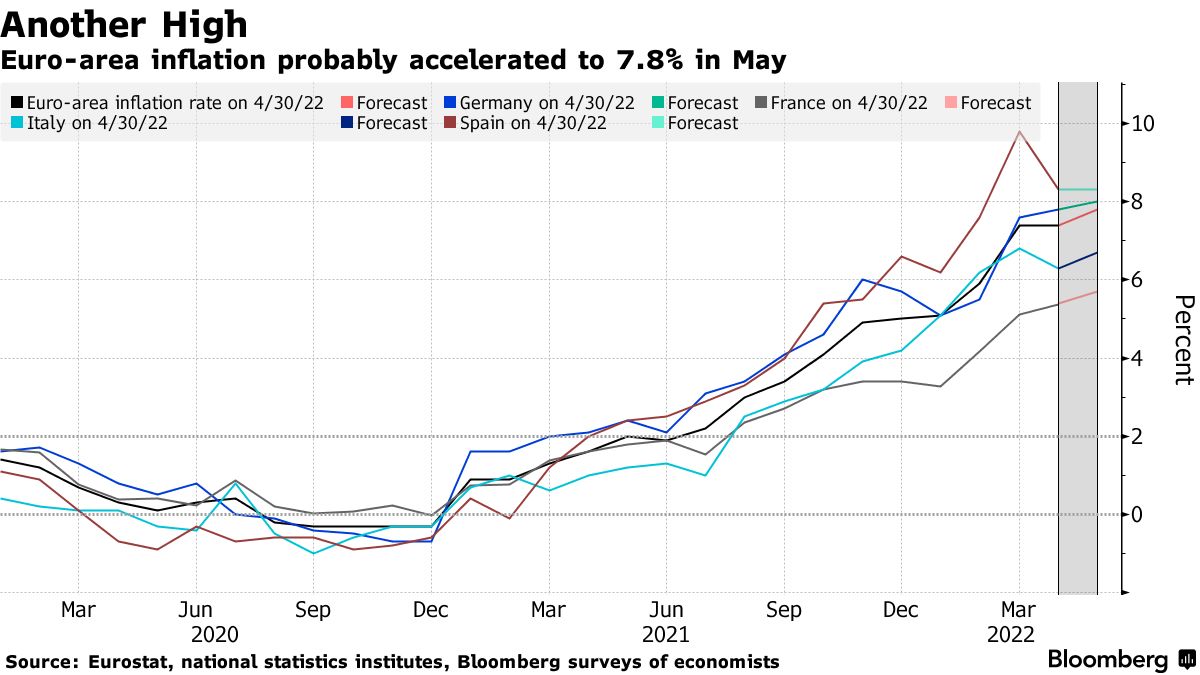
| Welcome to the Brussels Edition, Bloomberg's daily briefing on what matters most in the heart of the European Union. EU leaders had wanted to avoid talking about their sanctions stalemate at a summit starting today in Brussels, but intensive weekend meetings failed to break the impasse with Hungary over banning Russian oil imports. Diplomats said Hungary was adding new demands, even as the bloc offered to water down its plan by exempting oil carried in a major pipeline. The EU has a lot of credibility riding on its ability to strike a deal, and officials tried to cast this as a technical debate that could get resolved in the coming days. But other participants are worried that Viktor Orban is carrying water for Moscow. — Kevin Whitelaw Clock Ticking | Russia is back in default countdown, with another bond payment in question and the Kremlin fighting to find an escape route. As of Friday evening, coupon payments in euros and dollars worth about $100 million hadn't landed in investors' accounts, kicking off a 30-day grace period. Meanwhile, Finance Minister Anton Siluanov was quoted as saying late yesterday that Russia is constructing a way to pay its Eurobond debt that would sidestep western financial infrastructure. Food Blockages | The rusted Soviet-era rail tracks in Ukraine's southwest along the Danube River could eventually play a small part in a large and complex operation to secure vital food shipments. But a quarter of the 20-kilometer line is missing. It's just one small example of what European leaders are facing as they try to figure out how to get grain out of Ukraine, whose exports are normally bigger than the entire EU's. Slipping Back | Europe's latest push to revive long-stalled negotiations over a single market for banks risks being undermined by efforts to change the rules for winding down failed lenders. Some countries are trying to water down a seven-year old framework that forces investors to take losses when banks fail, which would be a red line for Germany and others, we're told. VR Stumbles | An ongoing battle between Meta Platforms and German regulators has created a stumbling block for the country's nascent virtual-reality industry. Local startups have been struggling to get their hands on Meta's headsets after they were pulled from the shelves and now they have to decide whether to to develop applications using less popular gear. Serbia's Balance | Vladimir Putin promised Serbia's Aleksandar Vucic an uninterrupted natural gas supply, the Kremlin said after the pair talked yesterday. Serbia, which hasn't joined sanctions against Russia, is extending its contract with the gas giant, maintaining a balancing act of seeking EU membership while keeping close ties with the Kremlin. Crowd Funding | Lithuanians donated more than 5 million euros over three and a half days to buy a Bayraktar combat drone for Ukraine. The private crowdfunding initiative, which received a green light from both the Lithuanian and Turkish defense ministries, aimed to raise the amount within three weeks to buy the Turkish-made drone and ammunition. Erdogan's Challenge | Turkey's hosting of 3.7 million Syrians who fled their country's war is stirring tensions as high prices and job insecurity take a toll just over a year before scheduled elections, ratcheting up pressure on Recep Tayyip Erdogan. Anti-refugee sentiment has gained ground and is now expressed by voters across the spectrum of Turkish politics. Energy Strain | Germany's energy security hinges on a utility whose bets on Russian energy are backfiring in the geopolitical standoff over the invasion of Ukraine. Amid volatility on gas markets, Uniper— created six years ago to run aging fossil-fuel assets — has shown increasing signs of financial strain. The ECB will be among the many institutions watching inflation data due this week. The statistics will begin trickling out today, with Spain forecast by economists at 8.3% and Germany at 8.1%. Belgium will also publish price data. Tomorrow, reports will be released for France and Italy as well as Austria, Portugal, Slovenia and the euro zone as a whole. All but one economist we surveyed foresee an acceleration in annual price increases, with the median estimate at 7.8%. Out of the four biggest economies in the euro region, only Spain won't show a quickening in inflation. All times CET - 11 a.m. German Chancellor Olaf Scholz and Portugal Prime Minister Antonio Costa joint statements during visit to Hanover Trade Fair
- 4 p.m. EU leaders open two-day summit in Brussels
- 5 p.m. European Parliament President Roberta Metsola holds press conference on European Council
Don't keep it to yourself. Colleagues and friends can sign up here. How are we doing? We want to hear what you think about this newsletter. Let our Brussels bureau chief know. | 






No comments:
Post a Comment