| Good morning. EU to discuss Russian oil sanctions, Russia finds a way to repay debt, China relaxes Covid curbs and UK holiday's economic impact. Here's what markets are talking about. The European Union failed to agree on a deal Sunday on a revised package of sanctions over Moscow's invasion of Ukraine ahead of a leaders' summit in Brussels. Hungary is so far refusing to back a compromise despite proposals aimed at ensuring its Russian oil supplies. EU ambassadors are scheduled to meet again Monday, but the lack of a deal means that sanctions could be a prime topic at the bloc's two-day meeting. An EU official said a deal is still possible in the coming days. Russia is constructing a way to pay its Eurobond debt that would sidestep the western financial infrastructure, now mostly off-limits because of the war in Ukraine, Finance Minister Anton Siluanov was cited as saying in an interview with Vedomosti. Foreign investors can open accounts at Russian banks in rubles and hard currency to receive payment, Siluanov said. In short, it's a reverse-image of the way European nations now pay for Russian gas while avoiding obstacles from sanctions. Meanwhile, Russia is back in default countdown, with another bond payment in question.  | China reported the fewest new Covid-19 cases in almost three months, with the easing of outbreaks in Beijing and Shanghai emboldening authorities to relax some of the strictest virus controls of the pandemic and move to stimulate the country's faltering economy. The decline in Beijing cases eased concern that the city could have been headed for a lockdown when it was reporting several dozen cases a day earlier in the outbreak despite increasingly strict restrictions. Meanwhile, Shanghai rolled out a raft of measures to support its lockdown-hit economy, including allowing all manufacturing to restart from Wednesday. The bank holiday to celebrate Queen Elizabeth II's 70 years on the throne may tip the UK economy into contraction but save it from the technical definition of a recession. The day off on Thursday to mark the jubilee will shave a half percentage point off gross domestic product in the second quarter, according to an estimate by Bloomberg Economics. Meanwhile, Boris Johnson continues to deal with the fallout from Partygate. European stocks are tipped to rise as Asian stocks climbed after China relaxed some virus measures. But traders remain split on whether the selloff is ending. EU leaders kick off a two-day meeting in Brussels with the war in Ukraine on the agenda. Defense, inflation, energy and food security are also in focus. Chelsea Football Club's sale to a group led by Todd Boehly and Clearlake Capital is expected to be completed Monday. Data include Danish and Portuguese retail sales, as well as Spanish and German inflation. Solaria Energia is among companies reporting earnings. This is what's caught our eye over the past 24 hours. Cash is king once more in the stock market, nowhere more so than in the US. Investors are piling into the shares of the most cash-rich companies at a pace not seen in years. As my colleagues Vildana Hajric and Katie Greifeld pointed out last week, assets under management for the Pacer US Cash Cows 100 ETF have risen to about $6 billion from $1.3 billion at the start of 2022. The fund, which tracks mid- and large-cap companies with high free-cash-flow yields, has seen an inflow every week so far this year, a run unprecedented in its history, according to data compiled by Bloomberg. The ETF has climbed 6% this year through Thursday, crushing the 15% slump in the S&P 500 Index. That's even better than the performance of a gauge of high dividend yield US stocks, which has also outperformed. While the ETF has benefited from exposure to energy stocks, the inflows show that investors are once again focusing on firms with the strongest fundamentals, as the threat of recession looms. Smoldering default risk in the corporate sector as refinancing costs rise is also likely to continue to fuel demand for cash-rich companies. 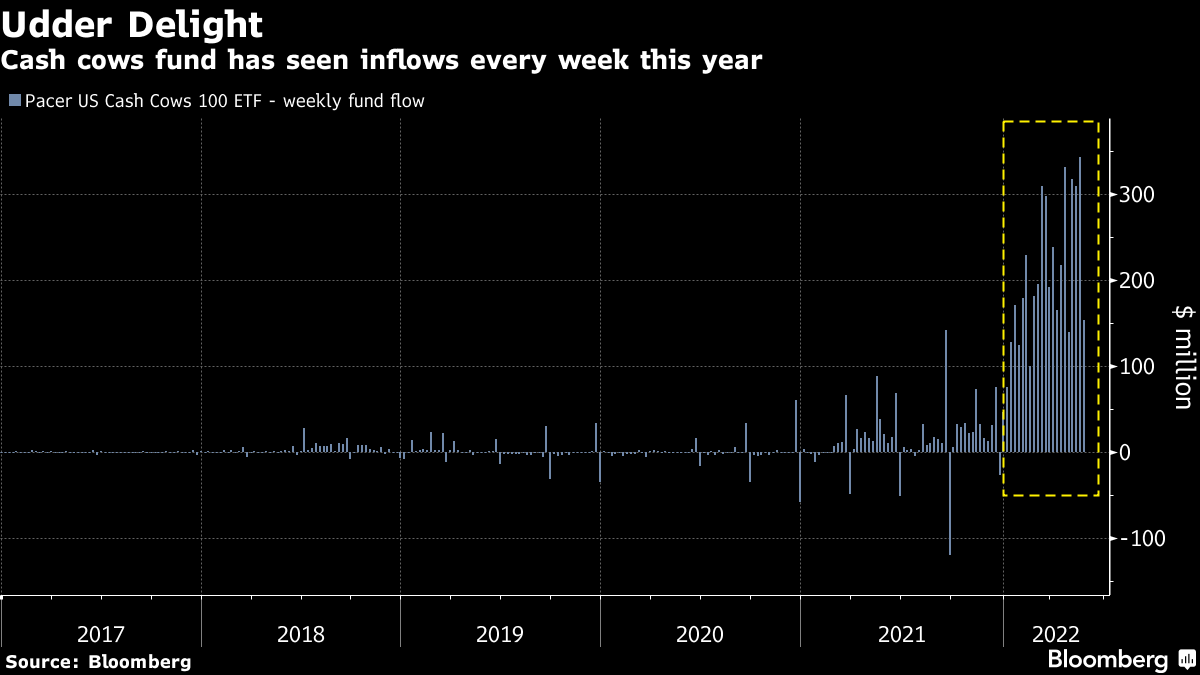 Cormac Mullen is a Deputy Managing Editor in the Markets team for Bloomberg News in Tokyo. | 






No comments:
Post a Comment