Wednesday, September 2, 2026

Why the 10-Year Treasury Yield Matters More Than the Fed

Click to watch Larry live on YouTube
Everyone's watching the Fed's September rate decision. But another rate – the 10-year Treasury yield – could matter far more for stocks…
Larry Benedict
Written by
Larry Benedict
Published on
Sep 2, 2026
There’s been plenty of attention on interest rates this past week. That focus is only going to intensify as we count down to the Federal Reserve’s next meeting in a couple of weeks – especially after Fed Chair Kevin Warsh’s hawkish comments at Jackson Hole on Friday.
Markets are now pricing in around a two-thirds chance that the Fed will hike rates by 0.25% on September 16. But there’s another interest rate I’m watching even more closely.
The U.S. 10-year Treasury yield recently pushed up to 4.78% – its highest level since January 2025. Meanwhile, the 30-year Treasury yield has climbed back above 5.25%. Its 5.34% peak last month was its highest level since June 2007. Those are significant levels.
While the Fed controls the overnight Federal funds rate, it doesn’t directly control longer-term Treasury yields. While policymakers can influence them, ultimately those yields are determined by the bond market.
And right now, the bond market is sending us a message that investors shouldn’t ignore…

Recommended Links


IPO Insider Warns: “Avoid OpenAI and Anthropic’s IPOs! Until You See This”

IPO insider Jason Bodner reveals how ordinary investors could risk their retirement if they invest in OpenAI and Anthropic’s IPOs the wrong way. But if you make this one small change, you could potentially set up a six-figure nest egg. Click here to get all the details.


The Gold Pullback Everyone's Misreading

Gold’s down $1,500 from its January high, and the crowd is sprinting for the exits. History says that’s a big mistake. Because even after the fall, gold still sits higher than it did a year ago — and a "crash" that leaves you up year-over-year isn't a crash at all. It's a breather. And a breather gives you a second shot at the miners that ran away from you in 2024 — the ones you swore you'd grab on the next dip. This is the dip. Don’t miss it. Go here to see Garrett Goggin's top miners to buy before this buy window closes.


Why the Bond Market Sets the Price
On August 19, the U.S. Treasury announced that it would at least double its buybacks of longer-dated bonds. Treasury said that the move was designed to improve liquidity in those older securities.
However, some in the market interpreted it as an attempt to lower longer-term yields. And you can understand why.
The U.S. government has an enormous amount of debt that continually needs to be refinanced. As older, lower-yielding bonds mature, the government has to issue replacement debt at substantially higher rates. That means the government’s interest bill increases.
Buying bonds increases demand, which typically pushes their prices higher. And because bond prices and yields move in opposite directions, that puts downward pressure on yields.
Yet despite initially falling after the Treasury’s buyback announcement, 10-year yields have reclaimed that lost ground and are pushing higher. And that highlights an important point.
The government can influence the Treasury market around the edges. But it can’t directly control where long-term yields trade.
Ultimately, yields reflect investors’ expectations around inflation, economic growth, future Fed policy, and the size and trajectory of government debt.
And when those yields change, the effects permeate right across the economy…

Tune in to Trading With Larry Live

chart

Each week, Market Wizard Larry Benedict goes live to share his thoughts on what’s impacting the markets. Whether you’re a novice or expert trader, you won’t want to miss Larry’s insights and analysis. Even better, it’s free to watch.

Visit us on YouTube to catch the latest!

What Higher Yields Mean for Stocks
When 10-year Treasury yields rise, borrowing costs throughout the economy typically increase too.
That’s not just mortgage rates but also things like corporate bonds. They’re usually priced at a premium to Treasurys. That means that the cost of borrowing typically rises for companies too.
Higher yields can also have an impact on how investors value stocks – especially those priced for strong growth. The higher the rate used to discount those future profits, the lower their present value becomes.
That’s particularly relevant right now with the enormous valuations placed on AI-themed stocks.
If borrowing costs increase while a higher discount rate reduces the present value of expected future profits, those stocks could get squeezed from both directions.
But there’s another major consideration too.
When Treasury yields were sitting around just 1% or 2%, investors looking for decent returns had relatively few alternatives to stocks. But when U.S. government bonds are yielding close to 5%, the equation starts to change. Stocks need to offer a sufficiently attractive potential return for the additional risk investors are taking on.
So far, stocks have handled the rise in longer-term yields reasonably well. But if those yields keep rising, the pressure on stocks could continue to build.
That’s why I’m watching the 10-year just as closely as what the Fed does later this month.
Because ultimately, a potential 0.25% rate hike is only part of the story. What happens further out on the yield curve could prove much more important for stocks.
Regards,
Larry Benedict
Editor, Trading With Larry Benedict

Get Instant Trade Alerts on Mobile!
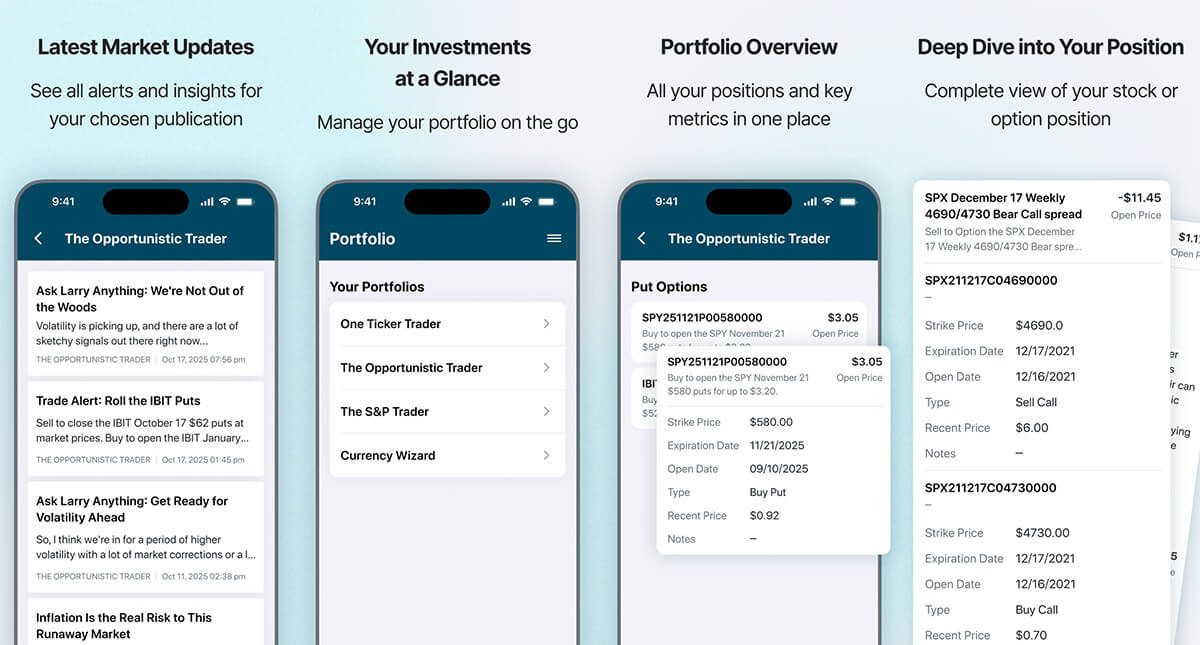
Click the icon below from your mobile device to download The Opportunistic Trader app today for one-tap access to trade alerts, issues, and model portfolios for all of Larry’s services.
Available in the app store on Android and iPhone.
Download on the App Store Get it on Google Play

More stories like this
Read the latest analysis on hot growth stocks, and market-moving developments
The VIX Just Hit a 2026 Low – and That’s a Warning
The VIX just fell to a 2026 low while the S&P sits a hair below its record high. Here’s why a "too quiet" market makes trading harder…
Sep 1, 2026 • 3 min read
The VIX Just Hit a 2026 Low – and That’s a Warning
Why Commodities Signal Inflation Is About to Get Worse
Energy, metals, and agriculture are rallying at once. Here's why commodities are signaling that U.S. inflation is about to take a turn for the worse…
Aug 31, 2026 • 3 min read
Why Commodities Signal Inflation Is About to Get Worse
The Retail Trader’s Real Edge Over Big Funds
Here’s why retail traders hold a real edge over Wall Street's biggest funds – and where the next AI-driven opportunity is quietly emerging…
Aug 28, 2026 • 4 min read
The Retail Trader’s Real Edge Over Big Funds

1125 N Charles St, Baltimore, MD 21201
www.opportunistictrader.com

To ensure our emails continue reaching your inbox, please add our email address to your address book.

This editorial email containing advertisements was sent to reunisoft.cryptonews@blogger.com because you subscribed to this service. To stop receiving these emails, click here.

The Opportunistic Trader welcomes your feedback and questions. But please note: The law prohibits us from giving personalized advice.

To contact Customer Service, call toll free Domestic/International: 1-888-208-6550, Mon–Fri, 9am–5pm ET, or email us here.

© 2026 Omnia Research, LLC. All rights reserved. Any reproduction, copying, or redistribution of our content, in whole or in part, is prohibited without written permission from Omnia Research, LLC.

How to Profit From the $1 Trillion Memory Crunch

Memory is one of the biggest bottlenecks of the AI build-out...
Not rendering correctly? View this e-mail as a web page here.

How to Profit From the $1 Trillion Memory Crunch

By Joel Litman, chief investment officer, Altimetry


The Navy's $3 million flight simulator made a pretty good blackjack player...

In 1949, a team at the Massachusetts Institute of Technology ("MIT") was tasked with a first-of-its-kind challenge.

They had to develop a computer that could respond in real time.

A typical early computer could receive a problem, work through the calculations, and return an answer... later. But "later" didn't cut it for the U.S. Navy's training programs.

When a pilot moved the controls, the flight simulator needed to react immediately. It had to calculate the aircraft's new speed and direction, then display the result before the pilot moved again.

The MIT team got to work on their naval assignment – and came up with the "Whirlwind"...

Far beyond an ordinary research project, the Whirlwind was built for fast, real-time computing...

It occupied roughly 2,500 square feet inside MIT's Barta Building. Nearly 100 racks of equipment filled the room.

The Whirlwind's speed was impressive. But its storage was perhaps even more crucial.

Each time the simulated aircraft moved, the Whirlwind had to preserve new data. The next calculation depended on the last one. A delay could break the entire sequence.

MIT designers initially used electrostatic storage tubes for the Whirlwind's memory. These tubes held the data the computer needed to keep operating. But they couldn't store information long enough to offer continuity.

So the team turned to magnets. Specifically, they pioneered "magnetic-core memory." Instead of relying on electrostatic storage tubes, the Whirlwind used tiny magnetic components to hold information.

The new design made the Whirlwind much more reliable. It was easier to add more memory with more magnets... which helped the computer respond faster.

By 1952, the Whirlwind was running so well that most of its daytime hours were assigned to Navy and Air Force projects. As Cold War tensions boiled, its work shifted away from aircraft simulation and toward air defense.

And at night, it had a little fun...

When they weren't using the Whirlwind for military projects, the programmers got creative. They used the computer's lightning-fast calculations to create a digital blackjack game.

The Whirlwind displayed the card numbers. Players aimed a "light gun" at the glowing spots on the screen, choosing whether to hit, stand, or reset.

Even this silly computer game showcased the value of memory – the programmers left some of the controls unlabeled to preserve precious processing resources. Players simply had to learn what each glowing spot did.

The Whirlwind's magnetic-core setup dominated the computer industry for the next two decades.

But these days, a familiar problem is rearing its head once again...


Recommended Links:

Emergency Briefing: Elon Musk's Next Big Move After SpaceX Is Now Live

Today, Joel Litman (followed by professionals at Fidelity Investments, BlackRock, and Vanguard) is revealing a group of stocks poised to skyrocket 1,000% or more as they benefit from Elon Musk's biggest venture yet. Click here to watch Joel's briefing now.


Own AI Stocks? Sixty-Year Wall Street Veteran Has an Urgent Warning for You

The Wall Street veteran who alerted his followers before the 2022 bear market... the COVID crash... and nearly every major market twist in modern history... is now stepping forward with a crucial new warning. Today, he explains why most investors are approaching this AI bull market the exact WRONG way... and reveals the way you should be playing it. This approach could put thousands of extra dollars in your pocket every month without touching options, crypto, or boring dividend stocks. Learn more here.


There's not enough memory to go around.

The AI revolution relies on processors that can complete an extraordinary number of calculations in seconds. Those processors still need memory, though. It's what supplies the information behind every calculation.

And when the memory can't keep pace, the processor waits.

Memory is one of the biggest bottlenecks of the AI build-out. The three major manufacturers – Samsung Electronics, SK Hynix, and Micron Technology (MU) – are racing to expand production.

They're spending more than $1 trillion combined on new facilities and manufacturing lines over the next decade.

That's creating a bottleneck behind the bottleneck...

Memory companies can only increase supply when they have enough equipment. After all, someone has to actually make the chips.

Major chip-equipment makers are already seeing the results of this demand. In 2014, Lam Research (LRCX) generated $678 million in operating profit. That number ballooned to $8.2 billion in fiscal 2026, signaling more than 12 times growth.

It's a similar story for fellow equipment maker Applied Materials (AMAT). Operating profits were $432 million in 2013... and an incredible $8.3 billion in 2025.

Share prices have also followed suit. Lam Research is up more than 8,500% since the start of 2013. Applied Materials has soared more than 4,000%.

Last week, I revealed another set of stocks that's poised to benefit from the current AI bottleneck. The most powerful signal in our firm's history is firing on these companies. And it's the same signal that preceded the rise of Nvidia (NVDA), the rest of the Magnificent Seven, and 448 of today's S&P 500 Index stocks. Click here to learn their names and ticker symbols.

All told, there's a massive opportunity in the memory market today... and it won't last long.

Regards,

Joel Litman
September 2, 2026


Anthropic’s New $35 Billion Deal

Anthropic keeps signing deals at a pace nobody in tech has matched. Here's what's inside the newest one.

Starlink Is So Dominant, Europe Is Paying Musk and Funding His Rivals

Britain is buying Starlink today while the EU pours billions into IRIS², creating two waves of spending across the satellite supply chain ...