Tuesday, September 1, 2026

The VIX Just Hit a 2026 Low – and That’s a Warning

Click to watch Larry live on YouTube
The VIX just fell to a 2026 low while the S&P sits a hair below its record high. Here’s why a "too quiet" market makes trading harder…
Larry Benedict
Written by
Larry Benedict
Published on
Sep 1, 2026
Investors have had plenty to digest lately – persistent inflation, uncertainty around interest rates, elevated Treasury yields, and ongoing geopolitical risks. Yet volatility has almost completely disappeared from the market.
The CBOE Volatility Index (VIX), often referred to as Wall Street’s fear gauge, fell back below 15 last week. On Friday, it traded as low as 14.1 – its lowest level since December last year.
For some folks, that might sound like a good thing. With the S&P 500 just a fraction below its all-time high, that low VIX makes things seem all rather comfortable.
But this market is too quiet.
The VIX is pricing an unusually benign environment at a time when plenty of risks remain. And as a trader, that creates its own set of challenges…

Recommended Links


IPO Insider Warns: “Avoid OpenAI and Anthropic’s IPOs! Until You See This”

IPO insider Jason Bodner reveals how ordinary investors could risk their retirement if they invest in OpenAI and Anthropic’s IPOs the wrong way. But if you make this one small change, you could potentially set up a six-figure nest egg. Click here to get all the details.


The Gold Pullback Everyone's Misreading

Gold’s down $1,500 from its January high, and the crowd is sprinting for the exits. History says that’s a big mistake. Because even after the fall, gold still sits higher than it did a year ago – and a "crash" that leaves you up year-over-year isn't a crash at all. It's a breather. And a breather gives you a second shot at the miners that ran away from you in 2024 – the ones you swore you'd grab on the next dip. This is the dip. Don’t miss it. Go here to see Founder and CEO of Golden Portfolio Garrett Goggin's top miners to buy before this buy window closes.


When Calm Markets Become Difficult
Many people assume quiet markets are easier to trade. But the opposite is typically true.
When volatility falls, option premiums usually fall with it. And when the broader market is slowly grinding higher rather than making large moves, there are fewer obvious opportunities to exploit. A fast-moving and volatile market can give traders an edge.
And that’s relevant to the way I trade. As a mean-reversion trader, I’m constantly looking for markets that have moved too far in one direction. That way, I can take advantage when momentum reverses and a stock snaps back the other way.
But you need movement to create those opportunities. When the S&P 500 is slowly grinding higher with a calm VIX, those setups become much harder to find.
And even if a promising setup unfolds, the potential reward might not be adequate for the risk you’re taking on. That’s why I’m less active right now than I usually am.
As traders, our job is not to trade for the sake of trading. We should put our capital to work only when the odds are tipped in our favor.

Tune in to Trading With Larry Live

chart

Each week, Market Wizard Larry Benedict goes live to share his thoughts on what’s impacting the markets. Whether you’re a novice or expert trader, you won’t want to miss Larry’s insights and analysis. Even better, it’s free to watch.

Visit us on YouTube to catch the latest!

Why Low Volatility Never Lasts
Market conditions never stay the same forever. And right now feels a bit like the calm before the storm.
I’ve traded through enough different market cycles to know that periods of unusually low volatility eventually give way to periods when volatility picks up. And that often happens when you least expect it.
I expect volatility to pick up as we move into the remainder of the year. There’s no shortage of potential catalysts.
Inflation sits well above the Fed’s 2% target. Interest rates remain uncertain. Treasury yields are elevated. And after the market’s strong run, valuations feel stretched. Any one of these factors could shake the market out of its complacency and trigger a correction.
Most investors don’t look forward to market corrections, but traders have a different take. Corrections can create some of the best trading opportunities for significant profits in a short time.
Stocks start making bigger moves, volatility rises, and option premiums increase. Markets also start overshooting in both directions. That’s the exact type of environment where we can put our trading strategies to work.
We don’t need to know what the catalyst will be. But from over four decades of trading, I do know that markets don’t stay this quiet forever.
In the meantime, we’ll be patient and not to force trades. That way, our capital stays intact so we can really take advantage when volatility returns.
Regards,
Larry Benedict
Editor, Trading With Larry Benedict
P.S. Today’s the last day to watch the replay of my AI Retirement Reset event. In it, I shared a ticker I believe will sit right in the path of a flood of money that’s moving from the typical AI stocks into a whole different sector.
If you want to be prepared to profit before that move hits, make sure to watch now.

Get Instant Trade Alerts on Mobile!
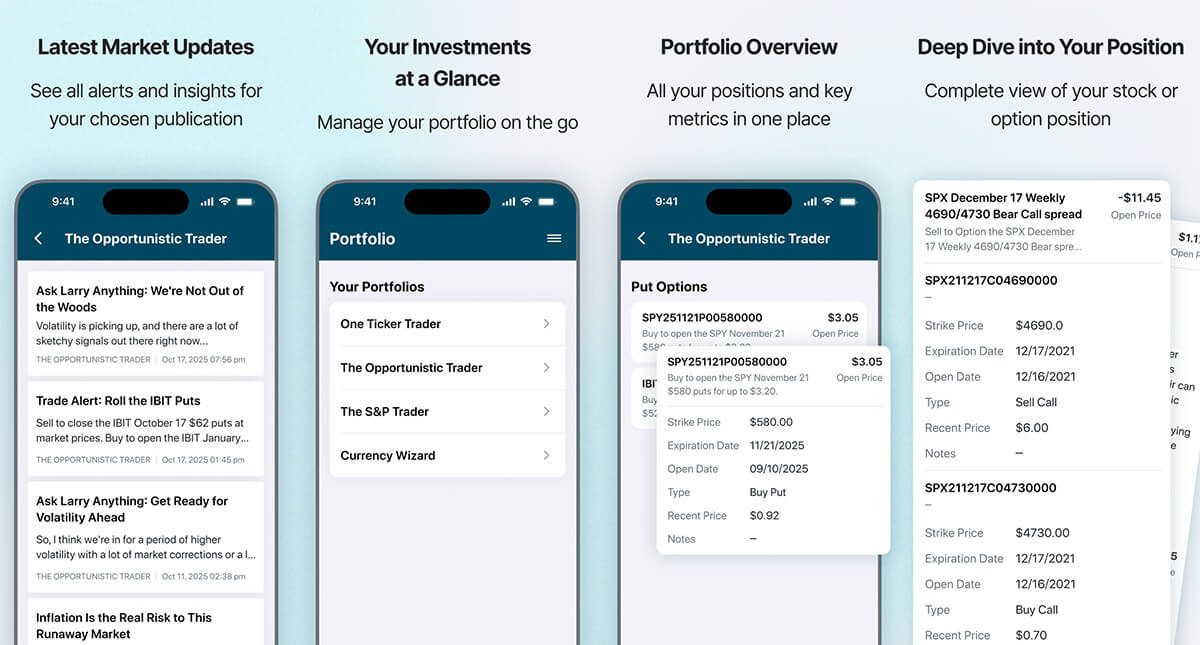
Click the icon below from your mobile device to download The Opportunistic Trader app today for one-tap access to trade alerts, issues, and model portfolios for all of Larry’s services.
Available in the app store on Android and iPhone.
Download on the App Store Get it on Google Play

More stories like this
Read the latest analysis on hot growth stocks, and market-moving developments
Why Commodities Signal Inflation Is About to Get Worse
Energy, metals, and agriculture are rallying at once. Here's why commodities are signaling that U.S. inflation is about to take a turn for the worse…
Aug 31, 2026 • 3 min read
Why Commodities Signal Inflation Is About to Get Worse
The Retail Trader’s Real Edge Over Big Funds
Here’s why retail traders hold a real edge over Wall Street's biggest funds – and where the next AI-driven opportunity is quietly emerging…
Aug 28, 2026 • 4 min read
The Retail Trader’s Real Edge Over Big Funds
Why Power Could Be AI’s Next Bottleneck
Nvidia's earnings have investors watching AI chips – but power may be the real bottleneck. Here's where the next data center winners could emerge…
Aug 27, 2026 • 3 min read
Why Power Could Be AI’s Next Bottleneck

1125 N Charles St, Baltimore, MD 21201
www.opportunistictrader.com

To ensure our emails continue reaching your inbox, please add our email address to your address book.

This editorial email containing advertisements was sent to reunisoft.cryptonews@blogger.com because you subscribed to this service. To stop receiving these emails, click here.

The Opportunistic Trader welcomes your feedback and questions. But please note: The law prohibits us from giving personalized advice.

To contact Customer Service, call toll free Domestic/International: 1-888-208-6550, Mon–Fri, 9am–5pm ET, or email us here.

© 2026 Omnia Research, LLC. All rights reserved. Any reproduction, copying, or redistribution of our content, in whole or in part, is prohibited without written permission from Omnia Research, LLC.

AI Is Running Into a Power Problem

Power is now becoming just as important to AI companies as chips and servers...
 
Not rendering correctly? View this e-mail as a web page here.

AI Is Running Into a Power Problem

By Joel Litman, chief investment officer, Altimetry


Data centers need far more electricity...

The AI build-out is creating a new problem for the power grid.

Research provider BloombergNEF now expects U.S. data-center demand to reach 194 gigawatts by 2035. That's 83% higher than the forecast it made seven months earlier.

At that level, data centers would consume about 20% of all U.S. electricity. (For reference, they use just around 6% today.)

The size of individual projects is also rising fast...

ChatGPT creator OpenAI plans to spend more than $30 billion on a data-center complex in the state of Georgia. The new site will need about 3.2 gigawatts of power.

That's a huge amount of electricity – roughly what it takes three traditional nuclear reactors to produce.

For the past few years, AI companies have spent heavily on chips and servers. Power is now becoming just as important.

Today, we'll explain why access to electricity is limiting AI growth and why companies that can bring power on line faster have a major advantage.

The U.S. power system wasn't built to handle this kind of demand...

PJM Interconnection gives us a good example. This regional transmission organization manages the electric grid across 13 states and Washington, D.C., serving about 67 million people total. Now, it's struggling to add enough new power to meet future needs.

See, every year, PJM holds a capacity auction where power companies bid to provide electricity. Basically, these companies promise to have their power available for PJM when it's needed in the future. But in the latest auction, there weren't enough bids to fully guarantee that PJM will have enough power to keep the grid running reliably.

That matters because the amount of money going into AI continues to rise...


Recommended Links:

What You Missed Last Week

Last week, Joel Litman (who called Advanced Micro Devices before it rose 21,000%) announced what could be the biggest call of his career: a short list of stocks that could soar 1,000% or more as Elon Musk launches a quiet new venture in a Texas county where there are 3 times more cows than people. Click here to see the full replay... and learn how you could profit from what Elon is building next.


Early Retiree Posts Final Message to Fellow Readers

For eight years, I've torn open my personal life and my finances. I've shot videos inside my home, all to tell ONE critically important story: a powerful secret about income... freedom... and early retirement. Now, I know I've done all I can – and it's time to say "goodbye." But I'm not going out quietly... or without securing one final prize for fellow readers. See this and grab your "share" while you still can.


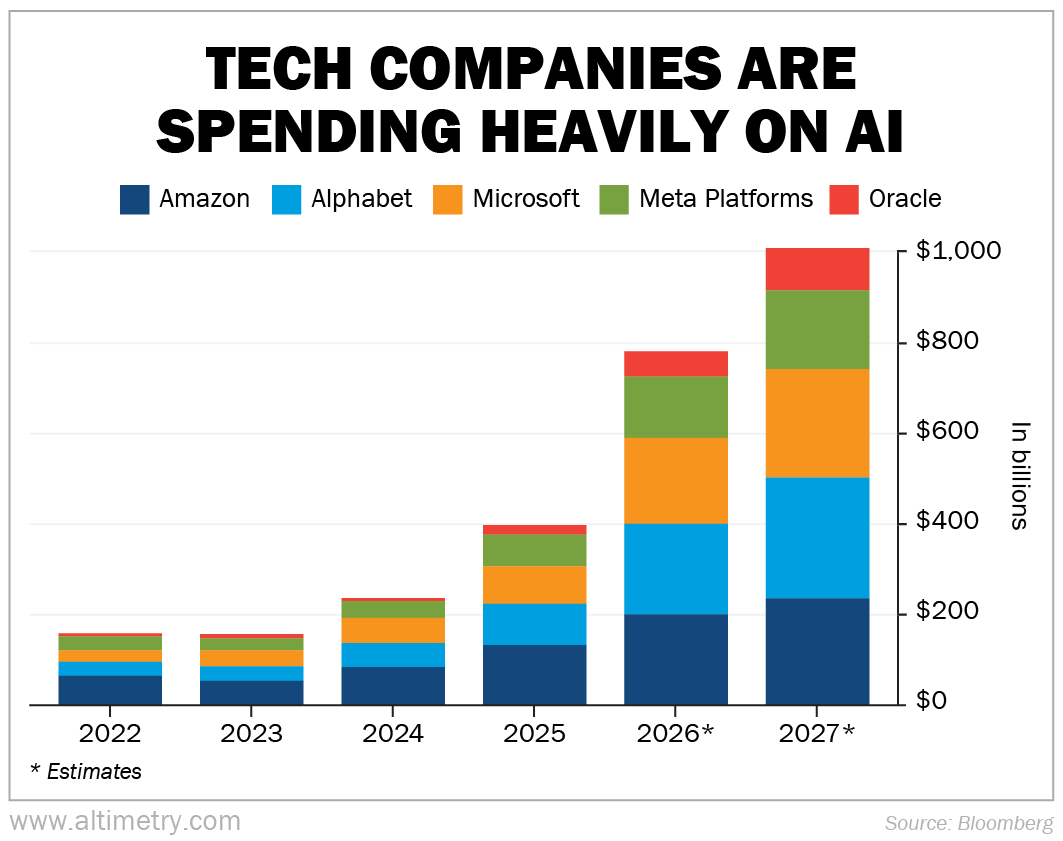
Last year, five of the biggest tech companies – Alphabet (GOOGL), Meta Platforms (META), Microsoft (MSFT), Amazon (AMZN), and Oracle (ORCL) – spent $397 billion on AI.

This year, that figure is projected to nearly double to $781 billion. And it could even surpass $1 trillion in 2027. Take a look...
A large part of this money is going toward data centers, chips, servers, and networking equipment.

But none of that equipment is useful without electricity.

This is why data-center developers are looking for ways to get power more quickly...

Some are building their own power plants directly on site. Others are signing agreements with nuclear-power operators or using natural gas power.

The goal is to reduce the time it takes between finishing a data center and having enough power to run it.

Traditional grid connections can take years... That delay is becoming expensive as projects get larger.

Elon Musk is trying to cut down on that delay...

The SpaceX (SPCX) CEO is building a factory in Texas to manufacture parts for gas turbines. These turbines can be used to generate electricity for data centers, giving them another source of power.

Right now, turbine blades and vanes are in short supply and can hold up deliveries. But Musk says producing the parts internally can reduce the amount of time it takes to get a turbine up and running by about 18 months.

His companies are already using this approach for AI facilities...

xAI has used on-site gas turbines near its Colossus data centers. It's also moving toward a permanent 1.2-gigawatt natural gas power plant.

That gives xAI more control over when new computing capacity can start operating.

Investors have spent years following the companies that supply AI with chips and computing equipment...

Now, power is becoming a larger part of the same story.

As we mentioned earlier, data-center demand is expected to hit a whopping 194 gigawatts by 2035. Meeting that demand will require a lot more electricity and huge upgrades to the power grid.

Musk's decision to manufacture turbine parts and build a power plant close to AI operations shows just how dire the situation has become.

Companies that can shorten the amount of time between building data centers and getting them on line will have a competitive edge. These are the sorts of businesses you should be looking to invest in as the AI boom continues.

Regards,

Joel Litman
September 1, 2026

P.S. Gas turbines are just the first step in Elon Musk's much larger plan to fix AI bottlenecks. In fact, I believe his next venture could be seven times bigger than SpaceX and Tesla – combined. I covered all the details in a recent free presentation. To learn how getting in on the right stocks early as Musk makes his next moves could give you some of the biggest gains of your life, click here.


Why fashion’s green push is failing

Emissions in the apparel sector posted two annual increases as the sector struggles to decarbonize  ‌ ‌ ‌ ‌ ‌ ‌ ‌ ‌ ‌ ‌ ‌ ‌ ‌ ‌ ‌ ‌ ‌ ‌ ‌ ‌ ‌ ‌ ‌ ‌ ‌ ‌ ‌ ‌ ‌ ‌ ‌ ‌ ‌ ‌ ‌ ‌ ‌ ‌ ‌ ‌ ‌ ‌ ‌ ‌ ‌ ‌ ‌ ‌ ‌ ‌ ‌ ‌ ‌ ‌ ‌ ‌ ‌ ‌ ‌ ‌ ‌ ‌ ‌ ‌ ‌ ‌ ‌ ‌ ‌ ‌ ‌ ‌ ‌ ‌ ‌ ‌ ‌ ‌ ‌ ‌ ‌ ‌ ‌ ‌ ‌ ‌ ‌ ‌ ‌ ‌ ‌ ‌ ‌ ‌ ‌ ‌ ‌ ‌ ‌ ‌ ‌ ‌ ‌ ‌ ‌ ‌ ‌ ‌ ‌ ‌ ‌ ‌ ‌ ‌ ‌ ‌ ‌ ‌ ‌ ‌ ‌ ‌ ‌ ‌ ‌ ‌ ‌ ‌ ‌ ‌ ‌ ‌ ‌ ‌ ‌ ‌ ‌ ‌ ‌ ‌ ‌ ‌ ‌ ‌ ‌ ‌ ‌ ‌ ‌ ‌ ‌ ‌ ‌ ‌ ‌ ‌ ‌ ‌ ‌ ‌ ‌ ‌ ‌ ‌ ‌ ‌ ‌ ‌ ‌ ‌ ‌ ‌ ‌ ‌ ‌ ‌ ‌ ‌ ‌ ‌ ‌ ‌ ‌ ‌ ‌ ‌ ‌ ‌ ‌ ‌ ‌ ‌ ‌ ‌ ‌ ‌ ‌ ‌ ‌ ‌ ‌ ‌ ‌ ‌ ‌ ‌ ‌ ‌ ‌ ‌ ‌ ‌ ‌ ‌ ‌ ‌ ‌ ‌ ‌ ‌ ‌ ‌ ‌ ‌ ‌ ‌ ‌ ‌ ‌ ‌ ‌ ‌ ‌ ‌ ‌ ‌ ‌ ‌ ‌ ‌ ‌ ‌ ‌ ‌ ‌ ‌ ‌ ‌ ‌ ‌
Read in browser

Global fashion brands have made splashy pledges to curb their climate footprint as consumers demand greener options. Today’s edition shows how those efforts are struggling, with the sector’s emissions rising.

The latest edition of the Zero podcast looks at the climate impacts putting mountain communities at greater risk of disasters like Nepal’s deadly flood. And in China, solar officially surpassed coal as the top source of power capacity.

Subscribe to Bloomberg.com for unlimited access to all our coverage.

Fading effort to curb emissions

By Olivia Raimonde

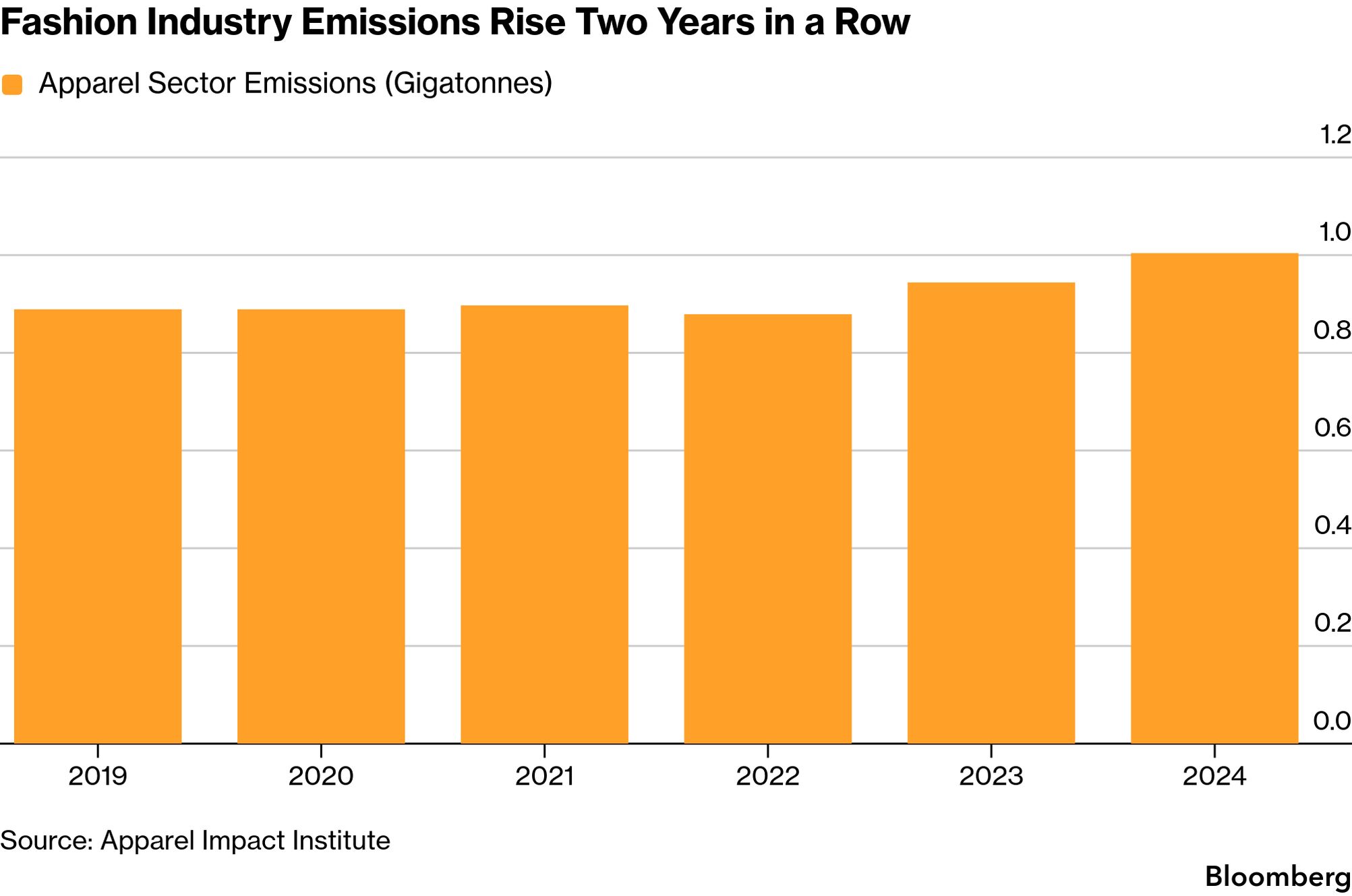
The fashion industry’s greenhouse gas emissions climbed in 2023 and 2024 due in part to increased global production of fiber, especially polyester, according to a new report by the Apparel Impact Institute.

Employees working in a clothing sewing workshop in Guangzhou, China.
Photographer: Pedro Pardo/AFP/Getty Images

Apparel-sector emissions rose 6.3% in 2024, following an increase of 7.5% the previous year; the year prior to that, emissions declined slightly. 2024 is the most recent year for which the institute has data.

Fashion emissions that year were roughly 1 gigaton — about the same as the entire climate footprint of Japan.

Read More: Top Fashion Brands Have a Supply Chain Battle Against Extreme Heat

“The trend is one that’s quite concerning,” said Kurt Kipka, chief impact officer at the institute, a nonprofit that aims to improve sustainability within fashion. “It is a clear sign of increased usage of materials.”

He highlighted cost as a significant hurdle for the industry in its efforts to decarbonize. Virgin polyester continues to be cheaper and more available than recycled material, he said. 

Now, as volatility caused by the Iran war is driving up energy prices, Kipka said it shows the need for clothing producers to look to alternatives to oil and gas.

The sector faces a 34% drop in profits by 2030, the institute found in separate research, with supply-chain disruptions and higher operating expenses unless companies act quickly to rein in their carbon pollution. 

Read more

Delayed target

2050

The new deadline for fashion brand Burberry Group Plc to hit net zero emissions, a decade later than an original goal.

Cleaner power

“That’s where renewable energy sources and onsite battery storage become a more attractive proposition.”

Kurt Kipka

Chief impact officer, Apparel Impact Institute

Kipka discusses methods for fashion producers to cut energy costs along with emissions.

Your Zero listen

On the morning of August 26, a glacial collapse in the Himalayas triggered a flash flood that sent ice, mud, rocks and fast-moving water through a valley in Nepal, wiping out entire communities. This week on Zero, Akshat Rathi is joined by Lou Del Bello, who has been reporting on the disaster for Bloomberg News from New Delhi. They discuss what can be done to keep mountain communities safe, and why events like this are likely to become more frequent in a warming world.

Listen now, and subscribe on Apple, Spotify or YouTube to get new episodes of Zero every Thursday.

Solar tops coal in China

By Felix Tam

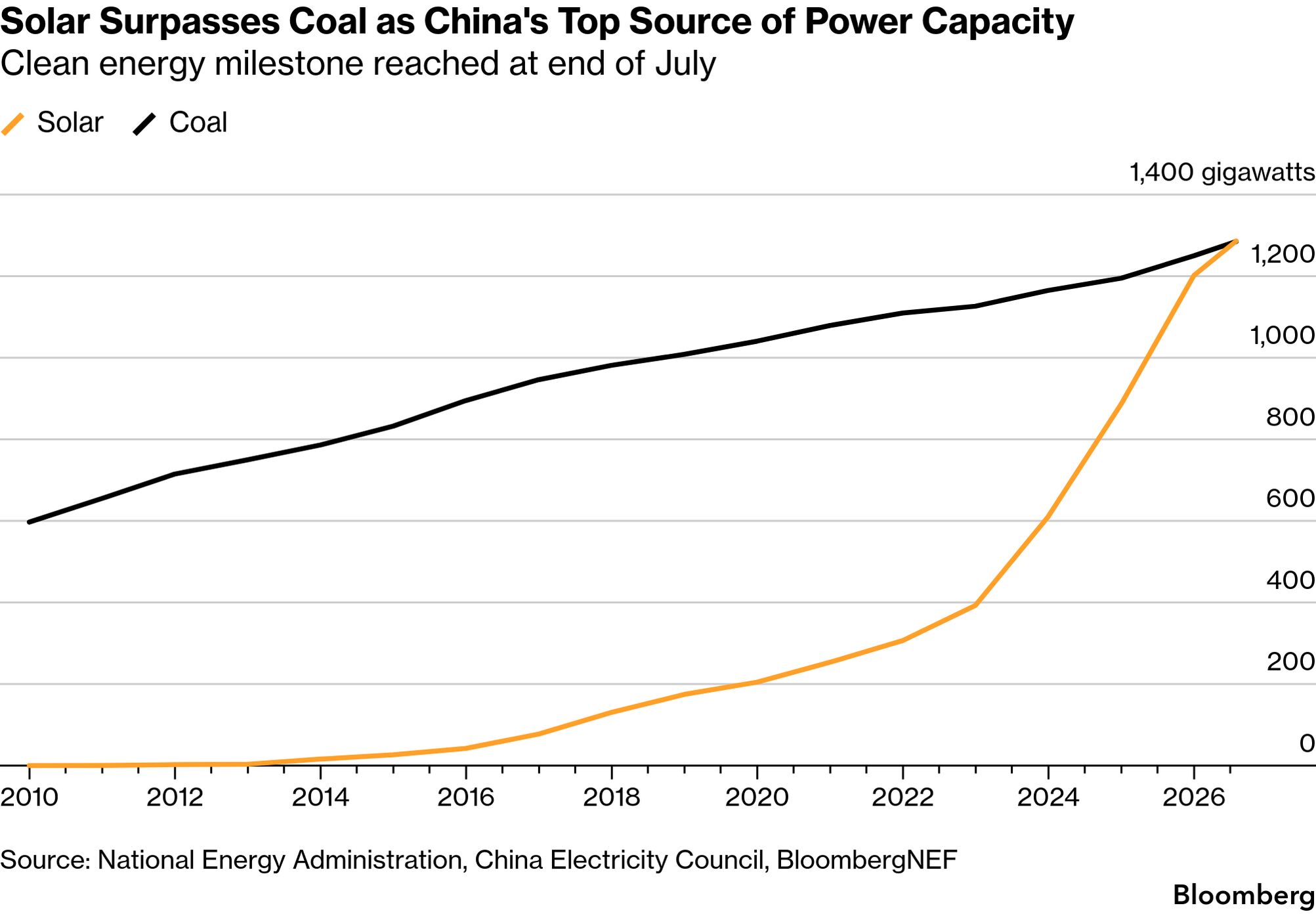
Solar panels are now China’s top source of power capacity, surpassing coal in a key milestone for the country’s green-energy boom.

Solar capacity reached 1,286 gigawatts at the end of July, accounting for 31.5% of total installed power generation, China Central Television reported, citing the National Energy Administration. The China Electricity Council had earlier flagged that solar was just 1 gigawatt behind coal at the end of June.

China remains the dominant player in the global solar supply chain, with investment in the sector expected to top 2 trillion yuan ($298 billion) over the next five years, the report added. Solar generation rose 15.5% from a year earlier to 802.4 billion kilowatt-hours in the first seven months of 2026, about one-eighth of the country’s total.

Read more

🎥 Attention all filmmakers!

Working on a short documentary about climate change? Don’t miss your chance to submit it to the Bloomberg Green Docs film competition. Grand prize: $25,000. Submissions will be accepted through October 2, 2026.

See official rules at bloomberg.com/greendocs.

More from Green

More from Bloomberg

  • Business of Food for a weekly look at how the world feeds itself in a changing economy and climate, from farming to supply chains to consumer trends
  • Energy Daily for a daily guide to the energy and commodities markets that power the global economy
  • Tech In Depth for analysis and scoops about the business of technology

Explore all Bloomberg newsletters.

We’re improving your newsletter experience and we’d love your feedback. If something looks off, help us fine-tune your experience by reporting it here.

Follow Us

https://assets.bwbx.io/images/users/iqjWHBFdfxIU/iDRduxloBOSA/v0/-1x-1.png icon https://assets.bwbx.io/images/users/iqjWHBFdfxIU/i5QE5__h22bE/v0/-1x-1.png icon https://assets.bwbx.io/images/users/iqjWHBFdfxIU/iiSKUb3JWcLI/v0/-1x-1.png icon https://assets.bwbx.io/images/users/iqjWHBFdfxIU/i_JvbwNnmprk/v0/-1x-1.png icon https://assets.bwbx.io/images/users/iqjWHBFdfxIU/iXt_II64P_EM/v0/-1x-1.png icon

You received this message because you are subscribed to Bloomberg’s Green Daily newsletter. If a friend forwarded you this message, sign up here to get it in your inbox.

Unsubscribe
Bloomberg.com
Contact Us
Bloomberg L.P.
731 Lexington Avenue
New York, NY 10022

Ads Powered By Liveintent | Ad Choices

Starlink Is So Dominant, Europe Is Paying Musk and Funding His Rivals

Britain is buying Starlink today while the EU pours billions into IRIS², creating two waves of spending across the satellite supply chain ...