The convergence of traditional finance and cryptocurrency is no longer theoretical sci-fi — it's here. Regulatory clarity across major jurisdictions is accelerating institutional entry into digital assets, from Europe's Markets in Crypto-Assets (MiCA) framework to expanding U.S. legislative momentum with the Guiding and Establishing National Innovation for U.S. Stablecoins (GENIUS) Act. For financial institutions, the question is no longer whether to engage with crypto, but how to do so safely.
The critical misstep many institutions make is treating crypto as an extension of existing products. It is not. Crypto fundamentally changes how anti-money laundering (AML) risk must be assessed, monitored and controlled.
At its core, blockchain introduces three defining characteristics: immutability, pseudonymity and borderless value transfer. These reshape both financial crime risk and the tools required to manage it.
Control shifts from accounts to keys
In traditional finance, assets are secured through centralized systems and reversible transactions. In crypto, control rests with private keys. When institutions offer custody, AML risk becomes inseparable from cybersecurity risk. A compromised key is not just a breach — it is an irreversible transfer of value, often beyond recovery. This requires controls such as multi-signature authorization, cold storage, strict access governance and wallet segregation — all of which sit outside traditional AML frameworks but are critical to risk mitigation.
Non-custodial wallets mean dynamic risk assessments
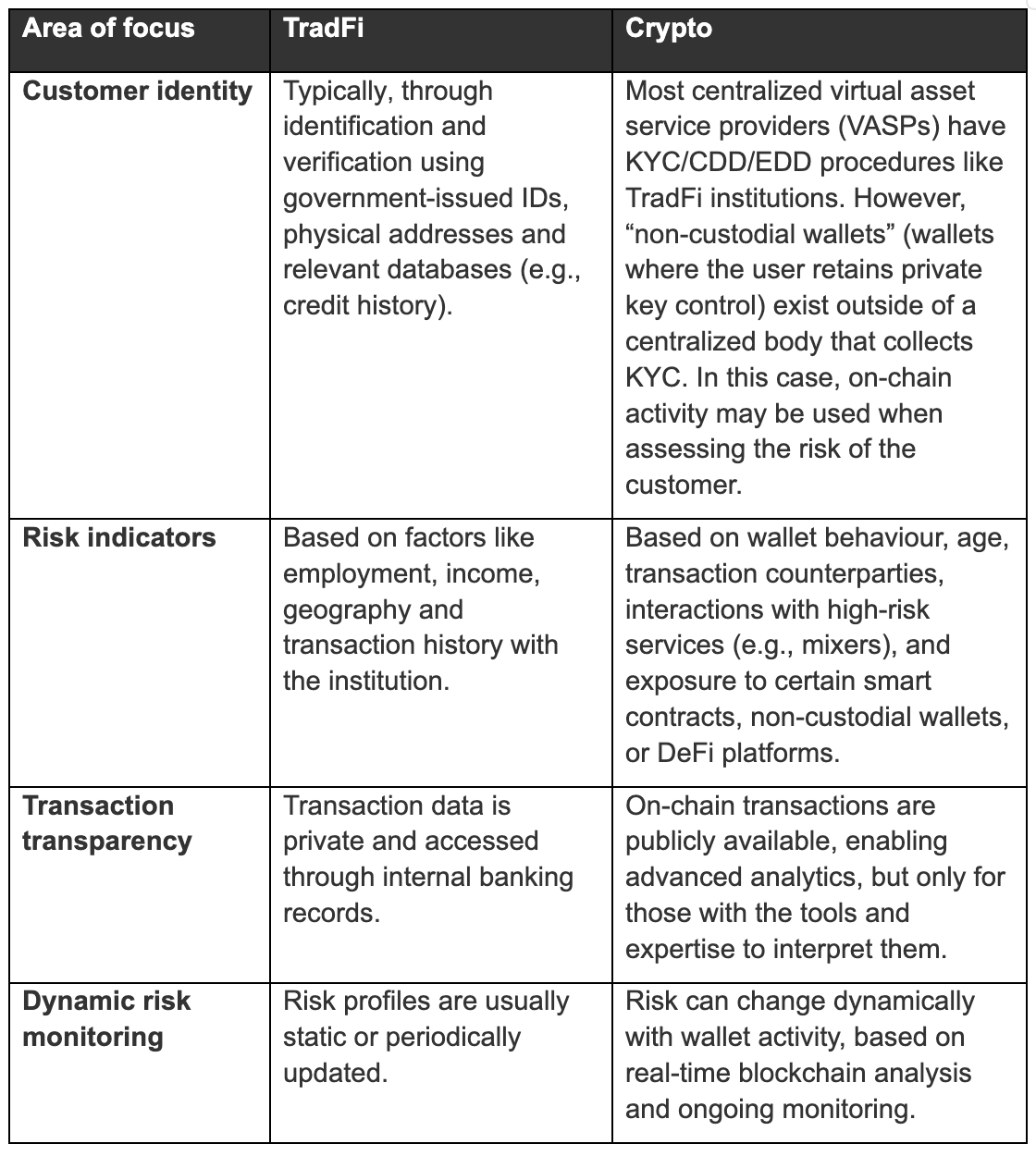
Traditional AML relies heavily on customer identity and static risk profiling. In crypto, this model breaks down. Customers can transact through non-custodial wallets that exist outside institutional onboarding frameworks, and illicit activity often hides in transaction behavior rather than identity.
As a result, risk assessment must evolve from "who the customer is" to "what the wallet does." This requires continuous monitoring of on-chain activity, including exposure to high-risk counterparties, mixers and decentralized protocols. Risk becomes dynamic, not periodic.
Crypto financial crime is structurally more complex
Cryptocurrency money laundering can involve newer technologies, such as chain-hopping and the use of privacy-enhancing technologies like mixers, that have no direct parallel in traditional finance. Transactions can traverse multiple jurisdictions in minutes, rendering legacy screening systems insufficient. Effective AML now depends on blockchain intelligence: the ability to trace funds, identify direct and indirect exposure to risky parties and interpret transaction patterns across networks.
These shifts require a corresponding evolution in governance and risk management. Boards and risk committees must redefine risk appetite to reflect crypto-specific exposures. Institutions should introduce specialized teams (e.g., digital asset approval committees and high-risk customer panels) to manage rapidly changing risks.
Most importantly, the Enterprise-Wide Risk Assessment (EWRA) must become dynamic. Static, point-in-time assessments are inadequate in an environment where risk profiles can change with a single transaction.
The table below illustrates how customer risk assessment must evolve:



No comments:
Post a Comment