A happy Sunday to you,
Traders use charts all the time…at their own peril.
While they provide incredible insights, taken in isolation, they’re more dangerous than you realize.
Allow me to illustrate my point.
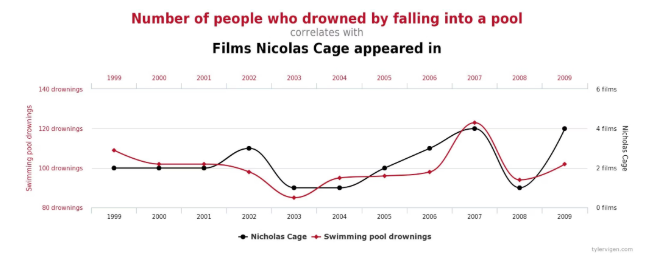
This chart graphs people who drowned by falling in a pool with Nicholas Cage film appearances.
So, does Nicholas Cage films cause people to unconsciously off themselves?
That sounds ridiculous.
But let me show you another chart I’ve seen across multiple forums lately.
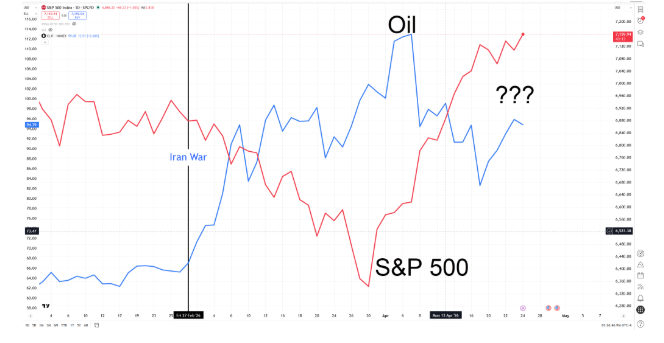
We all watched oil go up and stocks go down simultaneously since the start of the war with Iran (maybe conflict technically).
Did oil prices send stocks lower?
Think long and hard before you answer that question.
And now ask yourself, if that were true, why are they both rising right now.
Correlations can yield insights…but you need to be careful when you assign causation.
Stock prices go up for one reason and one reason alone: someone is willing to pay more than the current price.
That’s it.
If they aren’t willing to pay the current price, and someone wants to sell, the price goes down.
That’s why it was ridiculous to say homes during the Great Recession were worth $X when no one wanted to buy them.
No, those homes were worth $0 at that time. Because their value is only what someone was willing to pay for them at that time.
Why do you think Don talks about order flow so much?
Because that’s what moves price. Not the themes, the stories, or the 1,000 other headlines that CNBC tries to pass off for causation.
Yes, a major newsworthy headline will likely create a chain of events that moves markets. But it’s far from certain.
At the end of the day, price is ALL that matters.
Jordan Schneir
Editorial Director, TheoTRADE
The 9:30 open is where retail traders go to donate money.
The 10AM Bell is where Blake Young's traders have grown their accounts by an average of 24.8% per month -- for 11 straight months.
A $5,000 account produced over $13,600 in net profit. Not a cherry-picked trade. The whole account.
Blake goes live April 30th at 2PM ET to show you exactly how -- and the free Track Record Report is yours just for registering.
👉 Save your seat now →
Brandon Chapman: The Equal-Weight Tell
Someone just placed a bearish trade that does not care what the S&P 500 does next week.
When traders want to short the index, they reach for SPY. That conflates two separate bets, because the S&P 500 right now is really five or six stocks carrying 494 passengers.
The Block Hunter Console flagged two put verticals on RSP Thursday at the $202.50 and $195 strikes.
Combined size runs north of 20,000 contracts per tranche across two expirations.
The trade expresses a breadth thesis with defined risk. It does not need a crash to pay out. It needs the 494 names outside the Mag Seven to fail to participate.
Next week's earnings cycle decides whether the institution behind this print was early or right on time.
CLICK HERE to continue reading Brandon’s article.
Gianni Di Poce: The Crude Oil Conundrum
The Nasdaq and S&P 500 printed another week of fresh all-time highs.
Semiconductors keep stealing the show, which won't surprise anyone following the Sector Leader Bullseye.
Market internals look healthy. Surface action looks healthy.
One asset class keeps me cautious before I fall asleep at night.
The culprit is crude oil.
This note lays out why crude is the single biggest wildcard for stocks right now. You'll see when I expect it to roll over and how I'm positioned while that plays out.
Get this variable right, and you'll understand why the bull trend holds into the back half of the year.
You'll also see the window where the real volatility setups appear later on.
CLICK HERE to continue reading Gianni’s article.
Jeff Bierman: The Loudest Buy Signal I Have Ever Seen
Tuesday broke a record nobody celebrated. Institutions bought more Nasdaq futures contracts than any single day in market history.
I watched the report come across my desk and almost did a double-take. BlackRock, Citadel, banks, prop desks, insurance companies. They all loaded up at once.
History is unforgiving on this setup. Seven of the last eight times this happened, markets round-tripped within two to three weeks.
That pattern resolves lower nearly 88 percent of the time. Most traders will never see it coming.
I want to walk you through what I am seeing, the leverage stacking up underneath, and where I stand heading into next week.
Because knowing when institutions have reached peak conviction is how you sidestep the move that follows.
I have been running algorithms on the ThinkorSwim platform for a long time.
I have watched this pattern before…
…and the current accumulation reads like the loudest version I can remember.
CLICK HERE to continue reading Jeff’s article.
Blake Young: The Euro Stopped Me Out Four Times
Hey trader,
My textbook setup got run over on Friday.
Long euro at 1.1742, stop at 1.1737, clean Bollinger Band breakout with a retest entry.
The tape swept my stop and reversed.
Then it did the same thing three more times to anyone who tried to chase it.
If your breakouts have been dying like that, the problem is not your setup.
The volume underneath the open is telling you exactly why valid breakouts keep failing, and once you see it, you can stop fighting a tape that no longer rewards early entries.
Here is what I saw today and the three adjustments I am making on Monday.
CLICK HERE to continue reading Blake’s article.
Tony Rago: Why I Stopped Trading Live to Pull Up a Chart From Tuesday
Friday morning, the NQ was ripping through 30 ATR and the headlines were hitting the tape every few minutes.
The room was watching, waiting for setups.
I pulled up Tuesday's chart.
"All right. Let's do a round of homework, you guys."
For the next fifteen minutes, I stopped paying attention to Friday's live tape.
I walked the Golden Setup room through every trade that printed during Tuesday's RTH session.
Trade by trade, candle by candle. The winners, the losers, and everything in between.
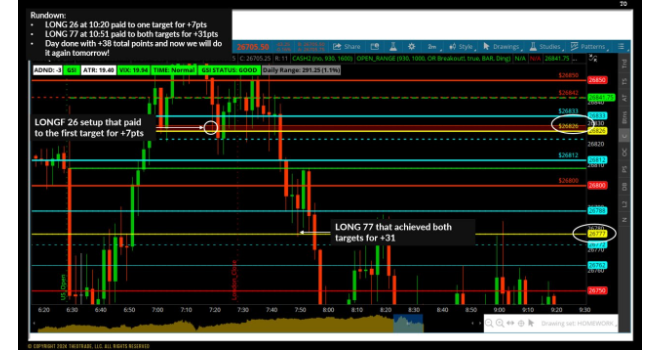
This is the exercise that keeps my traders in the game when the tape gets ugly.
CLICK HERE to continue reading Tony’s article.



No comments:
Post a Comment