|
Reading time: 5 minutes |
News | Crypto Converter | Crypto Calculators |
Oil spike hits Bitcoin, Grayscale signals market pause |
|
Key points: |
Bitcoin fell below $66K as oil surged past $110, triggering a broad risk-off move across global markets. Grayscale says investors are sidelined, not exiting, even as bearish positioning and ETF outflows increase.
|
News - Bitcoin dropped to weekly lows near $66,000 as escalating Middle East tensions pushed oil prices above $110 per barrel, weighing on equities, gold, and broader risk assets. The move followed renewed military escalation signals from President Donald Trump, adding to uncertainty around global energy supply. |
Crypto markets reacted sharply, with over $400 million in liquidations recorded in 24 hours. Bitcoin and Ethereum both declined as traders increased short exposure, while derivatives data showed rising demand for downside protection rather than panic-driven selling. |
Institutional flows echoed the cautious tone. U.S. spot Bitcoin ETFs saw over $170 million in net outflows at the start of April, extending recent selling pressure, although select products from Grayscale Investments continued to attract inflows, indicating selective inflows despite broader outflows. The firm also noted that investors are largely staying sidelined amid geopolitical uncertainty, signaling caution rather than capitulation. |
Fragile structure raises downside risk - Beyond macro pressure, internal signals show weakening conviction. The share of Bitcoin supply held by 1–3 month investors has dropped to 2026 lows, reflecting sustained selling from recent buyers. |
At the same time, a head and shoulders pattern is forming, with a potential move toward $60,000 if support near $64,500 breaks. A large cluster of leveraged long positions around that level increases the risk of a liquidation-driven decline. |
Markets pause, not panic - Despite volatility, Grayscale Investments maintains that markets are in a holding phase. While geopolitical risks and rising oil prices have delayed rate-cut expectations, steady derivatives activity and selective inflows suggest underlying demand remains intact. |
$285M Drift hack raises red flags: DPRK link, key failure, USDC backlash |
|
Key points: |
A $280M–$285M exploit on Drift Protocol shows signs of DPRK-linked activity, with cross-chain laundering patterns complicating tracing. The attack appeared tied to compromised administrative access rather than a routine code flaw, while delayed USDC freezes sparked industry criticism.
|
News - Solana-based Drift Protocol was hit by a massive exploit exceeding $280 million, making it one of the largest DeFi breaches of the year. The attack forced the platform to halt deposits and withdrawals as funds were rapidly drained and routed across multiple wallets. |
Blockchain analytics firm Elliptic said the exploit carries multiple indicators of North Korean state-sponsored involvement. The firm pointed to structured, premeditated activity, including early test transactions, pre-positioned wallets, and a coordinated cross-chain laundering flow resembling past DPRK-linked operations. |
Initial findings pointed to compromised administrative access, giving the attacker broad control over protocol parameters. This allowed the creation of a fake collateral market using a worthless token, manipulation of price oracles, and the removal of key safety limits before draining funds from shared liquidity pools. |
Cross-chain laundering and tracing challenges - Once executed, the attacker consolidated assets, converted them into USDC, and bridged funds to Ethereum, highlighting the growing complexity of cross-chain laundering. Solana's fragmented account model further obscured activity, making it harder to link transactions without entity-level clustering. |
Industry scrutiny intensifies - The exploit has also reignited debate over centralized intervention. Critics questioned why the USDC issuer failed to freeze funds despite several hours of onchain movement. While such action is possible, it is not mandatory under current frameworks. |
The incident underscores a broader shift in DeFi risk, where governance and key management vulnerabilities can be just as damaging as smart contract flaws, especially as attackers adopt more sophisticated, multi-chain strategies. |
Metaplanet climbs to #3 as Bitcoin treasuries start cracking |
|
Key points: |
Metaplanet acquired 5,075 BTC in Q1, pushing holdings to 40,177 BTC and securing the third-largest corporate treasury spot. A broader wave of treasury sell-offs highlights growing pressure, even as select firms continue accumulating.
|
News - Tokyo-listed Metaplanet expanded its Bitcoin holdings to 40,177 BTC after purchasing 5,075 BTC in Q1 2026 for roughly $400 million. The move lifted the company to the third-largest publicly listed Bitcoin treasury, overtaking MARA Holdings, which sold over 15,000 BTC in March as part of its balance sheet restructuring. |
Metaplanet's strategy combines long-term accumulation with a separate income-generation model built on collateral-secured Bitcoin option strategies. The firm reported 2.97 billion yen in Q1 revenue from this segment, with proceeds designed to be recycled into future BTC purchases. |
Despite the aggressive buying, Metaplanet's stock declined about 2% following the announcement, reflecting continued sensitivity to Bitcoin price movements and broader market conditions. |
Treasury boom faces reality check - Metaplanet's rise comes as several firms unwind their Bitcoin positions. Companies such as Empery Digital have sold portions of their holdings to manage debt, while Riot Platforms has also been linked to recent BTC outflows as miners weigh funding needs and AI-related pivots. |
Genius Group fully liquidated its Bitcoin treasury in Q1 to repay $8.5 million in debt, marking a complete exit after previously holding hundreds of BTC. The company said it may rebuild its position once market conditions improve. |
This shift extends beyond corporate players. Sovereign entities like Bhutan have also reduced holdings, signaling that prolonged price weakness is forcing even long-term holders to reassess. |
Accumulation vs survival - While selling pressure is rising, the trend is not uniform. Some firms continue to accumulate, and corporate treasuries still collectively hold over 1.1 million BTC, representing more than 5% of total supply. |
Metaplanet's expansion underscores that access to capital remains the key differentiator, as the gap widens between companies still buying and those selling to stay afloat. |
Coinbase signals Clarity Act breakthrough as yield debate peaks |
|
Key points: |
U.S. lawmakers are nearing a deal on the Clarity Act, with Coinbase signaling imminent progress despite ongoing yield disputes. Coinbase says there is no evidence of deposit flight to stablecoins, challenging banking sector concerns.
|
News - U.S. lawmakers are moving closer to a deal on the Digital Asset Market Clarity Act, a long-delayed crypto market structure bill stalled over stablecoin yield provisions. Coinbase Chief Legal Officer Paul Grewal said negotiators are "very close" to an agreement, with progress expected soon and a Senate Banking Committee markup likely in the coming weeks. |
The core dispute centers on whether crypto platforms can offer yield or rewards on stablecoin holdings. Banks argue such incentives could pull deposits away from traditional institutions, while crypto firms warn that restrictions would limit innovation and weaken U.S. competitiveness. |
Grewal pushed back on those concerns, stating there is no evidence that stablecoins have caused deposit outflows. He added that negotiators appear to be recognizing the importance of rewards alongside broader regulatory safeguards. |
Pressure builds around timeline - The bill has remained in legislative limbo since January after a planned Senate markup was delayed. President Donald Trump has criticized banks for slowing progress, urging lawmakers to advance crypto legislation and strengthen the U.S. position in the sector. |
Timing remains critical. Industry participants warn that failure to pass the bill soon could delay regulatory clarity for years, especially if political control shifts after upcoming elections. |
What's at stake - Beyond stablecoin yield, the Clarity Act is expected to define the framework for U.S. crypto oversight. Its passage could unlock new revenue streams for domestic exchanges and improve their ability to compete with offshore platforms. |
For now, negotiations are narrowing, but final approval still depends on resolving the remaining points of friction. |
The Best Place to Invest $1,000 Right Now |
|
This AI tech could go down in history as the crown jewel of Elon's career. It could send ChatGPT offline forever and trigger a 70X investment boom. Watch the free presentation. |
Watch Now |
|
More stories from the crypto ecosystem |
|
Interesting facts |
A single address once rivaled national Bitcoin reserves: The largest known Bitcoin address, often linked to exchange custody, has held over 200,000 BTC, exceeding the estimated holdings of several countries and highlighting how concentrated ownership can still be at the top. Ethereum users once paid more in fees than the transaction itself: At peak congestion in 2021, activity on Ethereum pushed gas fees into the hundreds of dollars, at times exceeding the value being transferred and accelerating the shift toward Layer 2 scaling solutions. An NFT game briefly out-earned Ethereum itself: At its peak, the Axie Infinity ecosystem generated more daily revenue than Ethereum's base layer, fueled by explosive play-to-earn demand and in-game asset trading.
|
Your tax bill is bigger than your investment portfolio |
|
You're making great income and losing half to taxes. Cash-flowing Airbnb properties fix both sides: real tax savings and monthly income. 500+ properties closed. 75% of clients come back for property two. |
Check out our deals here. |
We are not a tax firm. Not licensed CPA's, and we do not represent ourselves as such. |
|
|
Top 3 coins of the day |
TRON (TRX) |
|
Key points: |
TRX cooled off near $0.322 and moved sideways around $0.316, holding its broader uptrend despite a short-term pullback. Parabolic SAR flipped above price while Stochastic RSI reset from overbought levels, indicating a pause in momentum rather than a reversal.
|
What you should know: |
TRX maintained its upward structure after climbing from the $0.28 range, but recent candles showed consolidation just below $0.320 following a rejection near $0.322. The pause came as Parabolic SAR turned bearish in the short term, while Stochastic RSI dipped from overbought territory before curling higher again, signaling a momentum reset. On the fundamentals side, TRON's integration with regulated platform Zero Hash strengthened its institutional access narrative, while developer-focused initiatives like its latest university hackathon continued to support ecosystem growth. However, a $16M asset transfer linked to Justin Sun introduced some near-term uncertainty. For continuation, $0.320 remains the level to reclaim, while $0.312 acts as immediate support. |
Solana (SOL) |
|
Key points: |
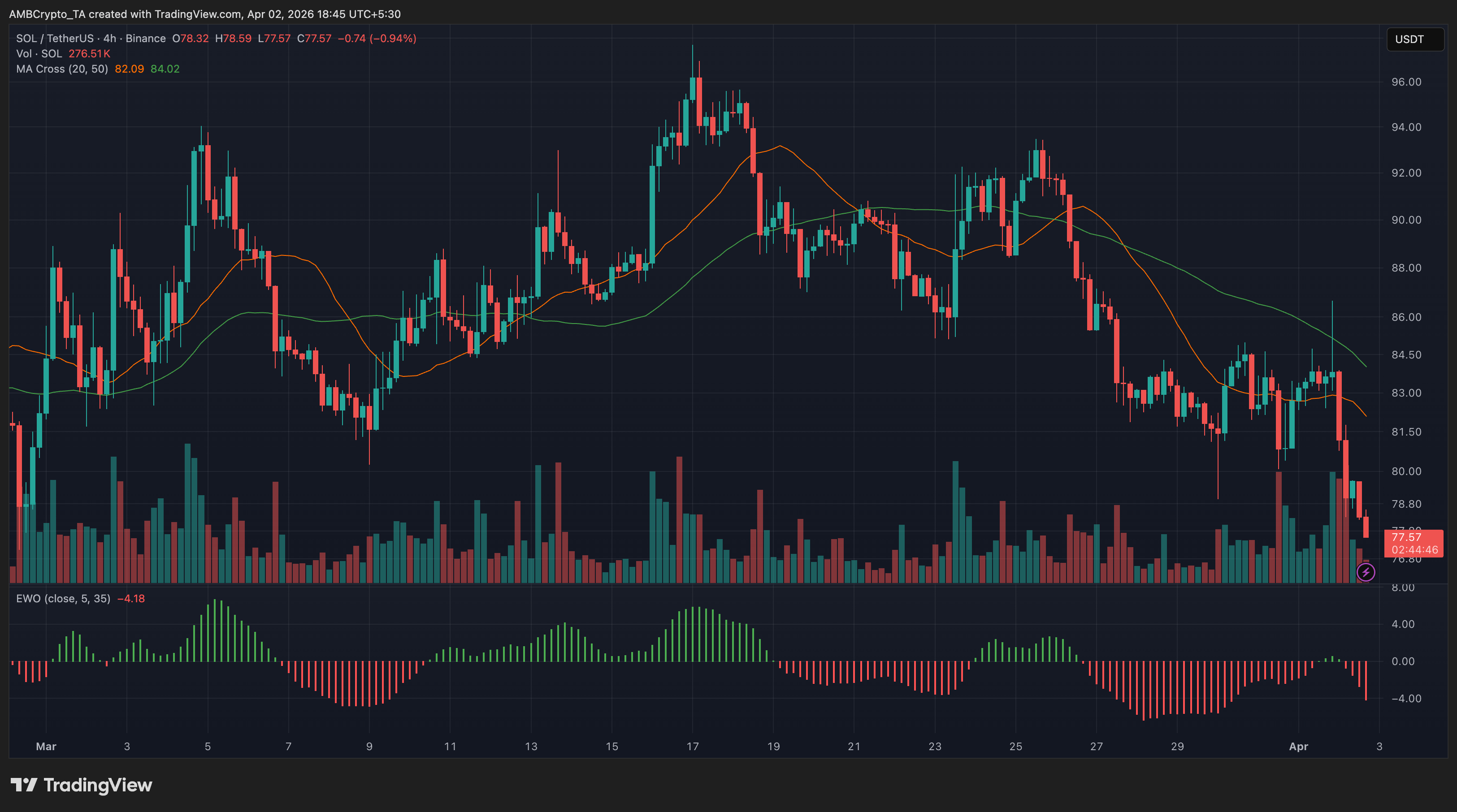
SOL broke below $80 and slid toward $77, extending its downtrend after repeated failed recovery attempts. The 20/50 MA crossover stayed bearish while EWO printed deeper red bars, highlighting sustained downside momentum.
|
What you should know: |
SOL weakened steadily after losing support near $80, with price drifting lower toward the $77 region as selling pressure intensified. The decline followed a failed rebound near $82–$84, reinforcing the broader downtrend as price remained below both moving averages. Momentum deteriorated further with EWO extending deeper into negative territory, while elevated volume during the drop signaled strong participation from sellers. The move coincided with a $285M exploit on the Solana-based Drift Protocol, which triggered panic-driven outflows and eroded confidence across its DeFi ecosystem. Unless price reclaims $82, the bias remains tilted lower, with $75 acting as the immediate support to monitor. |
BNB (BNB) |
|
Key points: |
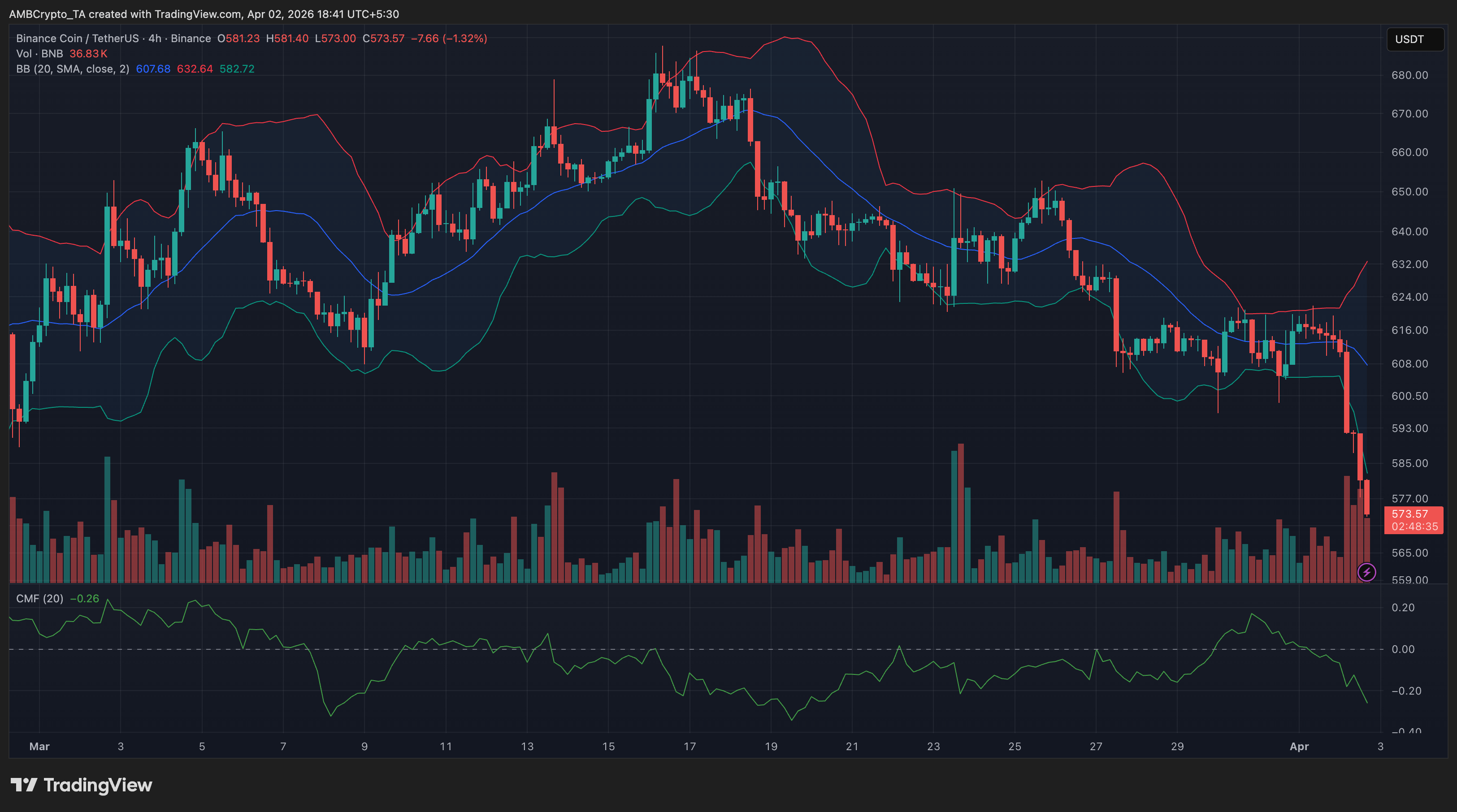
BNB dropped sharply toward $573 after losing the $600 zone, extending its downside move with accelerating sell pressure. Price pushed below the lower Bollinger Band while CMF stayed deeply negative, reflecting heavy outflows and elevated volatility.
|
What you should know: |
BNB came under sustained pressure after slipping below $600, with the decline accelerating into the $573 region as sellers remained firmly in control. The move intensified as price rode the lower Bollinger Band, signaling expansion in volatility rather than a quick exhaustion phase. At the same time, CMF stayed well below zero near -0.26, pointing to consistent capital outflows during the drop. Volume also expanded alongside the latest red candles, confirming strong participation in the sell-off. The weakness aligned with a broader market pullback tied to risk-off sentiment and Bitcoin-led declines. For now, $570 is the immediate support, while $600 stands as the key level that needs to be reclaimed for any stabilization. |
How was today's newsletter? |
|














No comments:
Post a Comment