  Good morning from Los Angeles. We are coming to you a little early before I board my plane to Seoul. We've also got a treat: Netflix co-Chief Executive Officer Ted Sarandos is here to break down what the heck happened over the last few days. Sarandos had an agreement to buy much of Warner Bros. Discovery. Even as Paramount Skydance continued to pursue the company, neither Netflix nor Warner Bros. wavered. But the ground started to shift last weekend — leading to Paramount's $110 billion deal for Warner Bros., one of the largest ever in corporate America. Paramount and Warner Bros. are trying to get this deal done quickly. Paramount has already wired Netflix $2.8 billion to cover the breakup fee. (Netflix shareholders are thrilled.) I received a lot of frantic phone calls and texts over the past couple of days. How did David Ellison pull off the deal? Why did Netflix back out? My colleagues and I spoke to more than a dozen folks intimately involved in the deal to explain how we got here. I urge you to read the piece. Paramount is paying at least $30 billion more than it initially planned. The reaction in Hollywood has been quite negative. Though a few prominent producers praised Ellison over the weekend, most executives are using words like scared and bleak. Matt Belloni and I broke down the industry reaction on The Town. Sarandos has been outspoken, raising alarms about what a Paramount deal will mean for Hollywood, but before we jump into it... Five things you need to know
The Ted Sarandos post-mortemIn the final days of his pursuit of Warner Bros. Discovery, Netflix co-chief CEO Ted Sarandos grew frustrated that no one was rallying to his side. Paramount was borrowing tens of billions of dollars to swallow a much larger company — debt that would force CEO David Ellison to cut billions of dollars in costs and eliminate thousands of jobs. Didn't anyone realize this? No politicians backed Netflix; even conservatives railed against the deal. No major Hollywood labor unions, talent agencies or filmmakers spoke out against Paramount as James Cameron had done against Netflix. The most powerful company in Hollywood — one that had at some point employed almost everyone — was alone. There are many reasons why Netflix isn't going to buy Warner Bros. Ellison used his father's considerable financial resources to backstop a deal that Paramount on its own had no business making. He used his team's political connections to influence Warner Bros. shareholders. But almost universal public opposition to Netflix didn't help. As one person involved in the deal asked late Thursday, "Did anyone other than Netflix want Netflix to win?" There are a few reasons why Netflix was isolated. Netflix's success has come at the expense of other companies, which is why many in Hollywood have dreamed of the company's downfall. The streaming company's longstanding refusal to embrace movie theaters — and Sarandos' frequent dismissal of them — didn't help. But rather than hear my take, let's hear from Sarandos himself. Our conversation has been edited and condensed for clarity. When did you decide not to match the offer and what went into that decision? Sarandos: We had a very tight range that we'd be willing to pay and made that offer back when we closed this deal. We hadn't moved much from that, except for moving to cash, which served to move the deal faster. I'm happy where we got in and happy where we got out. We knew right away, when we got the notice on Thursday that they had a superior offer and the details of that deal. We knew exactly what we were going to do. What scenarios had you planned in advance? We had done all the scenario planning, so we didn't have to go back to the board. We knew what we wanted to do. There was a lot of uncertainty in their financing. What would they be willing to do on price? Would they close all those other issues, but not raise the price? Once they did what I probably didn't expect, which was the personal guarantee for a $111 billion deal — it's pretty unprecedented — that was clear to us. They had taken all the other issues off the table and then they additionally raised the price. You were in DC... By the way, they were also very clear that they were not at last and final. They were emphatic. Remember, the deal we closed on December 5th was last and final. We presented it as last and final. It was. You were in DC the day that you pulled out, and a lot of people want to know: What did the Department of Justice say to you? What did Trump say to you? What impact did the growing political resistance have on your decision? I don't know that there was growing political resistance. It was a growing narrative of political resistance. But we were on a normal regulatory path. I was in DC on Thursday for a scheduled meeting with DOJ from a couple weeks ago to go through some questions about the deal. It was a very productive meeting, nothing out of the ordinary. Nothing had shifted or changed dramatically that hauled me to DC. You and I were both there for that Senate hearing. Republicans were very outspoken against the deal. The Republican attorneys general letter came out against it. And you had the Department of Justice, which you can say was going by the book, but there were two parts of that investigation, which is somewhat abnormal. This was completely normal. This story has been fed out for everybody, but it's just not accurate. We were not only involved with the DOJ, we were involved with 50 regulatory bodies around the world. These things have been going exactly the way they should. It was not a group of bipartisan AGs. It was a group of Republican AGs. This deal is approved by the Department of Justice, not by the Senate or by the committee. The president stayed completely neutral on this. The DOJ was doing what they do, and they had been quite diligent. And you guys were ready to spend a year or two in court? I'm very confident that we had a clear regulatory path. And your understanding is that the DOJ inquiry is now done. Yeah, we're in the clear. What was your first reaction when you saw the Susan Rice comments? I don't want or expect our board members to be out talking about politics ever, let alone in the middle of a deal, but they do have the right to speak, and she wasn't speaking for Netflix. Did you and her speak about it at all, or did the board talk about it at all? She and I talked about it. And did you contemplate taking her off the board because of it? No. When you were done with this Thursday, did you go to a bar and have a drink? I did have a glass of wine with our DC team. The truth of it is, someone was going to lose it for a dollar. And the quicker you accepted that, the better. And it might be you, it might be them, but someone's going to lose it for a dollar. Do you think the Paramount deal will get approved? I have no idea. I wouldn't want to speculate. Do you think it should be approved? It should be highly scrutinized the way I'm glad that ours was highly scrutinized. It should be looked at with every bit of the same microscope. Remember, we were asked to go and testify. David and I both were. I came. Let's say that the deal happens. How do you think Paramount buying Warner Bros. will impact Hollywood and the entertainment business? This deal is dependent on a lot of cost-cutting. We were in the books of Warner Bros., and the biggest cost centers are people in productions. There'll be cuts in excess of $16 billion. They are telling people who lend them the money that's going to happen in 18 months or so. It would be less production, less people working. Why do you think you had such a hard time convincing people to take your side on that? People really didn't want Warner to be sold to anybody. I can understand why. The business has been brutal for the last couple of years — the pandemic, the strikes, the profit squeezing that led to a bunch of reduced production. The last thing anybody wanted was another upset in the business. And it was aimed at us, mostly, because we had the deal. The movie theater issue cropped up again and again. Now that you aren't buying Warner Bros., does the strategy go back to what it was? Or are you still planning to put more Netflix movies in theaters? Everything I talked about would require us buying that theatrical distribution entity. But one thing that's been great about it is getting to know and have open dialogue with the theater owners. I really didn't have much reason to before. We've figured out some really creative things to do together like you saw with Stranger Things and KPop Demon Hunters. We have One Piece in theaters next week in the US and Japan. I think we're going to find a bunch of cool things to do together going forward. I could see us doing things that we haven't done before. There are a lot of people online who speculated that this was the plan all along, that you would just saddle Paramount with a bunch of debt, make them overpay, and then walk away with a bunch of money. There are easier ways to make $2.8 billion. We were deep in the regulatory process with 50 regulatory bodies around the world. We had spent a lot of time and energy. A lot of people did an incredible amount of work on this deal. I met the top 200 employees of Warner Bros., [co-CEO Greg Peters] and I did. We definitely wanted this asset. We didn't need it. Was the leadership team aligned the whole time? There was always this undercurrent of maybe Reed [Hastings] and Greg don't want to do this and this was Ted's deal. From the beginning, Greg and I were completely aligned. Reed's not a big fan of M&A generally, but he supported this deal from the beginning. This was an incredibly unique opportunity. It was a unique asset that was uniquely available — incredible IP, 100 years of storytelling, production capacity, the complimentary businesses of HBO and Netflix creating cost savings for consumers. I still believe in all the positives. I just believed in them up to $27.75 a share. Why was that the ceiling? If Paramount had come back at $33 a share, I think everyone would have understood you were done. But going up only a dollar? People assumed you could easily do this. Go back to the seven-day window, the waiver. It's pretty unusual. We did it because they kept creating uncertainty in the market — not just in the stock market, in the market generally. People were making decisions based on trying to figure out how the outcome of this deal was going to be. We wanted to eliminate uncertainty as quickly as we could. I said, 'Look, take seven days, figure out if you have a real offer, and if you do, we have a matching right.' Go figure out if you have another offer. What we want is a hard date on the shareholder vote. So, that's what happened. You were dealing with an unusual other buyer. Unusual, yeah, unusual, irrational, whatever words you want to use in that. It'll be fascinating to see the next steps. I have been on the record a lot in the last two weeks talking about what I think the future looks like. I'm confident in our future that we're not impacted by all that. In fact, maybe it's to our advantage. But I hope I'm wrong for the sake of the industry. You blamed uncertainty for the move in your stock price, but it just seems pretty clear that your shareholders did not like this deal. How did that affect your decision making? We've taken short-term hits for long-term gains in our business many times in our 20 years as a public company. And they worked out pretty well. This process caused some analysts and investors to wonder if Netflix is concerned about growth and engagement. Why tear up the strategy if things were going so well? You guys have said all along that was not the case. But how worried are you that the narrative now follows you around? It was a risk to the narrative, but not a risk to the business. If we kept chasing, then that's reasonable for somebody to presume that we needed it. I've never been a fan of midnight deal fever — auctions that people in the entertainment business like. Go to Sundance and they're up until two o'clock in the morning negotiating over a $10 million film. It seems pretty silly. Someone we both know asked me yesterday if I thought the last few months would hurt your reputation at all. If we didn't take a big swing every once in a while, we didn't take advantage of an opportunity when it was in front of us because we were trying to manage our reputation instead of managing our business, that would be bad. It should reinforce our reputation of being disciplined shepherds of our shareholders' capital. Shares of a couple other companies popped up when you guys didn't get this deal. Is there a world in which you guys go after another studio in the next 6 to 12 months? Unlikely. We are builders, not buyers. All that is still true. So how are you going to use that $2.8 billion? Just keep investing in the business. Paramount's a pretty big supplier for you guys. Warner Bros. is as well. Do you worry that they'll sell less to you? If they are six or seven times levered, they need to make some money, and we're buyers. So I can't imagine that's going to be a problem. Is the combination of Paramount Plus and HBO Max suddenly the stiffest competition you have? One and a half and one and a half still equals three. You're talking about the share of streaming viewing on Nielsen. Yeah. I wish them luck. They've got regulatory hurdles to clear. Even when we were thinking about keeping these businesses together and running, we knew that we had a difficult task ahead of integration. I can't imagine doing all that and trying to cut billions and billions of dollars. Today, Paramount has half of the people that they had one year ago. So that gives you some sense of where this is heading for the town and for the business. So when you see David Ellison at the Oscars in a couple of weeks, you'll shake hands? We were just at the Super Bowl together. Because you haven't had a lot of regulatory scrutiny like this … Do you think there will be more focus on you now? No, the best thing about the Senate hearing was a lot of folks in the government learned a lot more about us than they knew before, including that we make content for everybody. If our primary objective was agenda-led, we would be very small. We make content for everybody. What's going on with the federal tax incentive? I'm a fan. It's not that popular politically, but I really think that we should make sure that the country is competitive in every industry that we compete in. Every time I've talked to the president, we talked about what we're building in New Jersey. California is not that competitive. The US, without a federal incentive, is not that competitive. The New Jersey incentive is a blueprint for how it should work. I would love there to be a federal incentive that you could lay on top of the state incentives. Now you can go back to not having there be a story every time you have a meeting with the president. From the beginning of this, I know there was a very sexy idea that he was going to make the call. It was never the case. It was very clear from our first discussion that he never intended that to be the case. But the president has made a habit of using transactions as a way of asking for things. And I do think that the political pressure, even if it was noise, it spooked a lot of Warner Bros. shareholders. It's a lot cheaper to make noise than it is to actually raise your bid. So they tried that path first. Once it was clear that we weren't in the CNN business, it was a lot less interesting. He didn't care that much more about our deal. Do you feel like this deal was a distraction? It was all-in with the folks that were working on it, but not a distraction from the core business. And that was by design. If you feel like this is a rare asset, that also means that an asset like this may not come up again anytime soon, right? Possibly. Or if you look at the history of Warner Bros. ... The best of Screentime (and other stuff)
WarnerMount by the numbersWhile Paramount was campaigning against the Netflix-Warner deal, its lobbyists kept warning about an imminent monopoly. Netflix would control too much of the streaming market. There are several ways to measure the market power of an entertainment company. So let's apply some of them to a merged Warner Bros. and Paramount Skydance. (By the way: Are we going with WarnerMount? Para Bros? Dance Bros?) The company will be the single biggest TV distributor in the US, accounting for 13.7% of TV viewing in the most recent month, according to Nielsen. 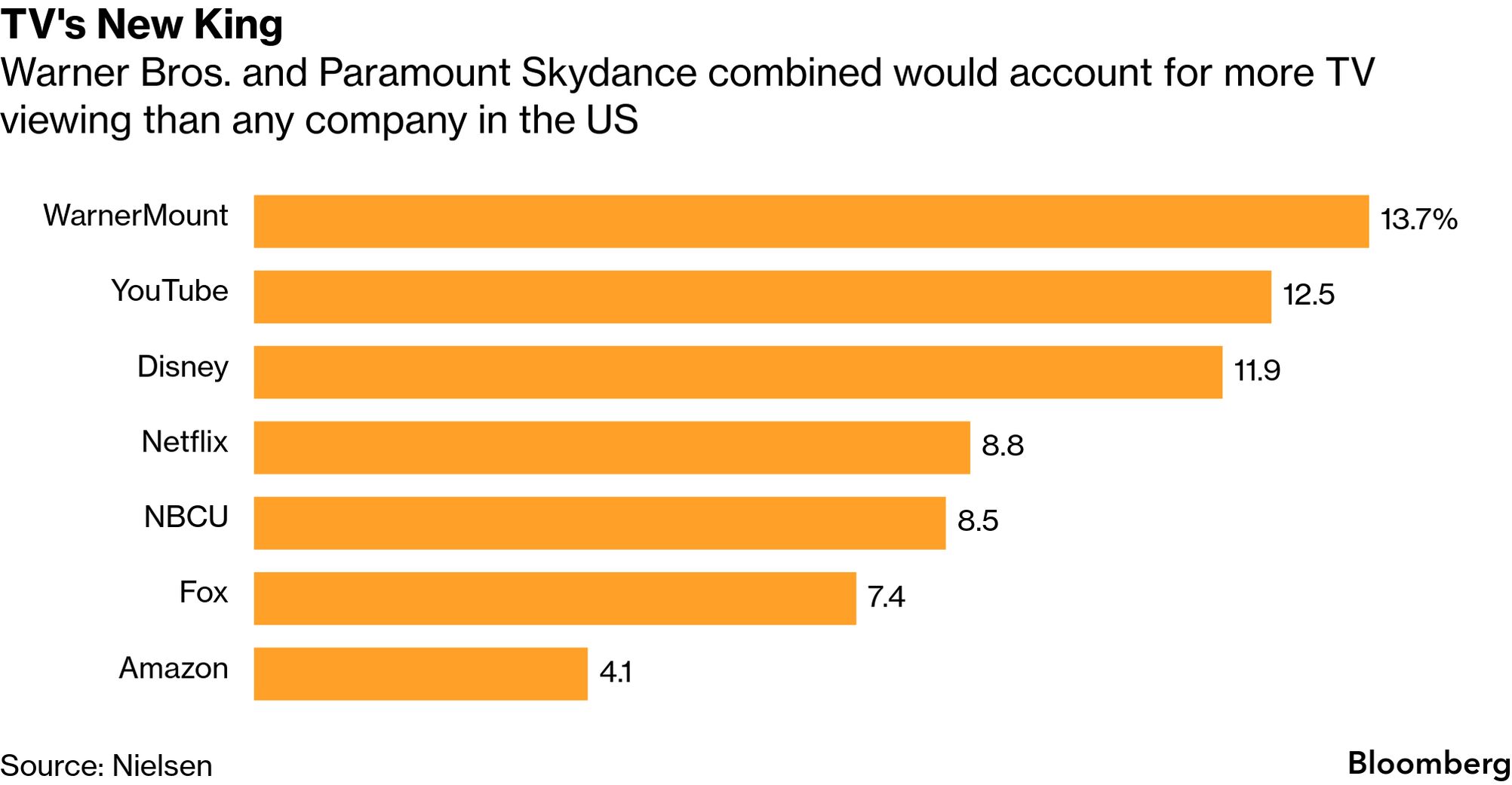 It may not hold that crown for very long given the growth of YouTube and decline in legacy TV. The combined company will be the largest owner of cable networks by a country mile. But its strength in streaming is slight. Paramount and Warner Bros. combined would only be the fifth biggest streaming service — and that is including Pluto TV and Discovery+. 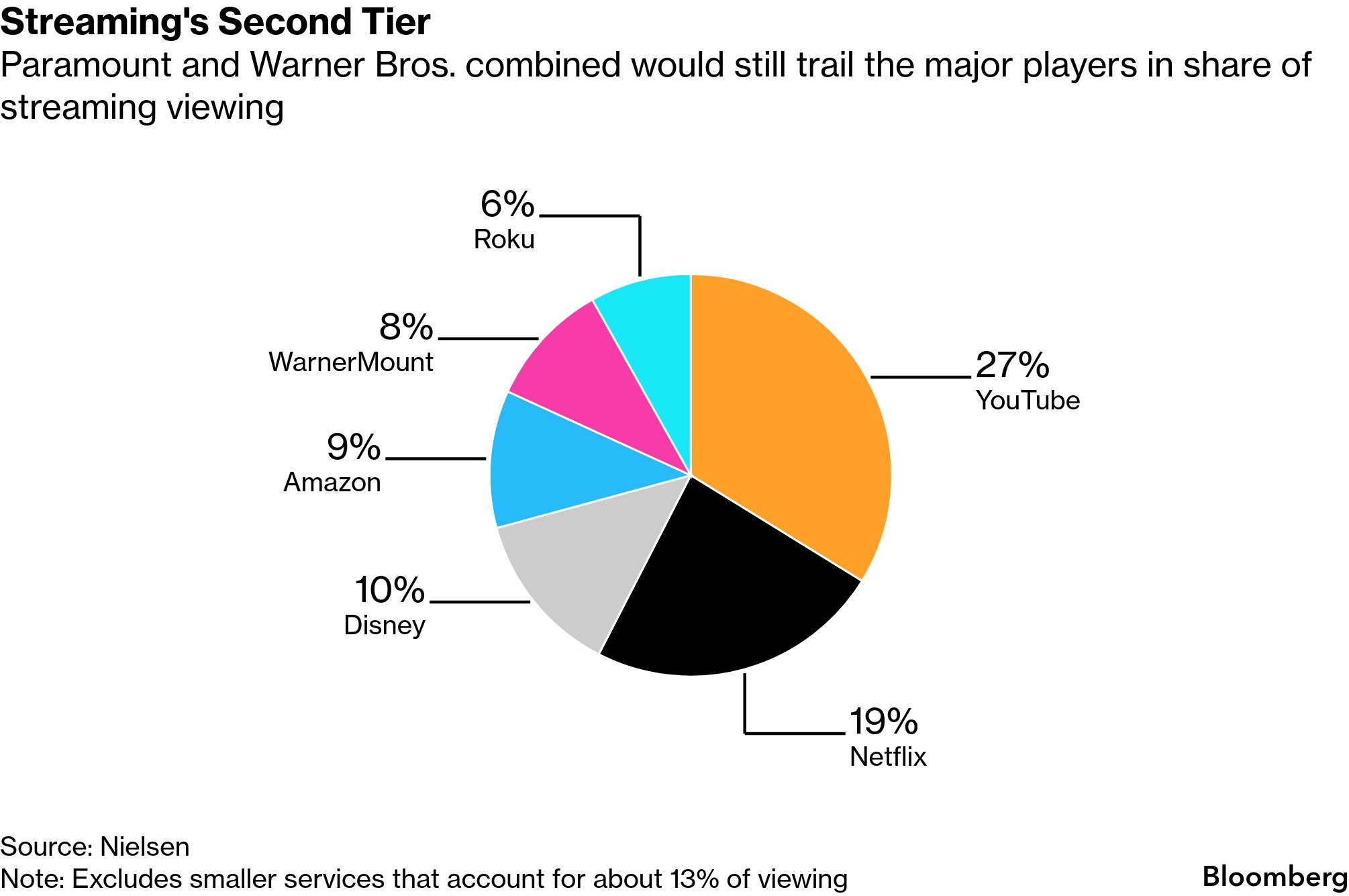 David Ellison is obviously betting that the combination of all the great programming across its services will make the service a bigger competitor. In terms of library and production, WarnerMount is probably the biggest in the world. Please send along any data on that front. The No. 1 movie in the world is…Scream 7. The film opened to $64.1 million domestically and $97.2 million worldwide, tops in the history of the franchise. The No. 1 tour in the world is…Lady Gaga. She's grossing almost $10 million a night with an average ticket price of $184.24. The most expensive ticket is the Zac Brown Band while Bad Bunny is selling the most tickets at almost 57,000 a night, per Pollstar. Deals, deals, deals
Weekly playlistMy friend Raffi introduced me to the Dutch-Turkish rock band Altın Gün. The final song on their most recent album, Garip, is particularly fun. More from BloombergGet Tech In Depth and more Bloomberg Tech newsletters in your inbox:
We're improving your newsletter experience and we'd love your feedback. If something looks off, help us fine-tune your experience by reporting it here. Follow us
You received this message because you are subscribed to Bloomberg's Screentime newsletter. If a friend forwarded you this message, sign up here to get it in your inbox.
|
Sunday, March 1, 2026
Ted Sarandos’ Warner Bros post-mortem





Subscribe to:
Post Comments (Atom)

-
PLUS: Dogecoin scores first official ETP ...
-
Swaps, memes, homes, tokens. View in browser Unicorn bucket We have talked a fe...


No comments:
Post a Comment