| |
They were each other's nemesis. |
| Ironically, they both believed in the same underlying problem: The world's population was growing faster than the earth's ability to feed it. |
| What they disagreed on was what to do about it. |
| William Vogt, an ecologist born in 1902, believed that if the world's population continued to grow and consume at the pace expected, there would be devastation on a global scale. |
| Mass starvations causing the death of untold hundreds of millions were forecast. |
| Vogt founded a movement that was referred to as "apocalyptic environmentalism." |
| It was based on creating fear, uncertainty, and doubt. |
| His desired "solution" to population growth was to limit it. |
| Vogt was such a strong advocate of population control… |
| He went so far as to become the national director of the Planned Parenthood Federation of America. |
| "A Biographical Sketch" |
| A devout follower of Vogt, Paul Ehrlich was arguably an even more rabid, fanatical amplification of Vogt's ideology. |
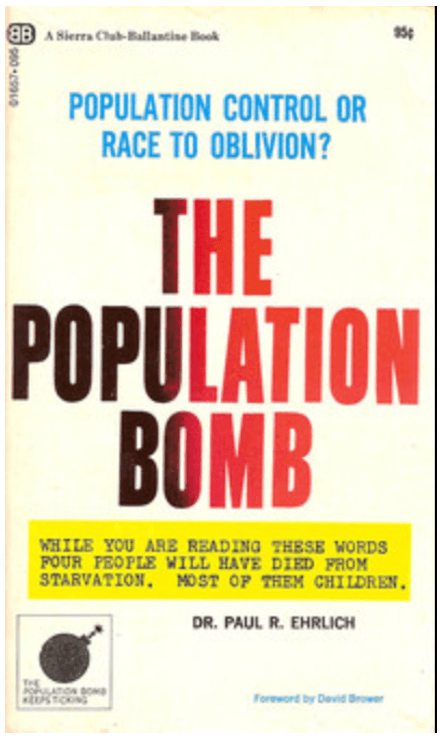
| And he became far more famous and well-known, thanks to his 1968 book "The Population Bomb." |
| |
| Ehrlich's book forecasted widespread famines and mass starvation for large swaths of the human population. |
| He went so far as to write that "in the 1970s and 1980s, hundreds of millions of people will starve to death." |
| He also forecasted life expectancy in the U.S. to fall to 42 years of age by 1980 due to the use of pesticides. |
| Selfishly, he proclaimed back then that the world's population needed to be cut in half. |
| He went so far as to urge wealthy countries to cut off food assistance to the third world and to sterilize parts of the human population so that they couldn't procreate. |
| He was heartless, self-righteous, and evil. |
| But Norman Borlaug, an agronomist born in 1914, had a different outlook on the issue of how to feed the world's increasing population. |
| By using technology, Borlaug took another approach. |
| "Preceded By…" |
| Rather than looking to curtail or reduce the world's population as a solution to reducing societal impact on the environment, he used technology to accommodate the world's increase in population… and dramatically reduce global famine. |
| Borlaug was an innovator. |
| He received his PhD from the University of Minnesota in 1937 in plant pathology and genetics. |
| He then took a research position in Mexico, where he developed high-yield, disease-resistant wheat. |
| This was just the beginning of what many refer to as the "Green Revolution." |
| And the impacts were astounding… |
| Borlaug's goal was simple: To produce high-yielding crops to ensure that the world had enough food to avoid starvation. |
| And he succeeded, not by just a little bit, but to an exceptional degree. |
| It has been said that Borlaug has saved more lives than any other person in history, perhaps as many as 1 billion. |
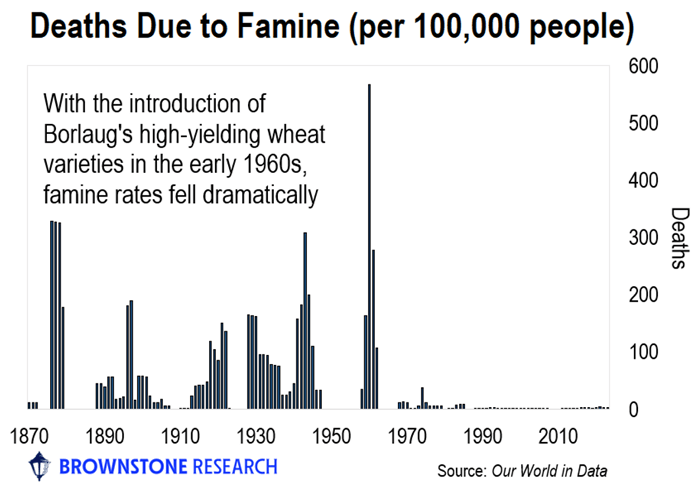
| And one chart tells the whole story… |
| |
| From the 1920s through the 1960s, there were still hundreds of famine-related deaths per 100,000 people globally. |
| In the 1960s, there were about 16.6 million total deaths due to famine. |
| But by the time Borlaug's innovative approach to agriculture had taken hold on a global scale, that number had dropped by more than 80%. |
| Today, it sits at only three deaths per 100,000 people and continues to drop. |
| Borlaug won the Nobel Peace Prize in 1970 for his work, as well as the Presidential Medal of Freedom and the Congressional Gold Medal. |
| And rightfully so. |
| This is truly one of the greatest stories of human ingenuity. |
| And yet, for decades after, population alarmist Paul Ehrlich amassed a large audience. |
| |
| "Service Details" |
| Ehrlich continued to make dire predictions about our future… |
| Here is a list of his most significant predictions: |
- Mass global starvation in the 1970s and 1980s.
- The global population will overtake the food supply, resulting in 100-200 million deaths from starvation.
- There would be a "Great Die-Off" of 4 billion people in the 1980s, which would include about 65 million Americans.
- By 1980, all important sea animal life would become extinct.
- There would be food and water rationing in the 1970s.
- "If I were a gambler, I would take even money that England will not exist in the year 2000."
- A scarcity in resources would drive up metals prices, specifically copper, chromium, nickel, tin, and tungsten during the 1980s and 1990s (note: prices did the opposite and dropped).
|
| Obviously, we all recognize that every single one of these predictions has been proven to be completely wrong. |
| It's hard to believe that anyone would listen to Ehrlich at all after being so concretely proven to be incorrect in his "science." |
| And yet, there still remain many who believe this nonsense. |
| There are even some strong arguments that the people behind the manmade COVID-19 virus, through gain-of-function research, and the corresponding mRNA "vaccines" (experimental drugs) were designed explicitly for population control – the largest genocide in world history – which we continue to see in the data in excess deaths across all countries that pushed the mRNA "vaccines." |
| Vogt, Ehrlich, and his followers, full of fearmongering and impractical "solutions," were wrong… dead wrong. |
| "Survived By…" |
| Ehrlich died on March 13 at 93. |
| He never, not once, admitted that his predictions were completely wrong (note: all of them were wrong). |
| In fact, in a 2009 interview, Ehrlich said that the biggest flaw in his book "The Population Bomb" was that it was "much too optimistic." |
| His only concession was that his timing on his predictions was a bit too premature. Pathetic. His book was written 58 years ago. |
| Borlaug, on the other hand, with his supporters, used technology to feed the planet and stave off starvation. |
| Technology has already brought about a world of abundance. |
| The builders, creators, problem-solvers, business leaders, and engineers proactively used and developed technological solutions to the world's challenges. We won, and we will keep winning. |
| This is the way. |
| Technology will lead to limitless, cheap, clean, abundant energy worldwide. |
| It will lead to cures for all diseases known to humanity… |
| It will continue to reduce the number of deaths worldwide related to transportation accidents… |
| It will continue to improve the quality of our lives… |
| It will eventually eliminate what is left of poverty around the world… |
| It will reduce the amount of human labor required. |
| It will recapture our time. |
| And in time, it will take us to the stars. |
| Paul Ehrlich is survived by 8,298,978,817 human beings on Earth, more than 130% more than in 1968. |
| |
| |










No comments:
Post a Comment