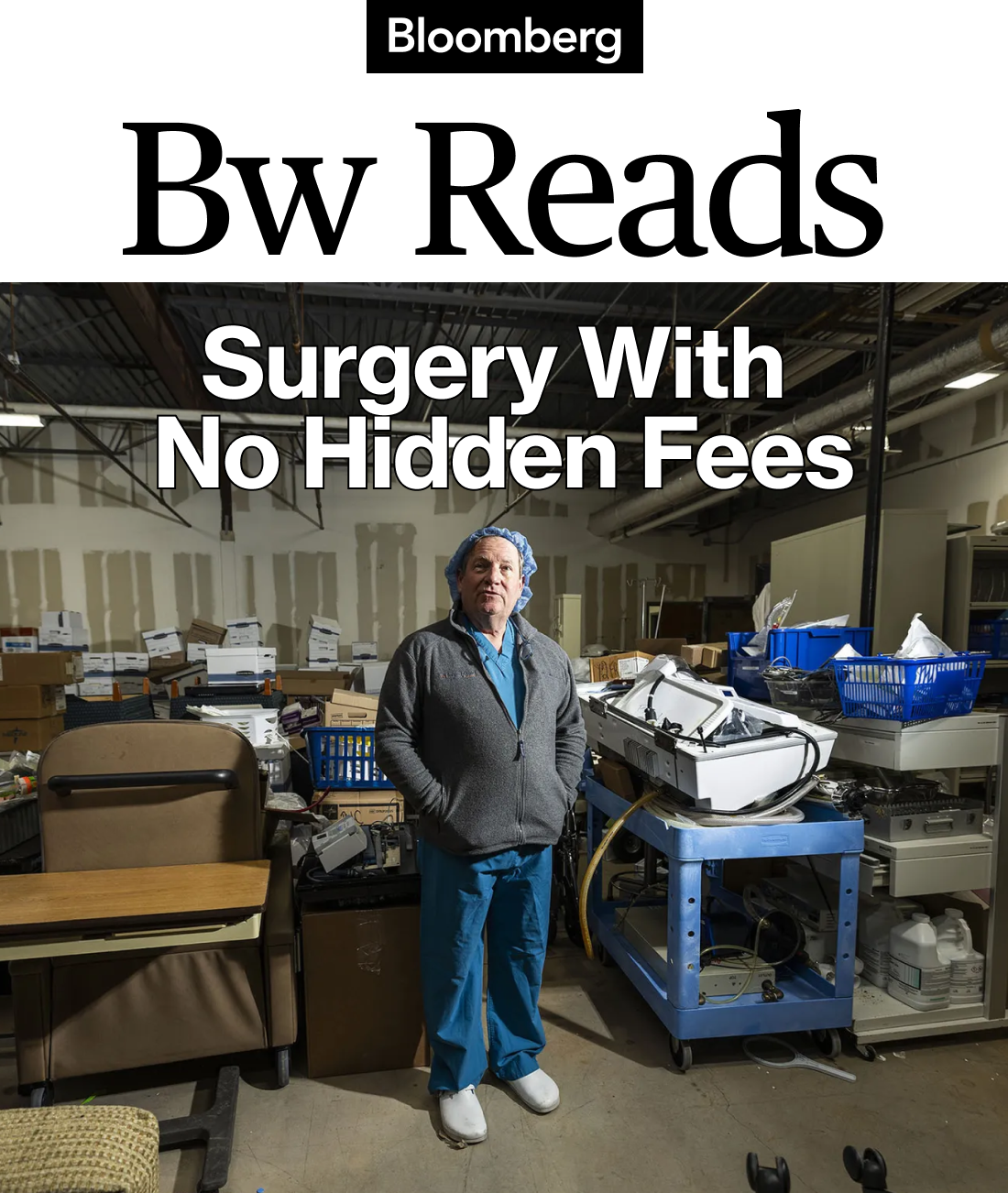
| Welcome to Bw Reads, our weekend newsletter featuring one great magazine story from Bloomberg Businessweek. Today Rowan Moore Gerety writes about an anesthesiologist and libertarian who has spent decades pushing his surgery center toward more transparent prices. Others are now following his lead. You can find the whole story online here (free!). You can also listen to it. If you like what you see, tell your friends! Sign up here. By 6:30 a.m. on a chilly Wednesday last year, the Surgery Center of Oklahoma is bustling. Six miles north of the state Capitol, beside a stretch of Route 77 lined with medical facilities, spouses waiting in the lobby scroll through their phones and slurp coffee from foam cups. A toddler in a Tigger-print medical gown and pajamas is on the way toward the operating room for his tonsillectomy, a doctor leading him by the hand. Those waiting include a young man in for a sinus operation and a middle-aged woman getting a hysterectomy. It's a diverse caseload by the standards of your average surgery center—most SCs focus on just one branch of surgery, such as thoracic or orthopedic. But what really separates SCO is its price transparency. There are no hidden fees, no massive charges mailed to patients' homes months later. The flat cost of each procedure has been set and mostly paid beforehand, often at a fraction of what a mainstream hospital in the area would charge. On SCO's website, an anatomical diagram displays the retail prices for more than 100 common procedures. A knee replacement will run you $17,679; a gastric bypass, $18,750. The surgery center's going rate for the hysterectomy is $9,190; for the sinus operation, $5,900; for the tonsillectomy, $3,875. Although these wouldn't be deals for patients with good health insurance, those with bad or no coverage would pay far more at some of the competing facilities nearby. The 150-odd physicians walking the halls rarely see patients with name-brand health insurance at SCO, but they treat lots of patients with high-deductible insurance, people who've been forced off Medicaid, and people whose procedures are funded by Christian cost-sharing ministries, as well as those whose employers fund their own insurance programs.  "I wanted patients with sticker shock to better be able to find us," says G. Keith Smith, one of the two anesthesiologists who co-founded the center. When he first posted the prices online, in 2009, he says, "I wanted to start a price war—wanted these damn hospitals bankrupting people to have to explain themselves. And I also wanted to understand the scams at play keeping the market from disciplining everybody in this industry." The US health-care system has long run on the theory that it's impossible to set prices before care has been delivered. Legions of providers, insurers and middlemen have abused that idea to make pricing impenetrable and charge whatever they want. Even a 15-minute office visit with a doctor might be flagged with different billing codes based on the patient's age and health, the medical issue discussed, where it was discussed and whether it was discussed for the first time. A thousand other contingencies depend on who's paying. The result is a model with no clear link between quality and price. For an identical operation performed at hospitals with comparable outcomes only miles apart, the resulting bills might diverge as much as 300%. Adam Russo, chief executive officer of Phia Group, which negotiates out-of-network bills for employer plans covering 50 million people, gives the example of a surgeon who operates in downtown Phoenix on Monday through Wednesday. "On Thursday and Friday, this guy likes to golf," Russo says, and operates closer to the links, in suburban Scottsdale. This puts the surgeon in network for many patients, he says, cutting the price tag by as much as 75%. "If you did that surgery on Wednesday, it's 200 grand. If you did that surgery on Friday, it's 50 grand. Same surgery, same doctor." Smith says he's offering a better alternative. He's playful and self-assured, with short, light brown hair, a boyish smile and a ruddy complexion. This morning he's padding through the halls in white leather clogs and a fleece over teal scrubs, producing a surgical cap from his pocket each time he enters the operating area to chat with patients or administer anesthesia. An avowed libertarian, Smith has spent decades arguing that the American health-care market would be far more efficient without the labyrinthine bureaucracies of big hospital systems, big insurers or big government. The week he meets with Bloomberg Businessweek at SCO, he's scheduled for his own MRI for a prostate screening. He grins as he notes that it will cost about $750 and that he's paying in cash. In Smith's view, even the most expensive procedures the American health-care system has to offer can become downright reasonable when you can negotiate a cash price. A side business he founded refers patients elsewhere for operations SCO doesn't offer, and Smith is fond of citing some of the "shockingly affordable" rates he's gotten for complex procedures. Open-heart surgery: $34,000. Brain tumor surgery: $41,000. For him the prices are clear arguments on one side of a debate he's been living out since the 1990s. 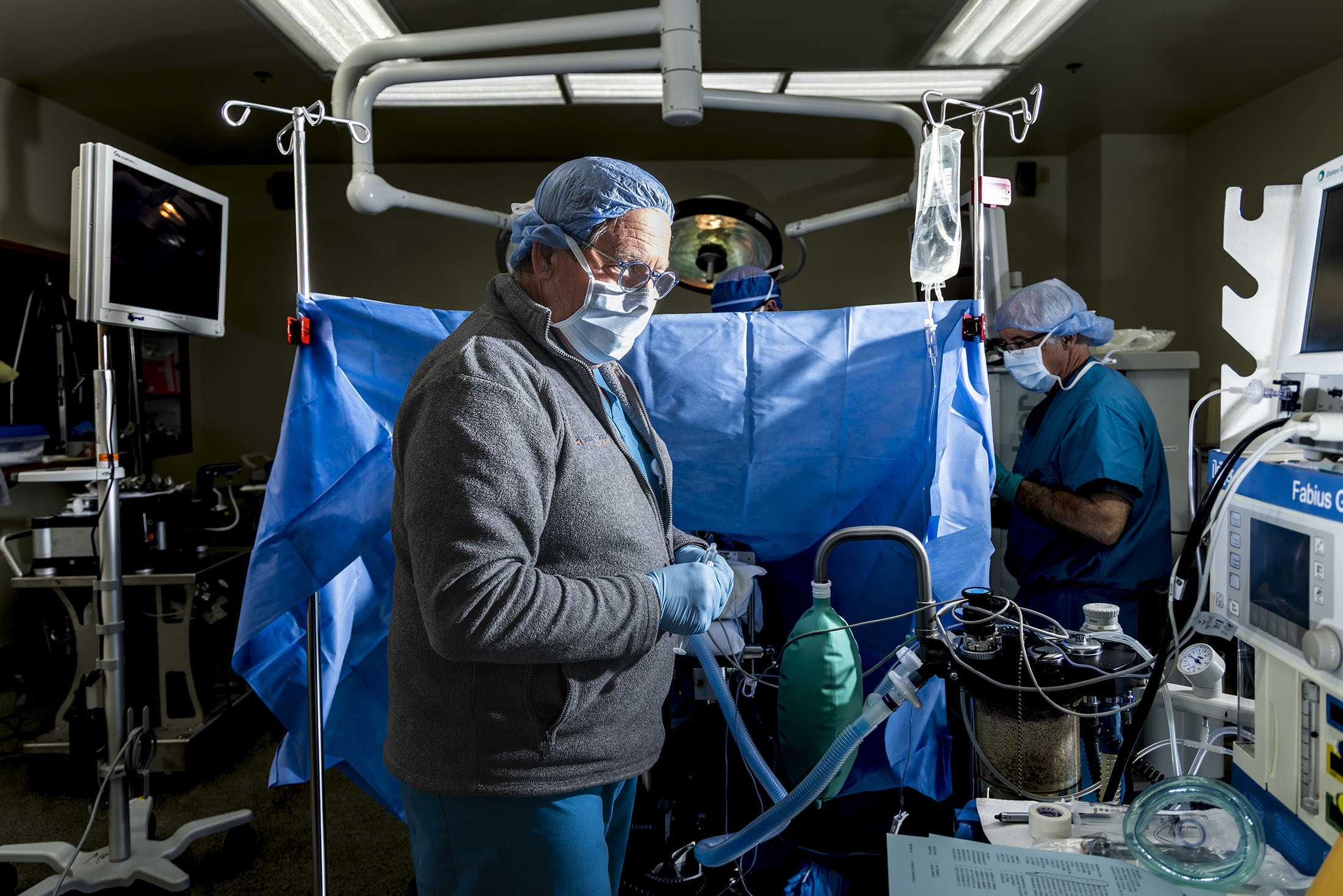 Smith during surgery at SCO. Photographer: Brett Deering for Bloomberg Businessweek When Smith gets going, his philosophy of medical care can start to sound much harsher. Americans aren't entitled to treatment, he says flatly. "If I don't have enough cash to secure some type of care, then I'll just not get it." And he rejects the solution that about 7 in 10 people on Earth enjoy: some form of national or universal coverage, funded by taxes. "If someone wants to volunteer to pay a medical bill for me, that is one thing," he says. "For Uncle Sam to stick a bayonet in their ribs and tell them to fork it over so this person you don't know can get this care?" A pained look spreads across his face. Put in those terms, it's easy to see where Smith's argument falls apart. The median American household might be able to pay cash for the MRI, but few could afford the surgery that might follow, much less an expensive heart or brain operation. At its most absolutist, his rhetoric amounts to two options for most people diagnosed with a serious malady: charity or death. Fortunately for Smith and his colleagues, as well as their patients, his principles aren't quite that rigid. Over the past decade in particular, SCO's transparent and competitive pricing has helped make it a valuable provider for Oklahoma's state and local employees, along with Christian Healthcare Ministries, a cost-sharing group that provides medical benefits by pooling funds from more than 150,000 families. And Smith's team, and its like-minded peers, appears to be getting results. SCO has been a pioneer in American medical pricing transparency. It's also given itself a lot of leeway by engaging with self-insured employers. Most large companies are self-insured, and governments in Oklahoma have grown keen to experiment with models like Smith's. Jon Wilkerson, the benefits director for Oklahoma City's home county of (yes) Oklahoma, says the county now steers close to two-thirds of its health-care spending to hundreds of providers with predictable fees, like SCO. While health-care spending by local governments and small businesses rose more than 60% in the past decade, Oklahoma County's costs have grown at half that rate. Wilkerson credits the county's use of smaller, specialized facilities with preset prices that can demonstrate patient outcomes comparable to those of larger hospital systems. To encourage patients to comparison shop, the county covers 100% of costs at its preferred providers. "The end result is we pay less, usually get some better quality, and our members pay nothing," Wilkerson says. Emergency services, oncology and mental health care are all costly forms of treatment that resist Smith's cut-and-dried math—it's hard to shop around in the midst of a health crisis—but surgery centers are good places to test his approach. Nationally, surgery accounts for more than 1 in 4 health-care dollars spent, or almost $1.5 trillion a year, much of it elective. Many of the nation's largest health-care payers, including Walmart, United Airlines and Lowe's, now push patients toward providers that offer all-in, bundled pricing for all kinds of care. The moment could hardly be more urgent. Last summer, President Donald Trump's One Big Beautiful Bill Act cut about $1 trillion from Medicaid and Obamacare subsidies, and those cuts took effect in January, threatening to knock millions of Americans off their health insurance. In Smith's waiting rooms, the no-surprises model has fans. Then again, many of those patients aren't the ones shelling out five figures in cash. Wilkerson says Oklahoma County guarantees its more than 2,000 beneficiaries $0 out-of-pocket costs for treatment at SCO. In 2025, Smith signed contracts extending the same treatment to 80,000 state employees and retirees as well as more than 350,000 people covered by Christian Healthcare Ministries. Jennifer Ashton, a comptroller with the county highway department, figured the deal was too good to be true when the county rolled it out in 2014, but she's since turned to SCO for a fully paid hysterectomy and a bunion removal, plus nerve ablations for her husband, a retired electrician. Ashton says she and her family have been thrilled with the results and recommend the surgery center to friends as far away as Indiana, where she grew up. (About one-third of SCO's patients come from out of state.) "I brag about it all the time," she says. Keep reading: How a Die-Hard Libertarian Is Negotiating Lower Health-Care Costs (🎁) |









No comments:
Post a Comment