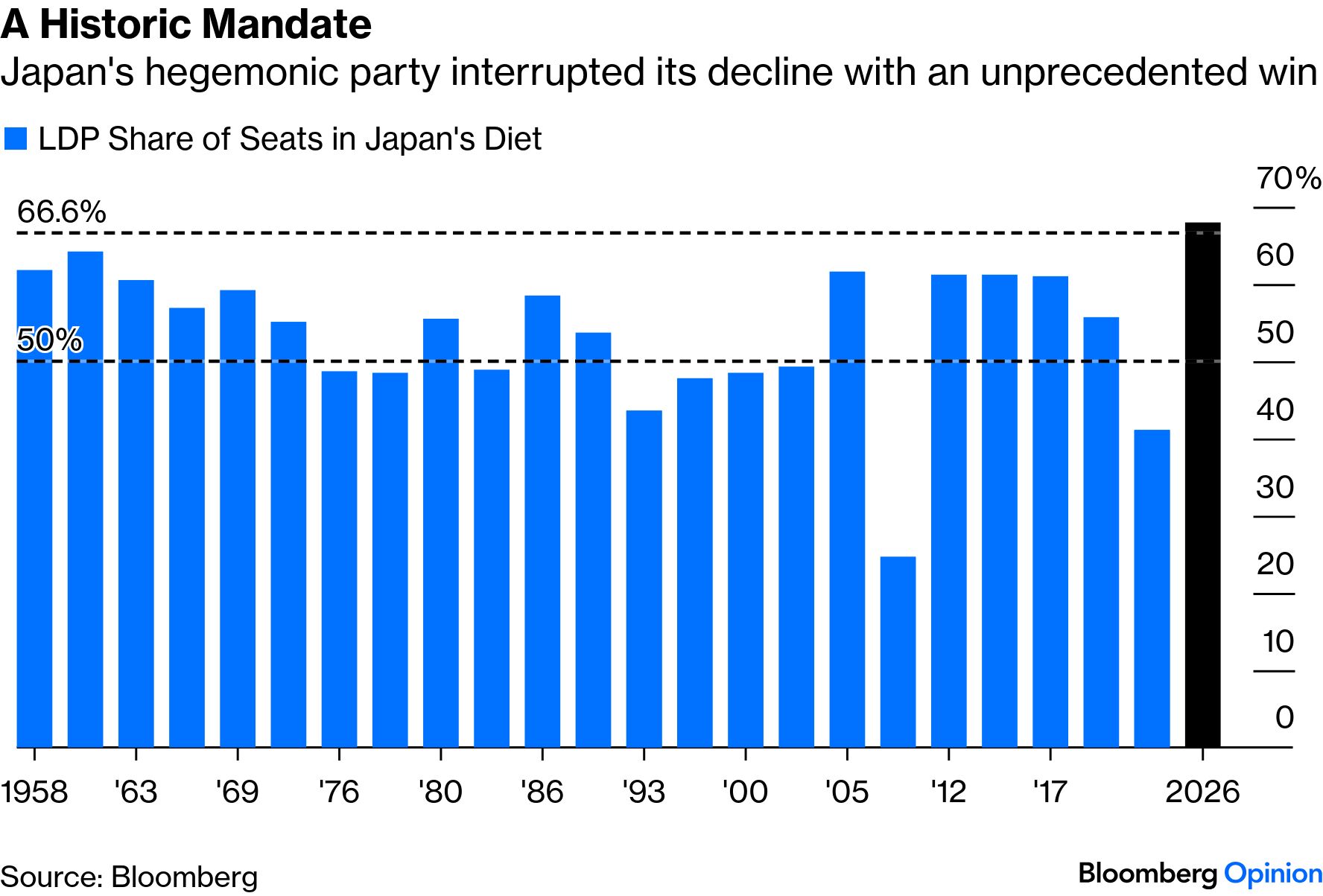
| I can't believe there were only three ads at the Super Bowl this year: Ok, fine. There were others — Pokémon, Poppi and Pringles — but "the Super Bowl of American football, which is also the Super Bowl of American advertising, and also increasingly the Super Bowl of American sports gambling," as Matt Levine notes, was won not by a team, but by that trio of hot topics: GLP-1 pills (which Lisa Jarvis says are upending the obesity-drug market), Claude AI (which Parmy Olson says will make analyst groupthink even worse) and DraftKings, which apparently is subsidizing Michael Che's mortgage. America's favorite sport isn't football itself, but all the eventizing — and dollar signs — surrounding it. Just look at prediction markets. Sure, you could bet $1 million in Bitcoin that the Patriots would win the game — and lose! — just like Drake. Or you could bet on the odds of a streaker hitting the field. Or on the surprise guest in Benito Antonio Martínez Ocasio's — AKA Bad Bunny's — halftime show. Lady Gaga and Ricky Martin performed. But did Cardi B? Matt says that's up for debate: Polymarket claims her appearance alongside Karol G, Pedro Pascal and Jessica Alba counted. But Kalshi chose to settle the market at the last traded price because Cardi B "was at the very least mouthing the words when dancing," but it's unclear "if she was singing," and it's "impossible to tell either way." Is this what we call sports now? I don't know! Truth be told, the only football I was watching was the one in Bad Bunny's hands. If you were one of the five (million — ugh) people watching Kid Rock's "All-American" show — one of Trump's biggest cultural blunders to date, in Nia-Malika Henderson's eyes — you probably missed the fine print: "Together, we are America." During his performance, Benito brushed shoulders with people from all walks of life, including Toñita, Young Miko, Alix Earle, and a random couple that got married, wedding cake and all. Watching it all unfold from the back of a headrest (I was flying back from Costa Rica, funnily enough), I've never felt prouder to be an American — and I'm saying that as someone who was cast as a tree in the kindergarten play, has fallen asleep at many a family gathering, has deep respect for nail techs and has shopped at Zara. Andrea Felsted says the singer's cream, head-to-toe getup — part of which was gifted to Zara employees this morning — was a symbolic nod to Spain that "ensures increased American visibility at a critical moment" for the brand. But for Puerto Ricans, Susanne Ramirez de Arellano says the Super Bowl halftime show was more than just a celebration of a broad "Latino" identity. It was an opportunity to tell a "story in Boricua Spanish on one of the most influential and iconic American national stages." Indeed, there were several nods to the Caribbean island, including the widespread blackouts that have ravaged the US territory, farmers in pavas (straw hats), viejitos (friendly old men) playing dominoes, piraguas (shaved ice) and sapo concho (the Puerto Rican crested toad). "As Bad Bunny emerges as a leading voice for all Latinos, his fans should go beyond simply dancing to his music or mouthing lyrics they may not fully understand. After you dance Sunday night, take a moment to discover what Benito is truly singing about: the raw, undiluted culture and history of Puerto Rico." Without it, America would be just as boring as the big game itself. Ten days ago, Sanae Takaichi gifted UK Prime Minister Keir Starmer a collection of cat toys — meant for Larry, the tabby cat and "Chief Mouser" at 10 Downing Street — during his trip to Japan. What was meant to be a lighthearted photo op now seems rather prudent: Larry, after all, is the government's most experienced employee. He has outlasted David Cameron, Theresa May, Boris Johnson, Liz Truss — the lettuce, too — and Rishi Sunak. Starmer, whose administration is now completely rattled by its association with disgraced financier and sex trafficker Jeffrey Epstein, seems all but certain to abandon his post before the nation's most trusted feline civil servant. 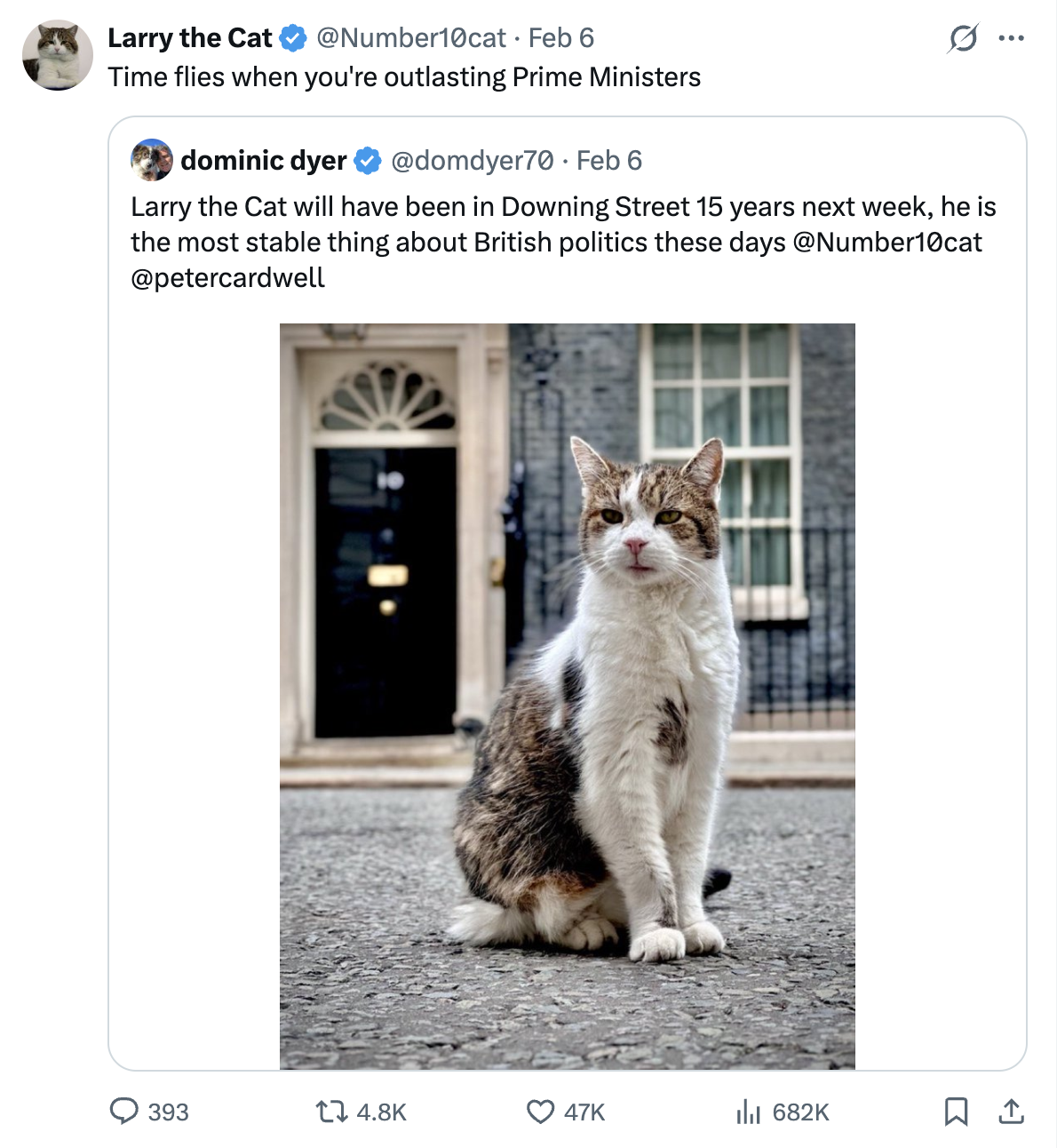 The Labour Party is scrambling as the fallout deepens. Morgan McSweeney, Starmer's chief of staff, and his director of communications, Tim Allan, are both gone. The PM's predicament is being described as "dire," with Scotland Labour Party leader Anas Sarwar calling on him to resign. If the end of the Starmer era is imminent, who might replace him? Adrian Wooldridge says that's the wrong question to ask. The Labour Party, he argues, doesn't just need a new leader. It needs an entirely different ethos. Like, say, that of the 1906 Liberal government. "This might sound quixotic," Adrian admits, but "the parallels between our own age and the Edwardian era are extraordinary: Not only did the the early 20th century see the disintegration of a one-party structure with the rise of Labour, it also saw the disintegration of an intellectual order. The Victorians had worshipped at the altar of the night-watchman state of minimal government intervention. But this philosophy was visibly failing to cope with the problems of a massifying industrial society." Enter: Winston Churchill, Lloyd George and Richard Haldane, who embarked on a philosophical shift within the Liberals' ranks. First came the free school meals for needy children in 1906. Then the medical inspection of state-school children in 1907. Old-age pensions were launched in 1908. And a "budget against poverty" in 1909. By the time World War I rolled around, Liberal ideas were well understood. Although the party didn't survive the war, the formula — combining state activism with a solid defense of liberal principles — did. Now, 120 years later, Labour ought to employ it once again, Adrian says. Not in need of a new formula is the aforementioned cat-toy gifter, Takaichi. Because whatever Kool-Aid she's serving her people is working shockingly well. On Sunday, the Japanese Prime Minister's ruling Liberal Democratic Party made history by winning 316 seats in an election landslide. "Comparisons to Margaret Thatcher are apt, but Britain's Iron Lady never won a mandate this emphatic," writes John Authers. "Even Shinzo Abe, her late mentor who became Japan's longest-serving leader, did not realize this level of success," notes Gearoid Reidy. "It sets her up to be one of the strongest, most consequential leaders the country has known for years." I hope she has a lot more cat toys in her signature handbag — she's going to need them. |









No comments:
Post a Comment