Sunday, November 30, 2025

ChatGPT Is Three. Don’t Crack the Bubbly Just Yet

To get John Authers' newsletter delivered directly to your inbox, sign up here. Happy third birthday to ChatGPT! Nno nneed to guess which st
View in browser
Bloomberg

To get John Authers' newsletter delivered directly to your inbox, sign up here.

Today's Points:

ChatGPThree Years Old

It's been three years since ChatGPT launched itself on to an unsuspecting world. Much like the opening of the World Wide Web to the public in 1993, it took a technology that had been growing for years and suddenly made it accessible to a broader public. It's had a similarly galvanic effect. Nov. 30, 2022, increasingly looms as a date when things changed.

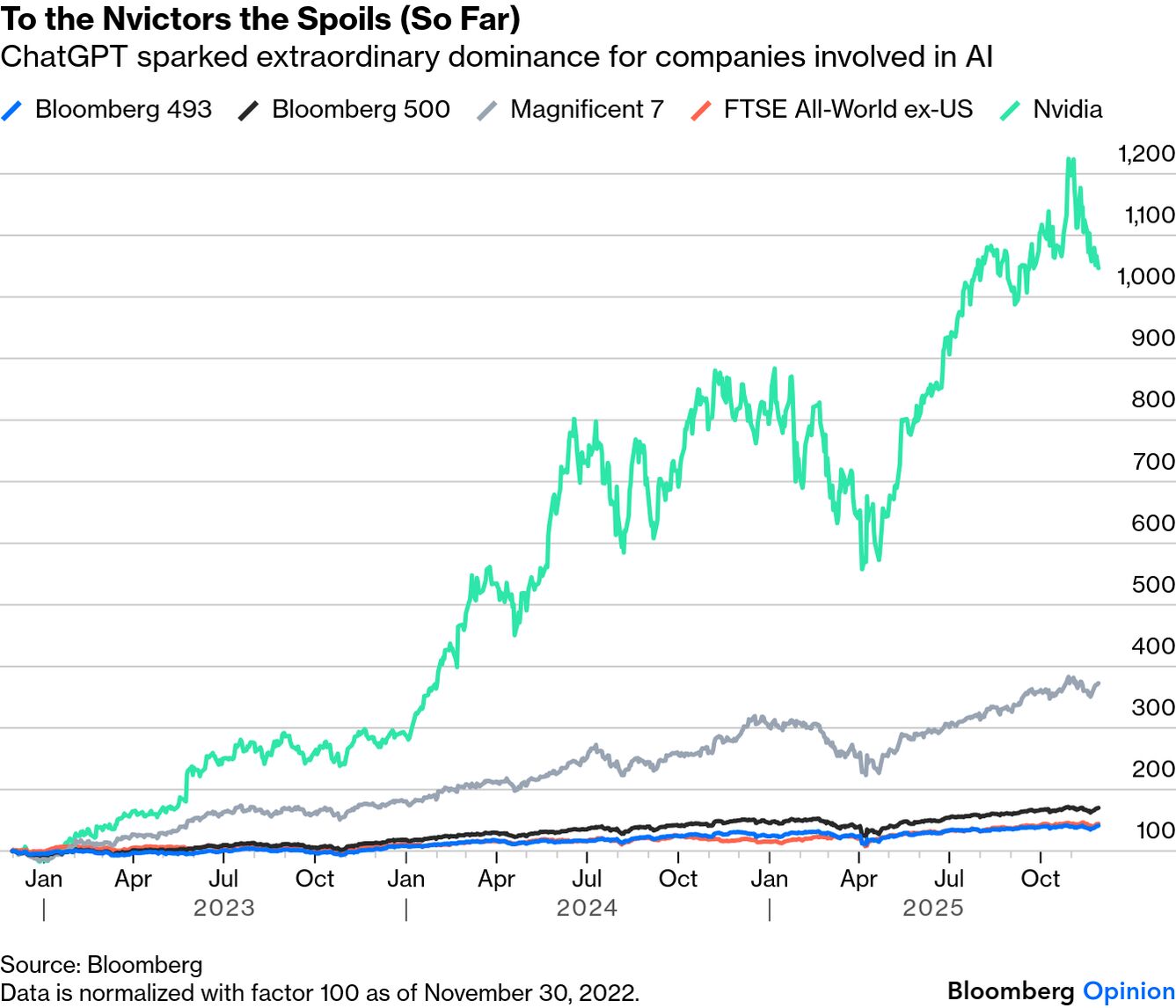
Much has been written about this, of course. Sticking to the market impact, the ChatGPT world has been one dominated by a few very big winners to date. The S&P 500 stock that has gained most in that time is, of course, Nvidia Corp. A rough ride in the last few days has brought the three-year gain in the share price a little below 1,000%. Beyond that, it's fascinating how concentrated the returns have been:

It's not unusual for some company somewhere to grow this much in three years. It's unprecedented for a firm that is already established among the world's largest to do so. That can be attributed both to the belief that AI will be transformative, and that Nvidia will be able to maintain a quasi-monopolistic position; with so much now running on these propositions, it's not surprising that both are coming in for re-examination. 

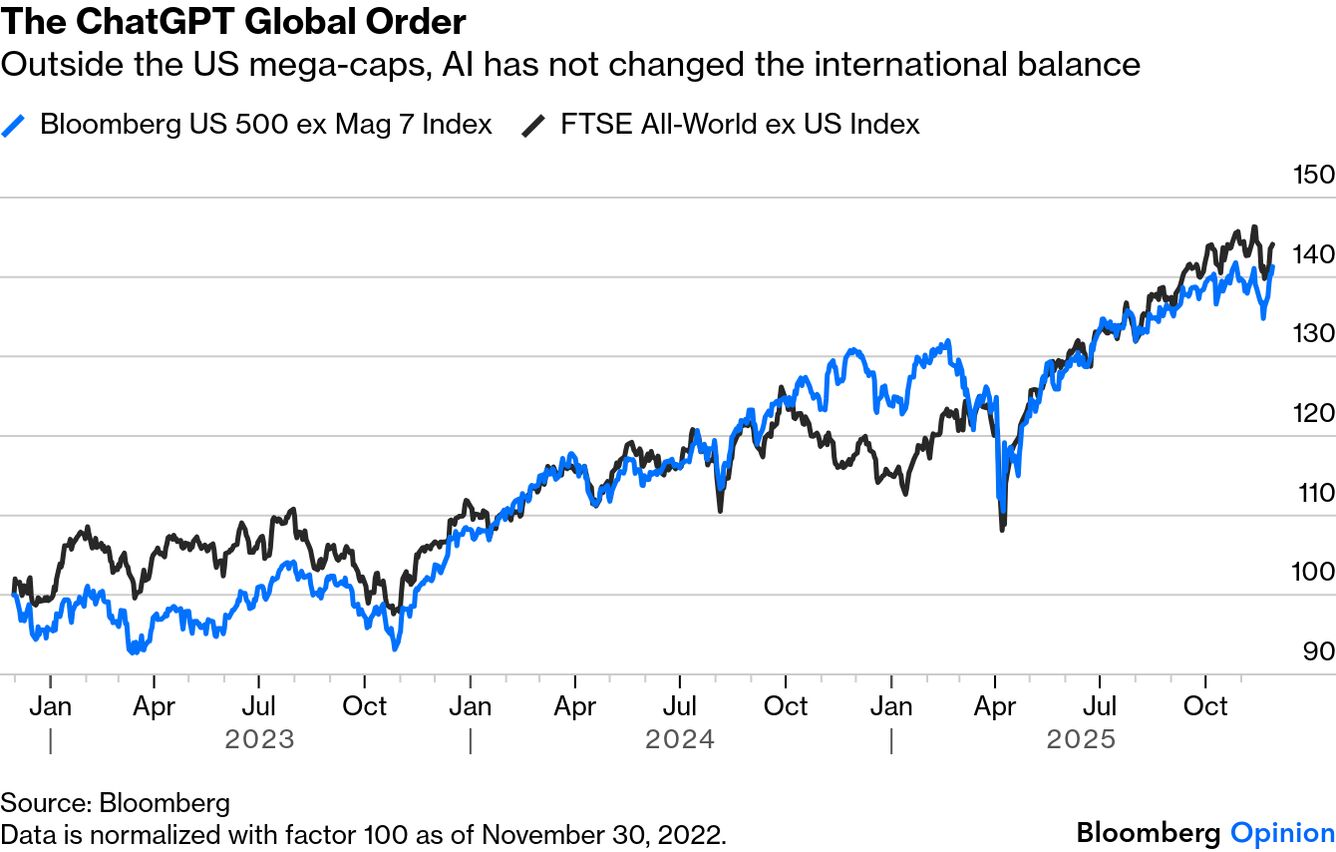
What is surprising is that generative AI hasn't yet altered the global order beyond showering capital on a few very large US companies that obviously stand to benefit. Using Bloomberg's index of the 500 largest US stocks excluding the Magnificent Seven tech groups, and comparing it with FTSE's index of all the developed and emerging markets outside the US, the two look more or less identical, and neither really springs into life until a year after the ChatGPT launch:

The amounts being spent on Nvidia chips are truly phenomenal, as Points of Return has documented, while the capital expenditures in the pipeline are big enough to shift forecasts for the entire economy. But as far as financial markets are concerned, this is still at base a story to an explosion in valuations for a select few companies viewed as likely winners.

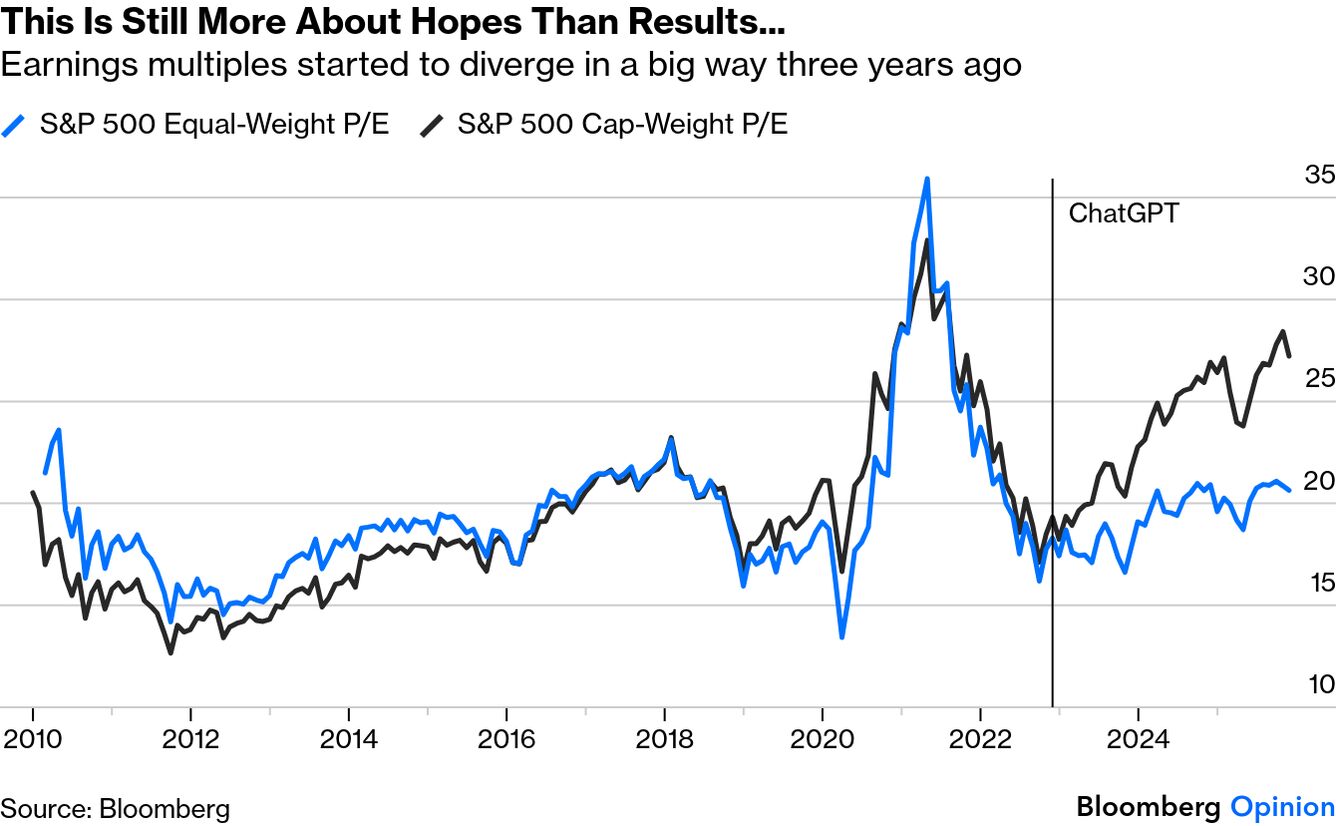
This chart compares the price/earnings ratios of the S&P 500 cap-weighted index (of which the Magnificent Seven now account for more than a third), and the equal-weighted index, in which each company accounts for 0.2%. Normally, the two move tightly together. Both were on the low side when ChatGPT came out, following the brief but savage bear market that accompanied post-pandemic rate hikes to rein in inflation. Thus, some of the great performance since then is due to starting cheap, rather than to the revolutionary new technology.

But the equal-weight P/E really hasn't increased that much. What changed almost instantly was the divergence between the equal-weight and cap-weight indexes. The valuation of the average US stock is high-ish but unremarkable. The overall index, giving full weight to the Magnificents, looks expensive: 

Where does all this leave us? The debate over whether this is a bubble gets a little arid, and depends too much on exactly how you define "bubble." We all have the opportunity to experiment with ChatGPT and other similar apps that have followed it, all of which have improved greatly in the last three years. There's obviously something exciting there, and it's in the nature of markets to try to be ahead of the curve. When you buy a stock you are taking on its future earnings stream, not what's in the past.

All that said, the stock market is telling us that so far this technology hasn't changed much of anything, beyond sparking massive growth in a few companies, which is based mostly on hopes for the future. It may not be through the bursting of a bubble, but somehow or other the lines on these charts are going to join each other again before ChatGPT has many more birthdays, either in losses for the Magnificents or gains for everyone else. Either way, it makes sense to take a deep breath and find ways to overweight everyone else, not US Big Tech hyperscalers. 

The Magic Pill

With Thanksgiving over, thoughts turn to the issue of how to lose a few pounds. And obesity drugs have suddenly made that much more attainable, while earning big dollars for their manufacturers. It's no coincidence that the stock that has contributed most to the rise of the S&P 500 in the three years of ChatGPT — and that wasn't in the Magnificent Seven — was Eli Lilly & Co., maker of Ozempic and Mounjaro. It's gained 202% in that time, which is more than Apple Inc., Microsoft Corp., Amazon.com Inc. or Tesla Inc. 

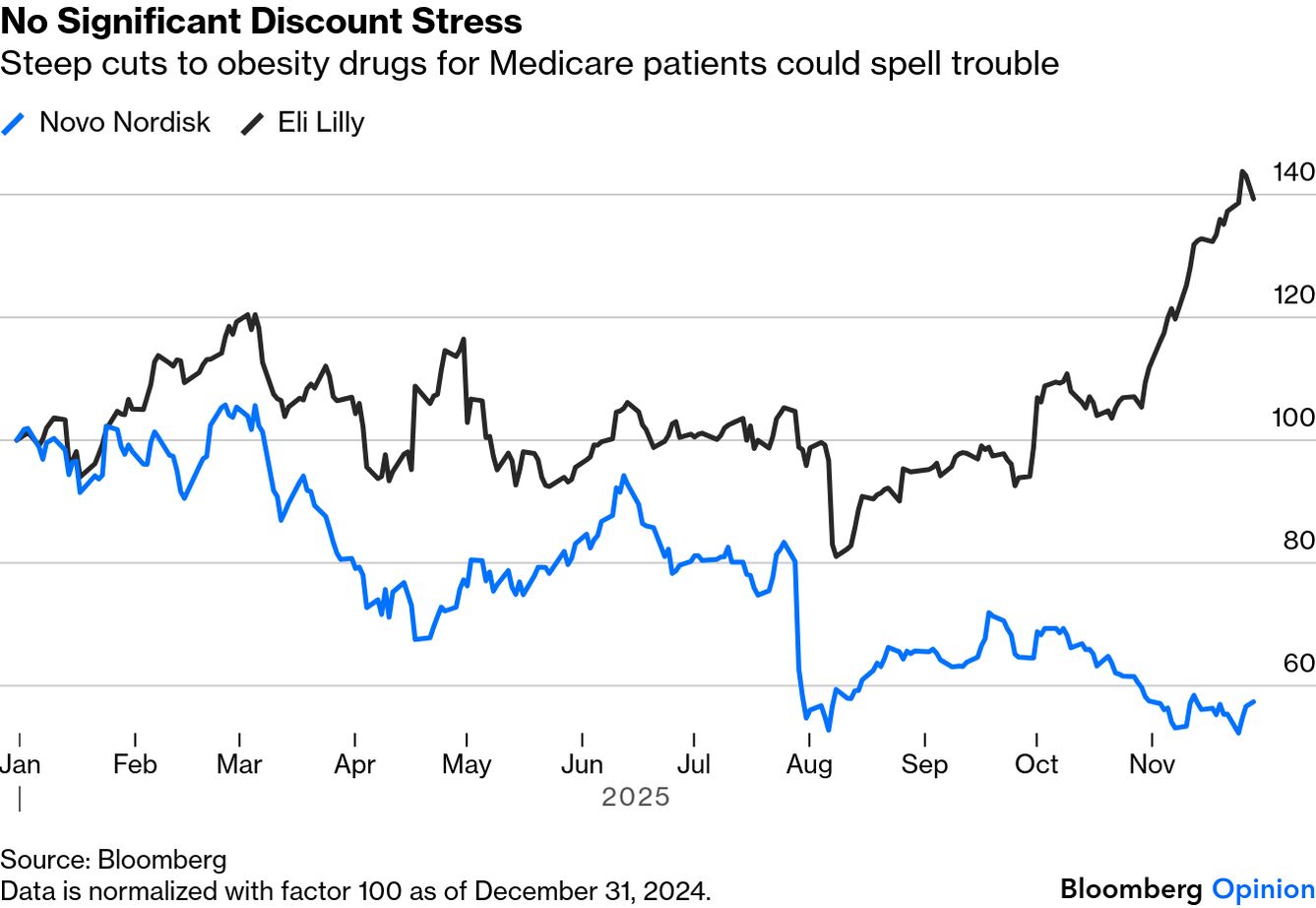
But for all the talk about the enormous market for these drugs, which seems even bigger as the country stirs after a few days of enforced gluttony, the issue of cost won't go away. That hurdle just got lower with Washington's recently announced discounts on Novo Nordisk A/S's blockbuster drugs Ozempic and Wegovy for Medicare patients, the federal health insurance program for the elderly. The 71% discount may delight patients and voters alike, but drugmakers will feel the pinch unless volume growth can overcome the margin squeeze. 

Bloomberg Intelligence estimates that Eli Lilly and Novo Nordisk's GLP-1 obesity drug sales could fall by at least $2 billion in 2026 to $26.4 billion. Medicare's coverage, set to begin next spring, should extend eligibility to at least 10 million potential patients, which BI analysts Michael Shah and Bethan Swift argue won't be enough to offset the price cuts. The discount has barely swayed investor sentiment, with Novo Nordisk still seen as a big loser, if the stock's reaction since the announcement is anything to go by:

The Danish company has endured a rough spell. Its growth prospects are heavily dependent on Ozempic (for diabetes) and Wegovy (for obesity), which both face headwinds. Shah argues these have fueled multiple guidance cuts, creating uncertainty for 2026:

The company is now trading at a forward P/E that's broadly in line with large pharma peers. Yet, despite this significant derating, sentiment about the stock is unlikely to improve until we get greater visibility around compounded GLP-1s (hurting Wegovy) and the measures in place to tackle them, plus evidence of improved commercial execution.

Despite both Lilly and Novo Nordisk being forced to swallow Washington's price cuts, it's Lilly's third-quarter earnings strength and its raised outlook that have investors leaning in. Expectations around the company's much-awaited weight-loss pill have helped propel it to an all-time high, making it the first health-care company to cross the $1 trillion market-cap threshold:
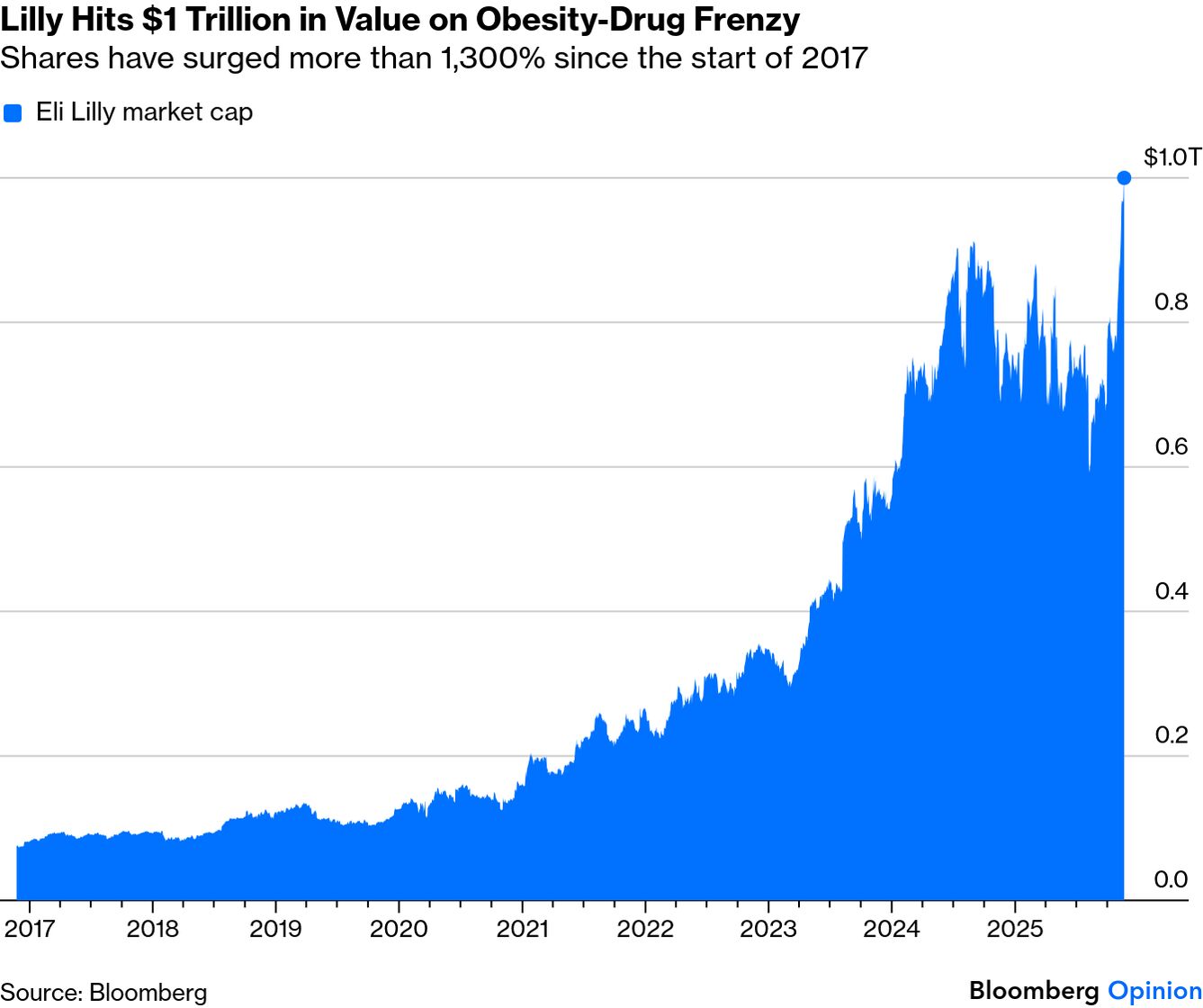
Ahead of a US Food and Drug Administration decision on whether to approve Lilly's oral obesity medication expected in early 2026, the firm has bulked up its supply. The elusive weight-loss pill remains the central catalyst in a market expected to reach $95 billion by 2030. Lilly's stock, up nearly 40% this year after a 32% surge in 2024, suggests investors are doubling down on the view that it will stay among the winners in the race to treat the obesity epidemic. It's running far ahead of the sector as a whole — this is how these exchange-traded funds tracking products and services related to cardiovascular and metabolic diseases, as defined by the Centers for Disease Control, have fared year-to-date:
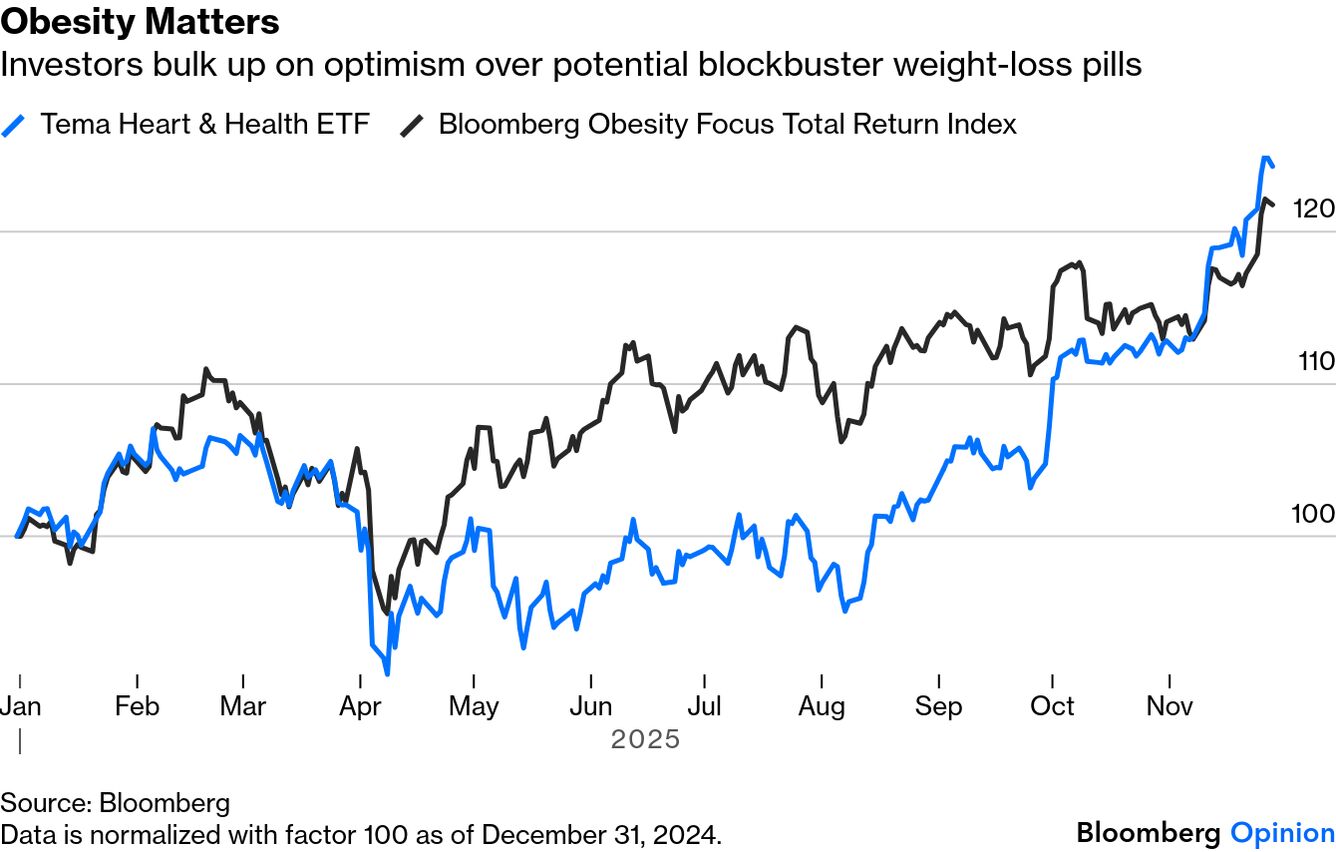
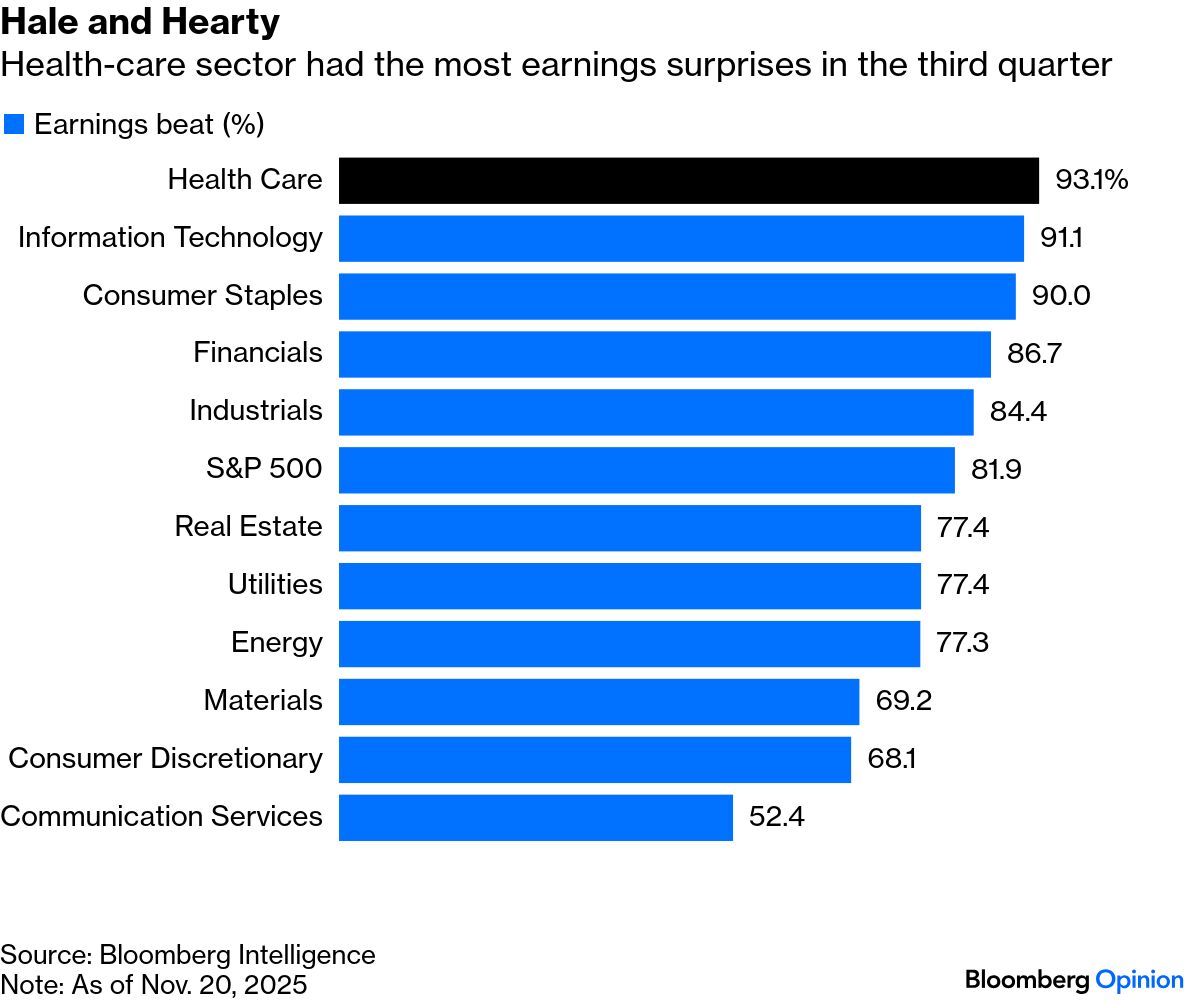
The TEMA Heart & Health ETF, launched a year ago, is hovering around record levels. Is the optimism justified? Judging from third-quarter health-care earnings, which produced more positive surprises than any other sector, it appears so. Demand for high-cost specialty drugs, including cancer treatments, helped power strong results at distributors such as McKesson Corp., Cencora Inc., and Cardinal Health Inc.:

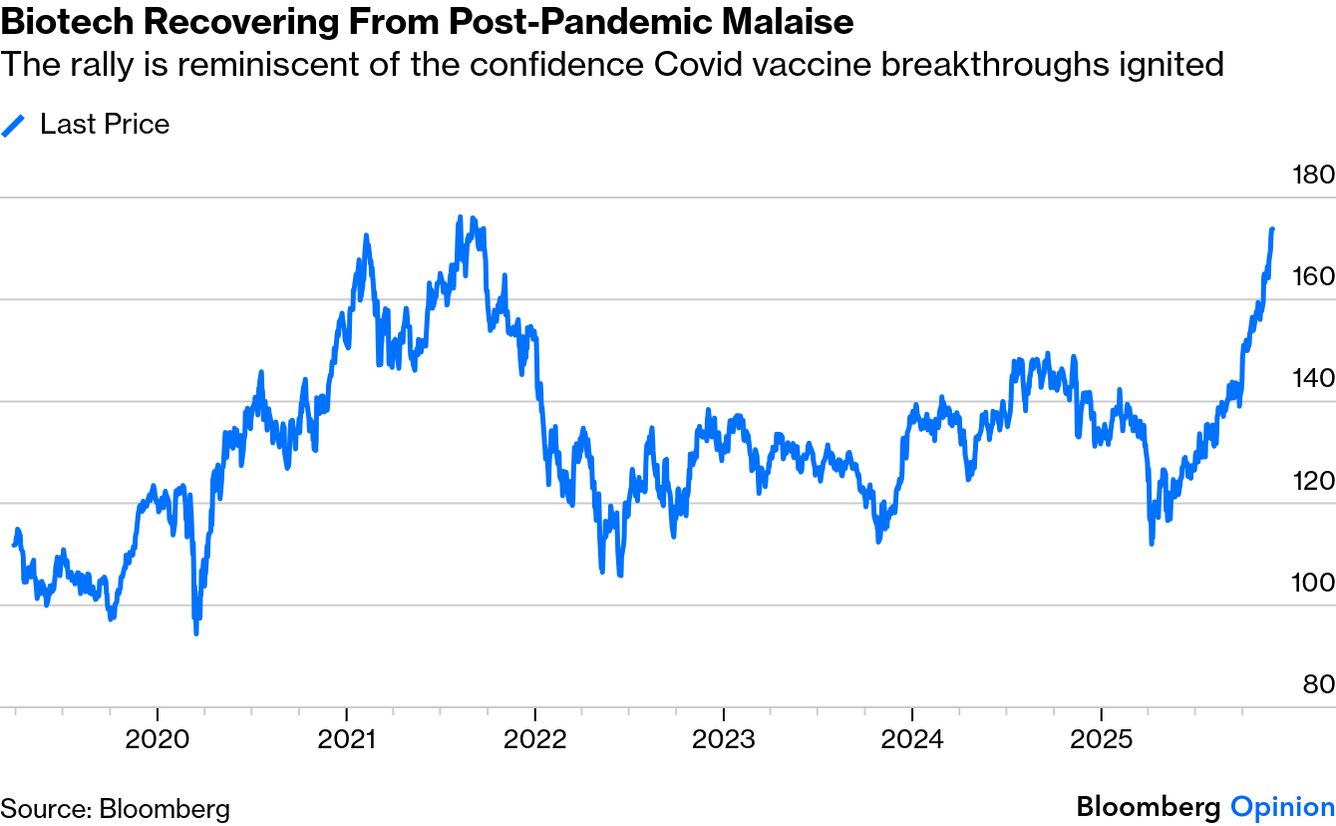
Their performance might also conceivably stem from using AI to improve the efficiency of pharmaceutical R&D. The iShares Biotechnology ETF has surged for six straight months, its longest winning streak since 2012. It's currently on track to eclipse the all-time peak it achieved at the height of optimism for Covid vaccines:

AI is already being put to work in biotech to deal with high failure rates, steep costs, and long development timelines, according to PitchBook. And so far, it's paying off. Biotechs that have baked AI into their model from the start now command nearly a 100% valuation premium to their non-AI peers:

While AI tools for experimental design and clinical-trial optimization will likely continue to be integrated into drug development, the success of AI-discovered assets will be the most significant benchmark for the technology and will have the greatest impact on the biopharma business model.

A lot, of course, is riding on faith in AI as the spark for a productivity revolution. And the experience of the companies that pioneered Covid vaccines shows that it's best not to take anything for granted: in the three years of ChatGPT, Pfizer Inc. is down 38% and Moderna Inc. has lost 85% — they have the second- and fourth-largest losses of market cap in the entire S&P 500. But for now, confidence in weight-loss pills and the curative properties of AI are enough to draw the sting from the Washington Medicare deal. 

-- Richard Abbey

Survival Tips

Tom Stoppard has left us at 88. He has been a part of the literary canon for as long as I can recall, and he doesn't deserve to be remembered for Shakespeare in Love, which I think is overrated — Upstart Crow basically made the same joke much more funnily. So instead, check out his great Cold War television play Professional Foul, or his laugh-aloud early comedy The Real Inspector Hound (now a staple of high school and college drama societies). It's a pastiche on Agatha Christie that has a lot in common with the Knives Out movies that we all enjoy. Or there's his early Rosencrantz and Guildenstern Are Dead, which has always been a fantastically useful reference on finance and probability theory. It starts with the heroes tossing a coin, calling heads 99 times in a row, only for it to come up tails every time. Discuss. Have a great week everyone. 

More From Bloomberg Opinion:

  • Capitalism's Latest Critic Ignores Its Secret Sauce: Adrian Wooldridge
  • Ray Dalio's Hedge Fund Bug Looks More Like a Feature: Chris Hughes
  • OPEC's Numbers Are an Exercise in Artistic Deception: Javier Blas

Want more Bloomberg Opinion? OPIN. Or you can subscribe to our daily newsletter.

Like Bloomberg's Points of Return? Subscribe for unlimited access to trusted, data-based journalism in 120 countries around the world and gain expert analysis from exclusive daily newsletters like Markets Daily or Odd Lots.

Like getting this newsletter? Subscribe to Bloomberg.com for unlimited access to trusted, data-driven journalism and subscriber-only insights.

Want to sponsor this newsletter? Get in touch here.

You received this message because you are subscribed to Bloomberg's Points of Return newsletter. If a friend forwarded you this message, sign up here to get it in your inbox.
Unsubscribe
Bloomberg.com
Contact Us
Bloomberg L.P.
731 Lexington Avenue,
New York, NY 10022
Ads Powered By Liveintent Ad Choices

No comments:

Post a Comment

Must Read: Is 2026 a "Tipping Point" for the AI Revolution?

This new tool could help you prepare in case it happens… ...