| Welcome to Bw Reads, our weekend newsletter featuring one great magazine story from Bloomberg Businessweek. Perhaps there's a Ninja Cremi or a Shark FacialPro Glow on your holiday list. If so, you should read Lily Meier and Shelly Banjo's article about how a flair for infomercials, TikTok and an endless stream of whiz-bang home appliances turned their maker, SharkNinja, into a $6 billion behemoth. You can find the whole story online here. If you like what you see, tell your friends! Sign up here. Mark Barrocas huddled with a group of employees staring at the dead skin extracted from their colleagues' pores. Minutes earlier, the chief executive officer of SharkNinja Inc. had halted the product meeting so an underling could "go get the gunk"—vials of dirt, skin and blackheads sucked out by a gadget the $6 billion consumer products maker was planning to release ahead of the holidays. Barrocas' team of engineers, marketers and researchers had been testing the at-home facial device on one another and other co-workers, who serve as guinea pigs for product developers. With 25 new gizmos a year, SharkNinja asks everyone from its accountants to human resources reps to double as testers in its 28 offices, enabling the Needham, Massachusetts-based company to tweak new and existing products around the clock. In this case, time was tight—it was late May, and the company was six weeks out from the planned production date. Barrocas still wasn't satisfied. Laid out on a table in SharkNinja's mock big-box store—replete with fluorescent lights, aisles brimming with vacuums and air fryers, and a logo resembling Walmart's—were multiple versions of the top-secret contraption, codenamed the Lily. How did they like the way the product moved across their faces, Barrocas cross-examined the group, some anxiously touching their skin with the device. "Any issue," he asked, "on the noise?" But it was the gunk he fixated on: Could his engineers light up the cartridge to make it more of a captivating moment on TikTok? How could they turn the excretion into a big reveal, a satisfying ritual like popping a pimple or pulling a Bioré pore strip off your nose? 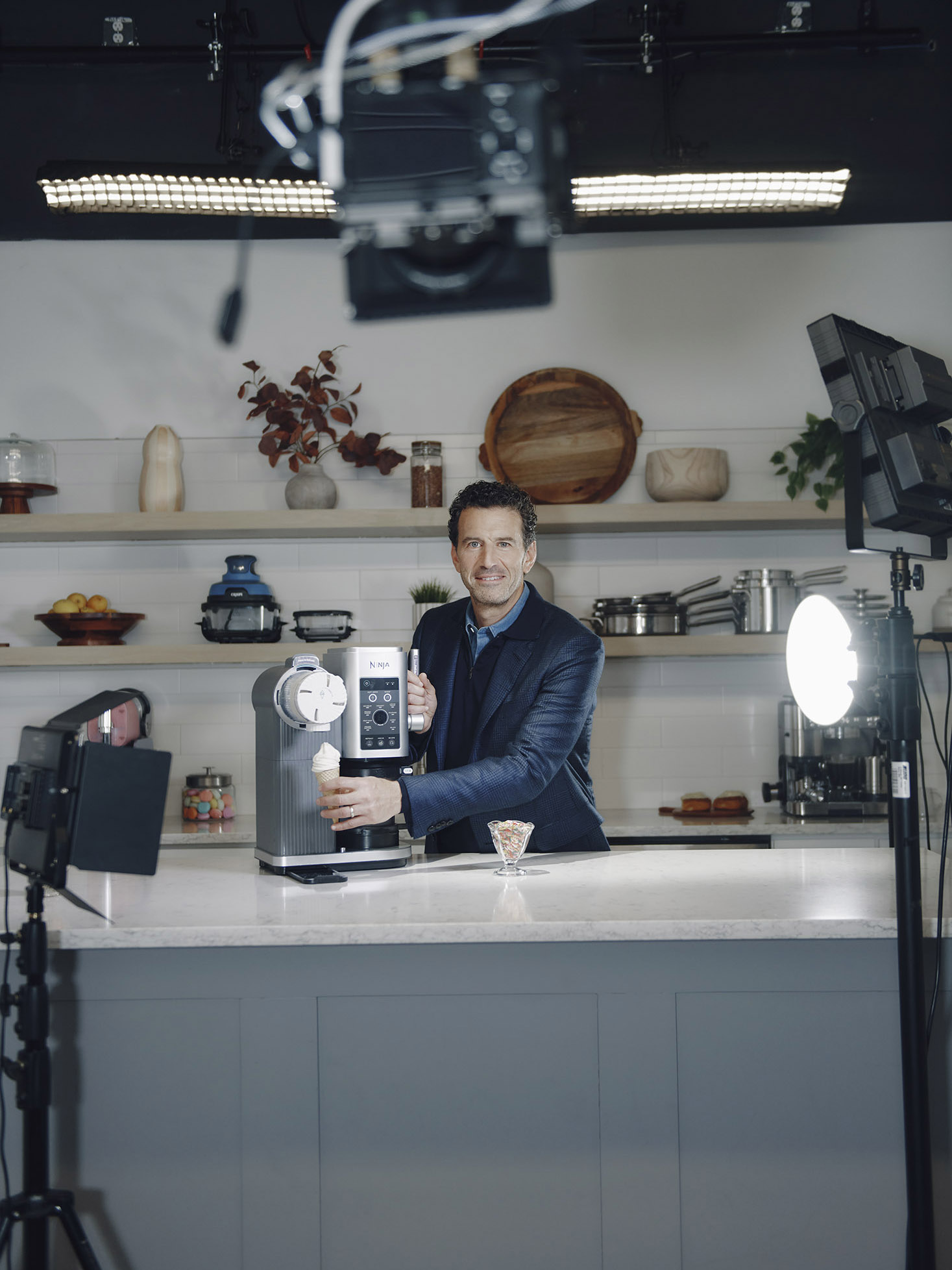 CEO Barrocas with a Ninja Swirl at SharkNinja headquarters in Needham in August. Photograph by Tony Luong for Bloomberg Businessweek SharkNinja began hawking vacuums on late-night infomercials in the early 2000s. Today it's still bent on building show-stopping features into its products, such as the black-water tank of its kitchen mop that reveals an obscene amount of dirt. For the FacialPro Glow, as the product would eventually be named when it landed on shelves in early October, the goal was to get users to share that pore-declogging moment with their friends or social media followers. "People are extremely voyeuristic when it comes to things coming out of their face," says Sofie Pavitt, a licensed esthetician and influencer who tested the device. This obsession with making products as irresistible as they are functional is what's turned SharkNinja into the infomercial king for the TikTok age. Unlike shoppers who want premium brands they can flaunt as countertop trophies—an $800 Breville espresso machine, a $2,600 Miele microwave oven—SharkNinja fans are more interested in a reasonably priced product with instant payoff. Want to cook a pizza with the exact precision necessary to blacken the crust? For $300, the company claims its Ninja Artisan 5-in-1 Portable Electric Pizza & Outdoor Oven can do that in three minutes, every time, no matter what dough you stick in there. Same thing for its affordable espresso makers, which do away with that need-a-Ph.D.-to-brew-a-cup-of-coffee feeling while making a pretty decent latte, replete with foam art—more fodder for TikTok. The company has used a similar formula for ice cream makers, hair dryers, air purifiers and dozens of other consumer gadgets. Its strategy is to woo customers from the premium end willing to trade down and customers from the low end open to trading up, says Neil Shah, chief commercial officer. Take converts like Carrie DiLeonardi, a 29-year-old nonprofit worker. Last year, after she got her mom to splurge on buying her the $349 Shark FlexStyle hair-dryer-styler combo—almost half the price of a Dyson Airwrap—her social media feed was flooded with videos of the Ninja Creami ice cream maker. The $230 device, which claims to make almost any frozen dessert in under two minutes, now has top billing on her wedding registry. "I was like, 'Oh, this is fun,'" she says. "You can turn anything you want into ice cream." Says Goldman Sachs Group Inc. retail analyst Brooke Roach of the brand: "It's aspirational, but it's still attainable." SharkNinja—Shark is the part of the business that sells vacuums and beauty products; Ninja makes kitchen items—might not yet be a household name, but chances are you've seen one of its hit products in a Target or Sephora, or encountered one on TikTok, Instagram or Reddit. Those familiar with the brand tend to be fanatical. The company's Ninja Slushi frozen drink maker, which launched in July 2024, sold out 10 times in the US, with a global waitlist soaring past 170,000. Its Shark CryoGlow face mask was trending on TikTok in the UK, where it first launched, in a matter of days. A video of the Shark TurboBlade, a fan that can stand vertically or horizontally, got more than 75 million views on TikTok and Instagram, and its Ninja Luxe Café coffee maker is the No. 1 espresso maker this year to date, the company says. Product reviewers are at the ready every time the brand unveils a contraption. "The Ninja Creami Changed the Way I Think About Making Ice Cream at Home," wrote Bon Appétit magazine in a July headline. "Is the Ninja Creami Ice Cream Maker Worth the Hype?" asked the Food Network earlier this year. The Ninja Creami subreddit currently has about 62,000 weekly visitors, who share so many recipes that Reddit users made a rulebook on how to submit them. "The ingredients need to be bullet points and the directions need to be numbered steps," it details. And the company—which spends $1 out of every $10 it makes on advertising—has continued to boost that buzz by enlisting celebrities like David Beckham and Kris Jenner to hawk its goods. It cut a product-placement deal with F1 The Movie; along with SharkNinja's logo being featured on Brad Pitt's black-and-gold Mercedes, the brand sold a special collection of gold hair dryers, fans, vacuums and coolers. 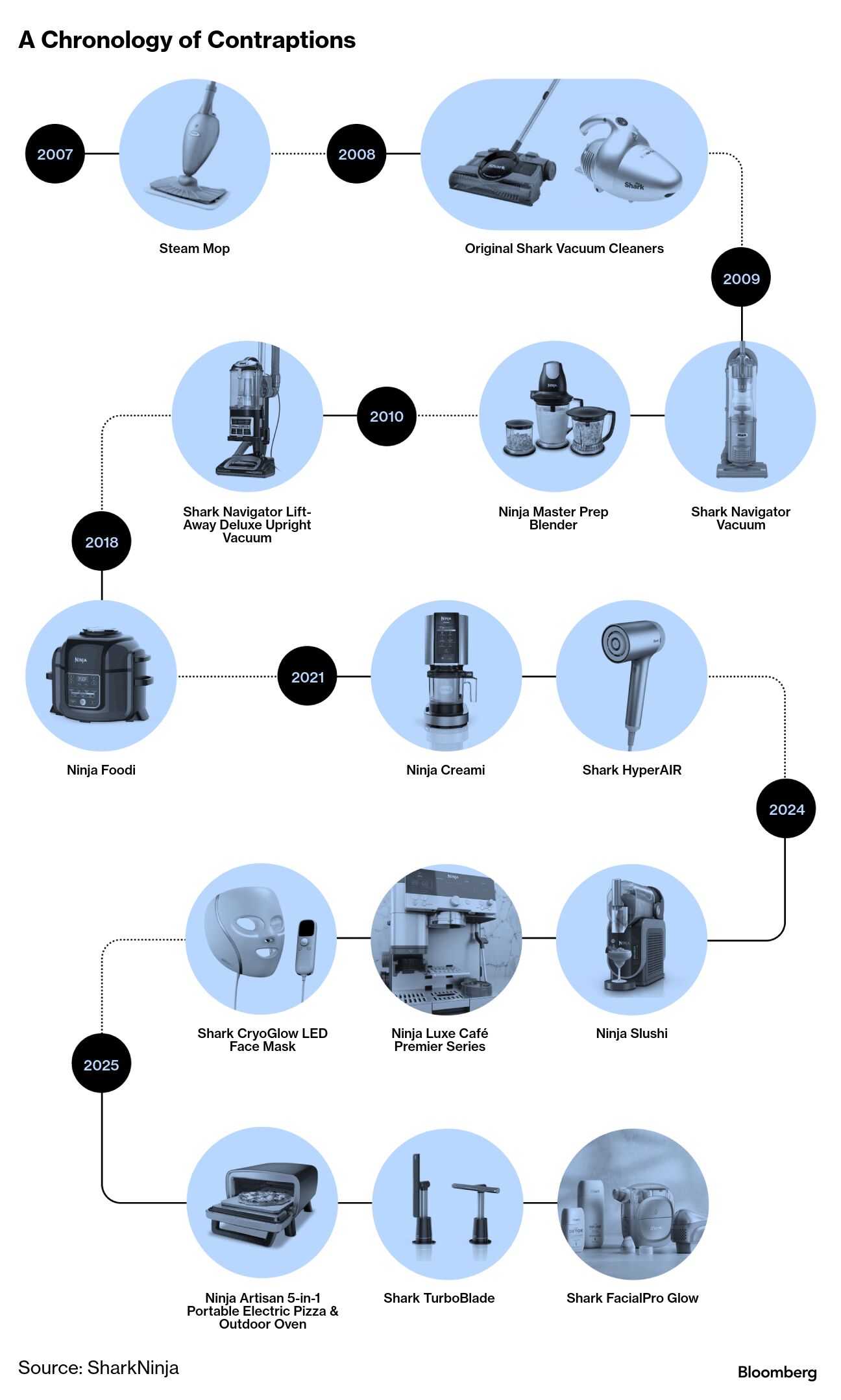 All of which has allowed SharkNinja to more than double its annual revenue in only five years and sent its shares soaring by roughly 103%, as of mid-November, since going public in 2023. This ascent, though, hasn't been without controversy. Competitors Dyson Group Plc and iRobot Corp., deriding the company as less innovator and more copycat, have both sued for patent infringement involving vacuums. (SharkNinja has been embroiled in lawsuits with both companies. It settled with iRobot last year and with Dyson this winter.) But the largest retailer in the world doesn't seem bothered. SharkNinja's ability to produce hits has become so expected, executives say the company sometimes doesn't even need to give Walmart Inc. and other retailers the specifics of a new product before the chains guarantee them coveted shelf space. (Walmart didn't respond to a request for comment.) That reliability is pretty remarkable, says Jad Jichi, Ninja vice president for global creative, given that when you really think about it, "there's nothing we make that you actually need." Keep reading: SharkNinja Built a $6 Billion Empire Selling Gizmos Nobody Needs |












No comments:
Post a Comment