| Bloomberg Evening Briefing Americas |
| |
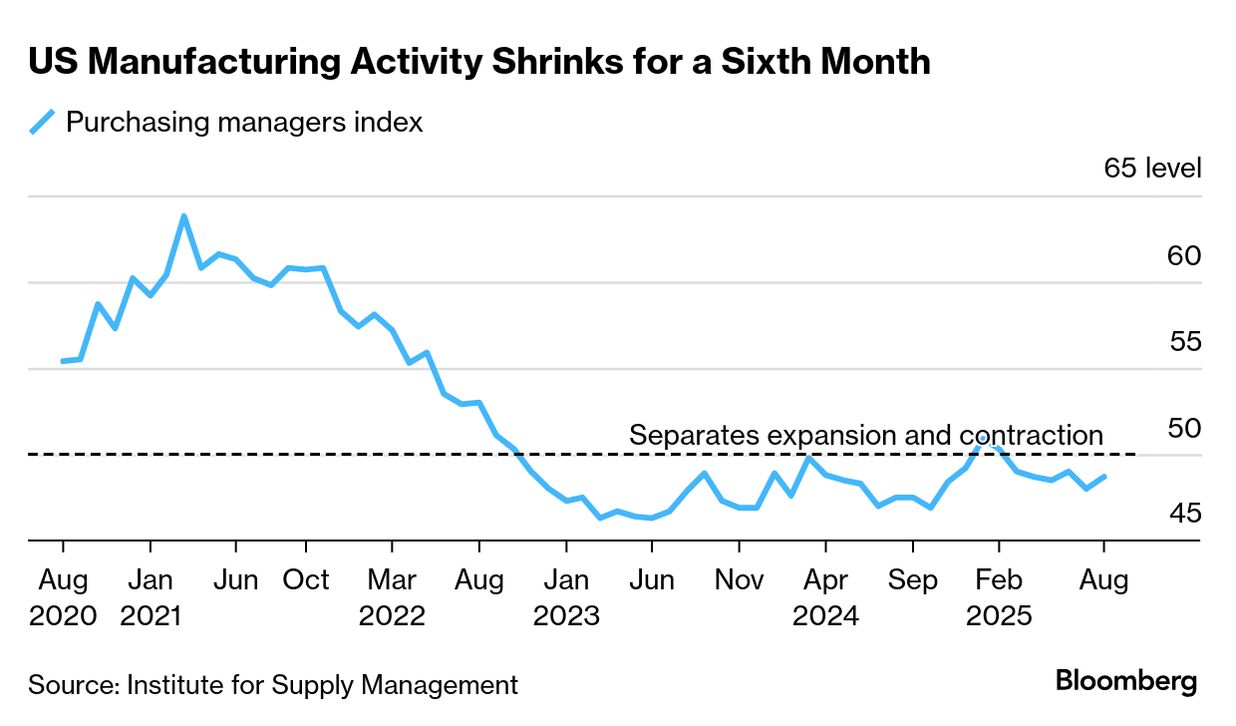
| US factory activity shrank in August for a sixth straight month, driven by a pullback in production that shows manufacturing remains bogged down by higher import duties tied to President Donald Trump's trade war. At the same time, there were a few positive signs. Orders expanded for the first time since the start of the year, with the ISM gauge of new bookings jumping 4.3 points, the largest increase since the beginning of 2024, to 51.4. A measure of prices paid for raw materials declined to 63.7—still elevated but the lowest since February. Still, the mixed report highlights the number of cross-currents facing the nation's producers. While still experiencing higher costs as a result of levy hikes, manufacturers appear to be benefiting from solid business investment and resilient household demand. But factories also are wrestling with supply chain disruptions related to Trump's scattershot tariff orders and retreats—and now a court ruling deeming most of his levies illegal. The ISM supplier delivery gauge showed delivery times lengthened last month. Also, the group's import index indicated a faster pace of contraction. Investors on Tuesday didn't like the look of things, and stocks and bonds took a dive. Here's your markets wrap. —Natasha Solo-Lyons and David E. Rovella | |
What You Need to Know Today | |
| |
| Anthropic has closed a deal to raise $13 billion from investors in a new funding round that nearly triples its valuation to $183 billion, including dollars raised—a larger-than-expected haul that makes the artificial intelligence company one of the most valuable startups in the world. | |
|
| A US judge on Tuesday ruled Trump's deployment of National Guard troops to Los Angeles during protests against his immigration raids violated federal law, just as the Republican threatens to use the military in other American cities led by Democratic mayors. The deployment violated a more-than century old statute—the Posse Comitatus Act—that restricts the use of federal troops to enforce domestic laws, US District Judge Charles Breyer held. Trump's justifications for the militarization of areas of Los Angeles and his use of armed soldiers in Washington DC have been based on false claims of widespread protest violence and skyrocketing crime, respectively. In the case of Washington, the government's own data showed a 30-year record low of violent crime in 2024. Opponents of Trump's historic deployment of military personnel among Americans in a non-emergency setting have condemned the actions as performative, meant to appeal to the GOP's base and normalize the sight of soldiers on American streets. | |
|
| |
|
| Chinese leader Xi Jinping used a mix of bonhomie and economic allure this week to send Trump a clear message: Beijing has too much global clout to be dictated to by Americans. Cameras captured the Chinese president in a rare, apparently unscripted chat on Monday with Kremlin leader Vladimir Putin and India's Narendra Modi at a summit in the Chinese port city of Tianjin. At one point, Xi held the hand of the Indian prime minister, as the three men laughed casually, a striking scene given just months earlier New Delhi and Beijing were seen as rivals. The gathering comes as decades of painstaking US diplomacy aimed at developing close ties with India—particularly as a counterweight to China—have been thrown into doubt as the 79-year-old Trump dropped onerous tariffs on New Delhi. At least one reason for the sudden shift, the New York Times reported, may have been tied to Trump's claim of credit for a recent ceasefire between India and Pakistan and the his pursuit of a Nobel Peace Prize. | |
|
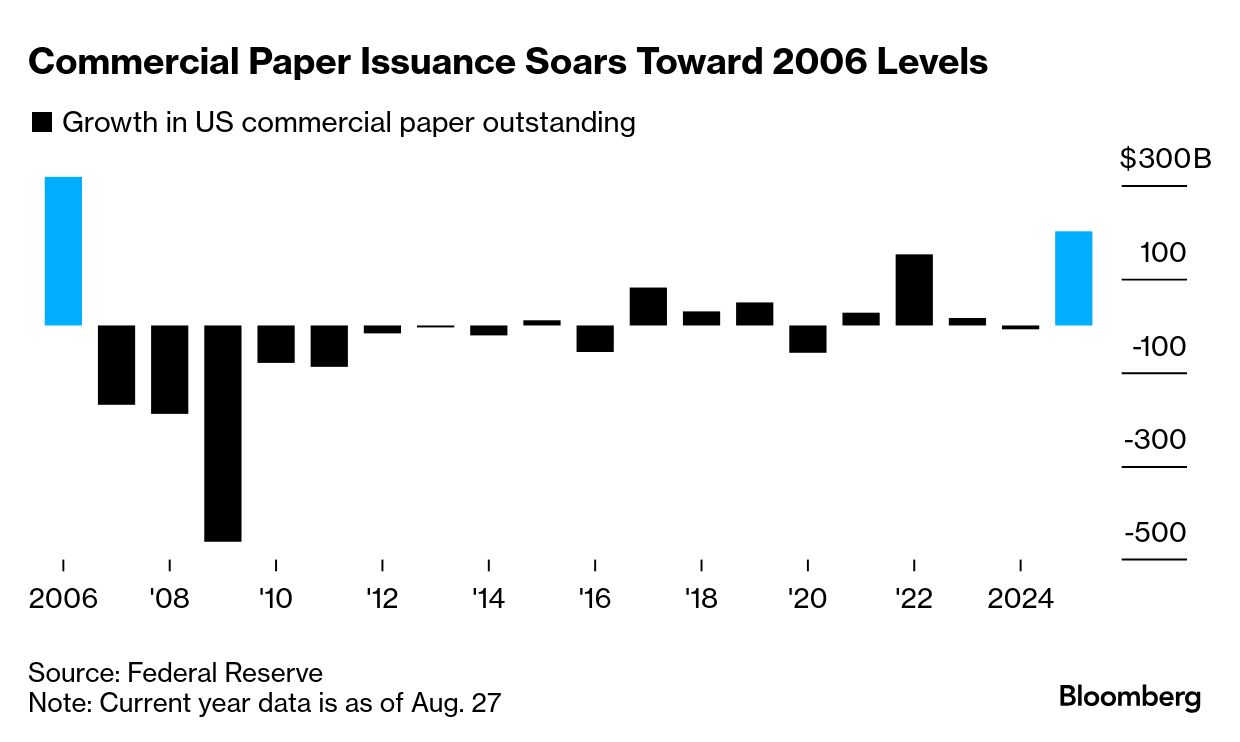
| Once a $2 trillion cornerstone of global finance, the US commercial paper market was left in disarray following the 2008 financial crisis. Now, after years in the shadows, it's staging an unexpected comeback. Uber rolled out a $2 billion commercial paper plan in June. That followed Netflix's $3 billion facility a month earlier. Coca-Cola, PepsiCo, Philip Morris International and Honeywell International have all tapped the market in recent months, selling billions of dollars worth of the short-term IOUs, which typically range in maturity from 30 to 90 days. The renewed embrace of commercial paper is fueling the biggest expansion in the market since 2006, and underscores just how dramatically corporate America has been shifting its funding mix. But of course, it's not without risks. | |
|
| Jane Street Group pulled in a record $10.1 billion in net trading revenue in the second quarter, beating out all of Wall Street's biggest banks as the market-making giant reaped the benefit of trade war volatility. The revenue figure is said to have more than doubled from a year earlier, pushing Jane Street's first-half trading revenue to an all-time high of $17.3 billion. | |
|
| |
What You'll Need to Know Tomorrow | |
| |
| |
| |
| Enjoying Evening Briefing Americas? Get more news and analysis with our regional editions for Asia and Europe. Check out these newsletters, too: Explore all newsletters at Bloomberg.com. | |
| |
Before it's here, it's on the Bloomberg Terminal. Find out more about how the Terminal delivers information and analysis that financial professionals can't find anywhere else. Learn more. Want to sponsor this newsletter? Get in touch here. | | | You received this message because you are subscribed to Bloomberg's Evening Briefing: Americas newsletter. If a friend forwarded you this message, sign up here to get it in your inbox. | | |

















No comments:
Post a Comment