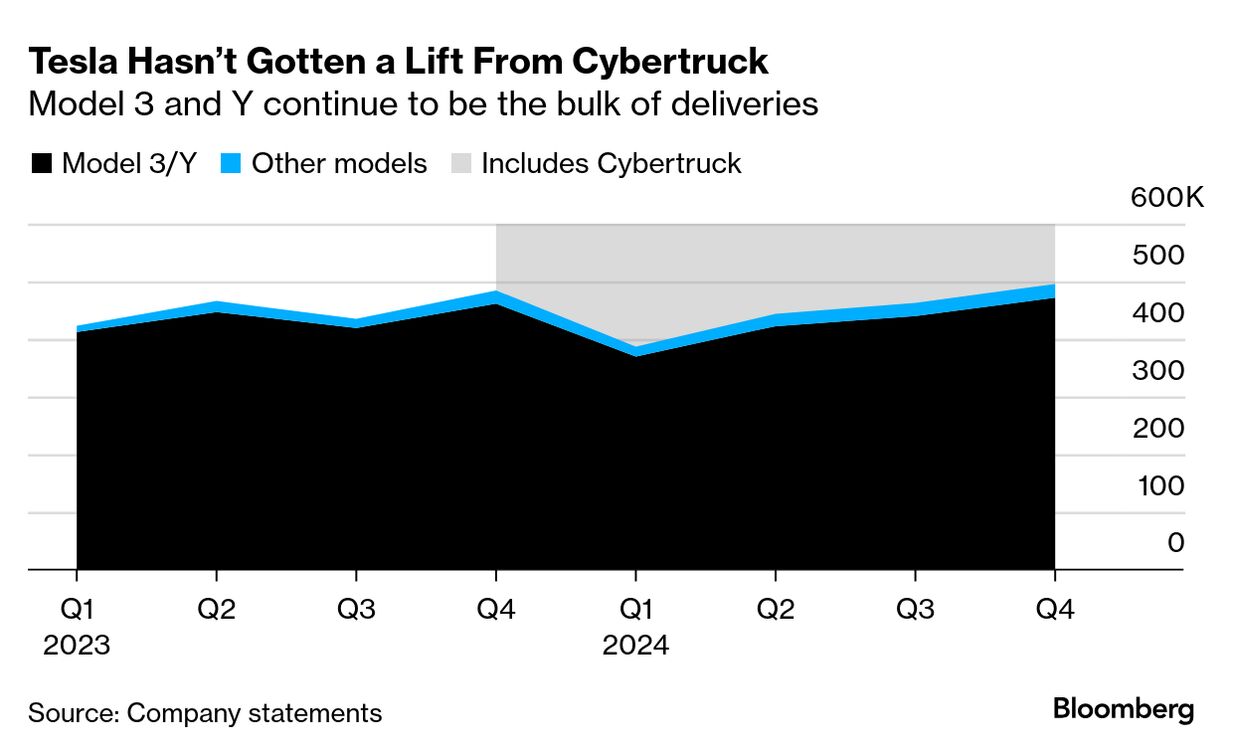
| Thanks for reading Hyperdrive, Bloomberg's newsletter on the future of the auto world. Musk's Pickup Is a Sales Letdown | A year and a half after Elon Musk first unveiled a Tesla Cybertruck prototype in November 2019, he allowed for the possibility the pickup wouldn't be a hit. "To be frank, there is always some chance that Cybertruck will flop, because it is so unlike anything else. I don't care," Musk wrote on what was then still called Twitter. "I love it so much even if others don't."  A Cybertruck inside a Tesla store in San Francisco in January. Photographer: David Paul Morris/Bloomberg More than two years after that post, Tesla finally started delivering Cybertrucks to customers. On Thursday, the world learned how many of the pickups the company has sold in the US, via unpleasant means — yet another safety recall. Tesla estimates that 1% of the 46,096 pickups it's calling back have a defect, according to a recall report filed with the US National Highway Traffic Safety Administration. Pieces of steel trim along the exterior of the Cybertruck are joined to the vehicle by an adhesive that's "susceptible to environmental embrittlement," the company said. Tesla says it will foot the bill for replacing the panels with ones that meet its durability requirements. But as of March 18 — the day the company submitted the recall report — the company had not yet corrected the issue in production. It expected to sort out the remedy on or around March 21. The Cybertruck has been remarkably recall-prone in the 15 months that it's been on the market — this is the eighth safety campaign the pickup has been a part of since launch. In fairness, some of these recalls have been over relatively minor issues, such as when Tesla ran afoul of a minimum font-size rule (yes, there is such a thing) in 2.2 million vehicles the company fixed early last year with an over-the-air software update. That issue and a defective tire-pressure monitoring system defect pertained to other Tesla models, too. But this is the second time Tesla has recalled its truck over trim pieces coming loose. The earlier instance was in June of last year, when the company recalled the model twice in one day (the other flaw had to do with windshield-wiper motor failures). Even the world's best automakers aren't immune from the occasional embarrassing recall. The wheels on Toyota's bZ4X coming loose when the company was first introducing the electric SUV in 2022 comes to mind. But the number of vehicles Tesla is recalling — over a year into Cybertruck having been on sale — also ought to be a source of chagrin. Cybertruck hasn't been a total disaster — it was the No. 5 best-selling EV last year, according to Kelley Blue Book — but Detroit's all-important lead in full-size pickups is safe. Ford's F-Series was the top truck line for the 48th straight year in 2024, with sales climbing 21%. Tesla has yet to crack the 50,000 sales threshold despite the company lathering perks and promotions onto early iterations of the pickup that seem to have been stuck on lots for months. Musk said in June of last year Tesla planned to stop making Foundation Series edition trucks "pretty soon." Early this month, the company started offering free Supercharging to move those pickups out of inventory. Musk seems to be more invested in metrics other than sales. "If something is cool, if it's a great product, like, show it to a kid, OK?" the CEO said during Tesla's annual meeting last year. "The kids got, like, no filter. Like, a five-year-old, six-year-old, something like that — or even a three-year-old. And say, which car do you like? Cybertruck. So it's like, that's how you know."  Thailand Prime Minister Paetongtarn Shinawatra with President Xi Jinping during her state visit to China on Feb. 6. Photographer: Xinhua News Agency/Xinhua News Agency The hollowing out of local economies in the American heartland helped lead to the rise of Donald Trump as a political force. Seeking to rebalance US-China trade and bring manufacturing jobs home, Trump imposed tariffs on China during his first term that were kept in place by the Biden administration. Chinese manufacturers priced out of the US had to search for alternative markets. Since 2017, many emerging economies have seen their purchases from China increase substantially, taking its manufactured goods trade surplus to historic heights. "This is China Shock 2.0 or China Shock 3.0," says Gordon Hanson, a professor of urban policy at the Harvard Kennedy School and one of the authors of the research paper that coined the name of the phenomenon. "China has this immense manufacturing capacity, and the goods have to go somewhere." The lesson from the US experience, he added, is that "there's a political response to all this. People get mad." | 










No comments:
Post a Comment