Monday, March 31, 2025

As rates descend, watch out for a tariff avalanche

To get John Authers' newsletter delivered directly to your inbox, sign up here. Liberation Day (or the imposition of US tariffs) is coming t
View in browser
Bloomberg

To get John Authers' newsletter delivered directly to your inbox, sign up here.

Today's Points:

Emerging Markets' Tariff Windfall 

This newsletter has been comparing the descent from high interest rates to mountaineering for more than a year. The analogy continues to work, but now needs a seismological addition.

The descent is more perilous than the climb. Coordination is vital, with tired climbers roping together for safety. Throughout last year, the story was of a halting and slow descent, with central banks steadily taking the risk of letting rates reduce. Now, with the descent well advanced but still incomplete, they must contend with the tariff earthquake triggered by President Donald Trump. In mountainous terrain, this could trigger landslides and avalanches.

Inflation never reached the heights of the 1970s that ignited Paul Volcker's infamous monetary policy tightening, which eventually turned out to be a masterstroke. By the turn of this year, post-pandemic inflation had been reduced to embers. While the disinflation process was frustratingly slow, and remained stubbornly above official targets, its direction of travel was not in doubt.

The geopolitical excitement of the last three months had surprisingly little effect. That's because tariff policy has remained unclear, and because the risks of both slower growth (which would require lower rates) and higher inflation (which would push for raising them) appear to have risen. With possible effects canceling out, it's not so surprising that expectations for central banks barely moved. The following chart shows the implicit policy rates discounted on the overnight index swaps market as of Dec. 31 and again on March 31, as calculated by Bloomberg's World Interest Rate Probabilities service:
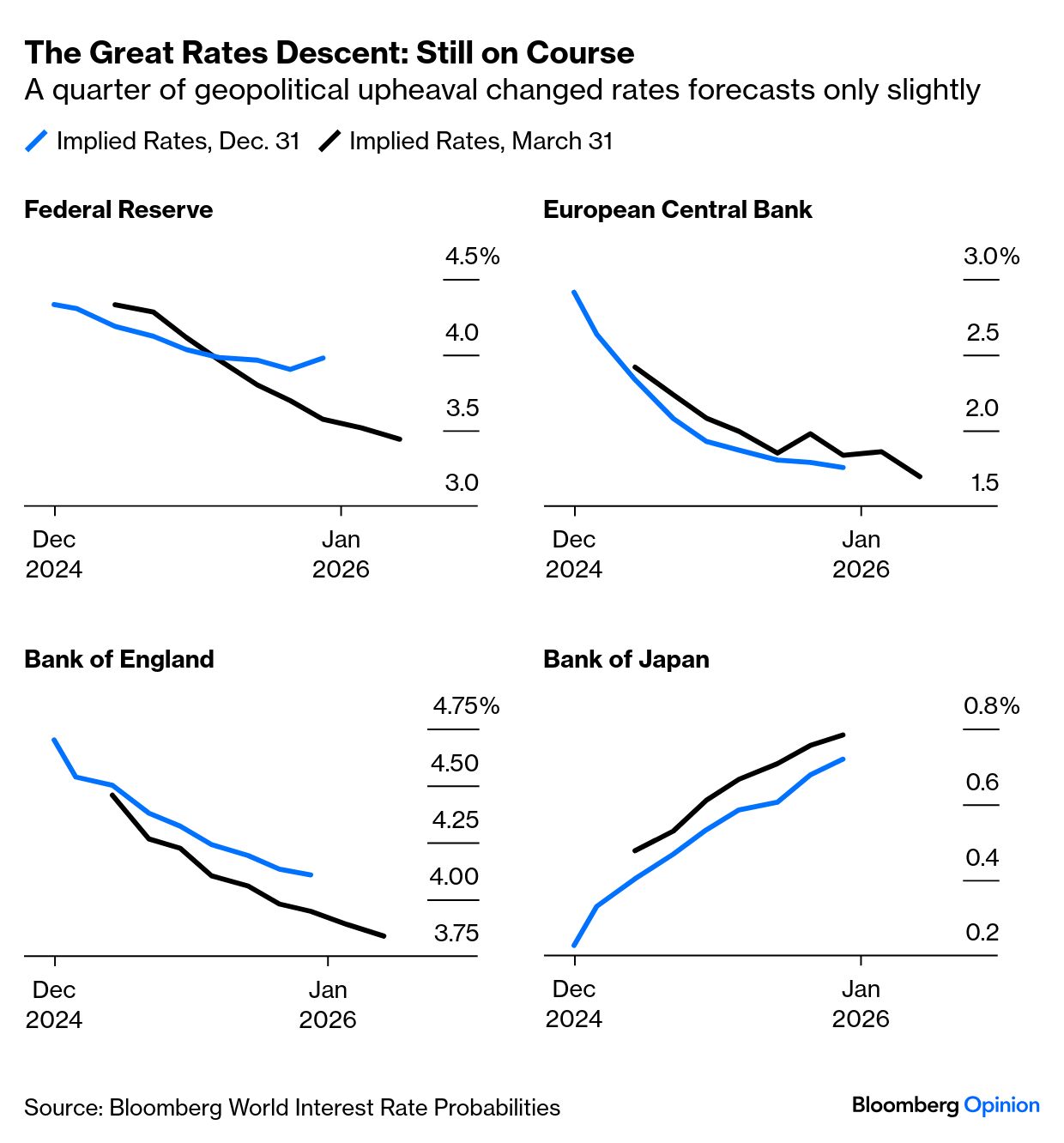
To some extent, the central bankers can't be expected to adjust their outlook to the new protectionist reality, as there's still no clarity on the magnitude and scope of tariffs. After Trump's promised "Liberation Day," Jerome Powell and his Federal Reserve colleagues could have to pivot swiftly. So far, though, it's noticeable that for all the sharp rises in consumer- and market-based inflation forecasts, US rates markets appear more worried about a slowdown than inflation; projected rates have fallen far more for the Fed than for other central banks.

That recession risk doesn't yet show up in employment data. Despite DOGE's decimation of the federal workforce under Elon Musk, jobs numbers have held up, but the ramifications of the restructuring could well be felt down the road. Further, consumer opinion surveys by the University of Michigan and the Conference Board are increasingly gloomy. This is dangerous. Oxford Economics' Bob Schwartz points out that disappointment is sending confidence to recession levels amid growing fears of higher inflation and deteriorating economic prospects. 

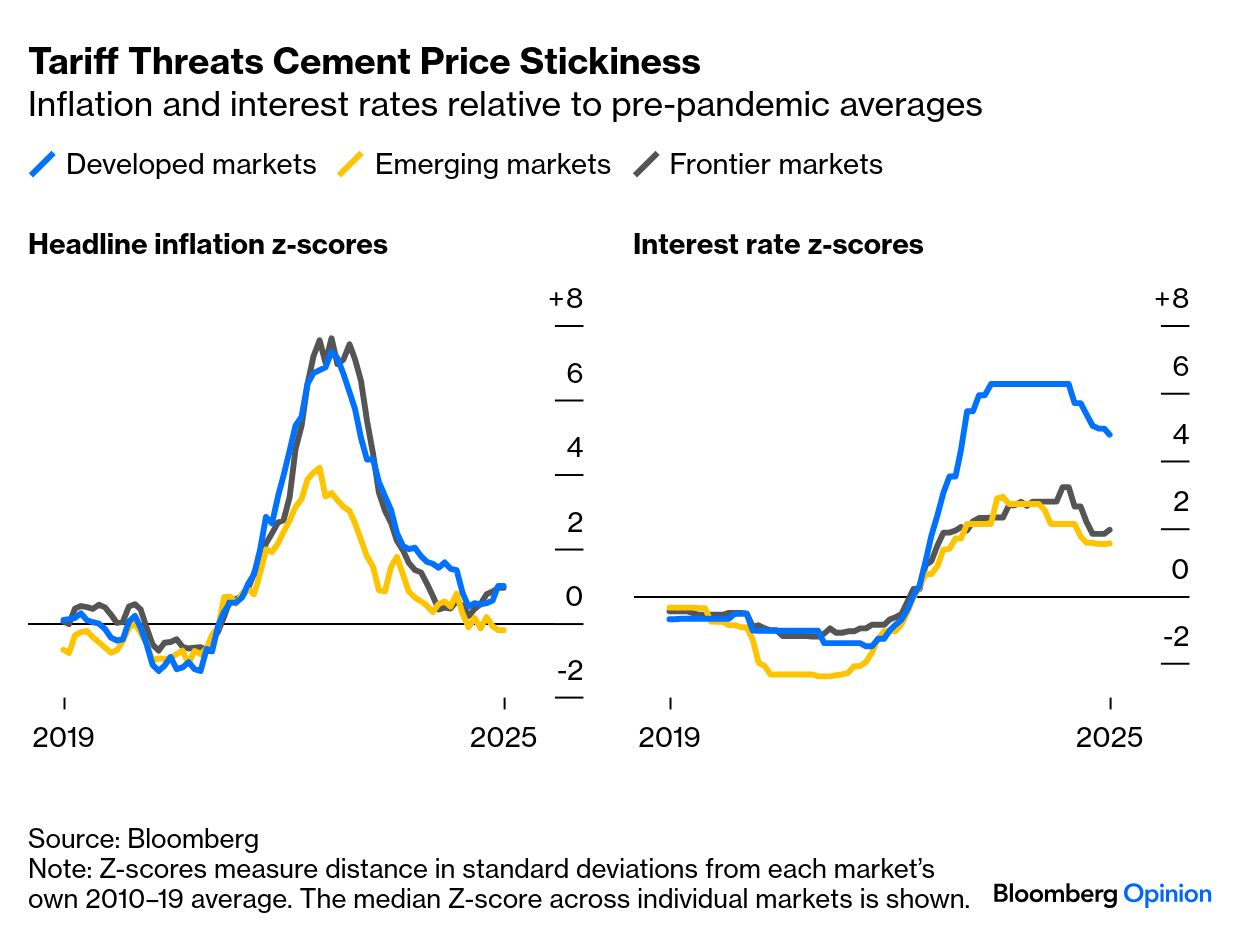
Powell's description of the potential passthrough effect of tariffs on prices as "transitory" doesn't help, as it contributes to worries that the Fed could let inflation get out of control again. It's also clear that in most cases, the pace of price rises remains outside central bankers' comfort zone. This is most true in the developed world. Although inflation in emerging markets has stalled, they're in a better place relative to developed markets, which, incidentally, were late out of the blocks in dealing with the post-pandemic surge.

The following chart employs the methodology this series has used in the past to show the impact in terms of standard deviations from the pre-pandemic norm, rather than in absolute terms. This shows an epic shock from inflation, and then a rate shock that felt far worse in developed markets. While inflation is approaching norms, rates are still very high by the standards of the the decade before Covid:

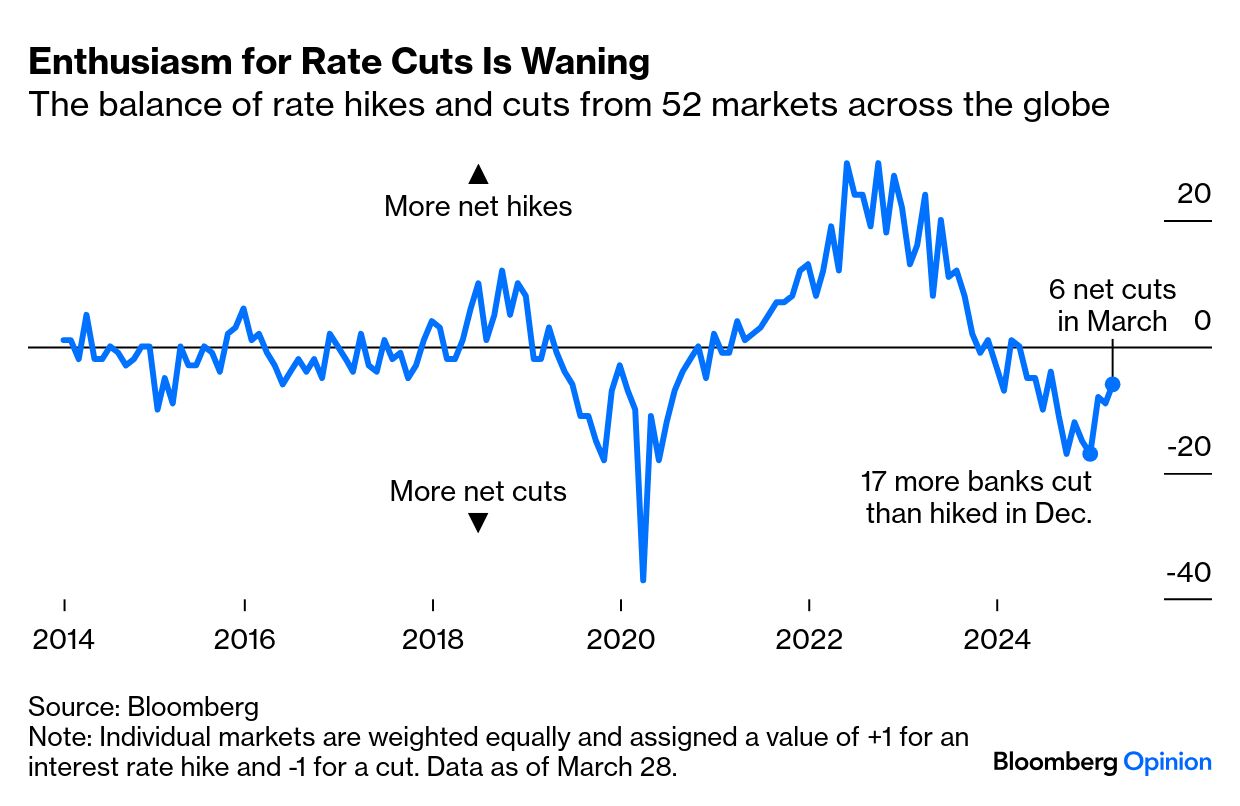
Despite this, progress on inflation hasn't turned into steadily lower rates. As this diffusion index shows, there have been more cuts than hikes in each month this year. But in March, there were only a net six cuts across the world, the fewest since last summer. The great descent from high rates hasn't halted or reversed, but it has slowed down sharply. And policy tightening is no longer regarded as an abnormality:

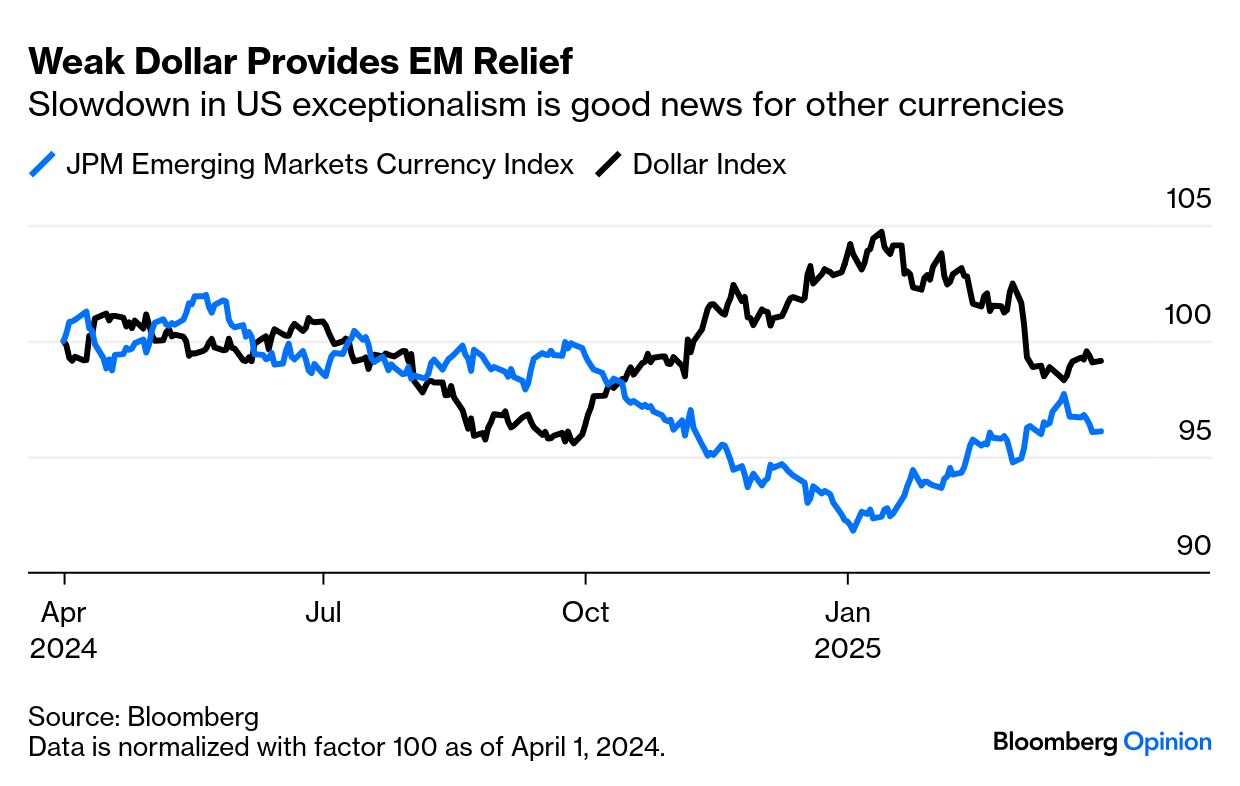
Emerging markets central banks had a proactive response to post-pandemic inflation, raising rates long before their developed counterparts. This might make them useful as harbingers of another turn upward — and so far, only Brazil and Turkey have hiked lending rates. They did so under idiosyncratic circumstances with only a loose connection to the uncertainty around potential tariffs. Plunges in their currencies forced them to act, rather than rising prices.

For the broader emerging markets, however, a weaker US dollar caused by the retreat from the US exceptionalism trade has had the happy side effect of propping up their currencies. That frees central banks from dilemmas over whether to intervene. This is how the JP Morgan Emerging Market Currency Index has fared since last year:

What is driving this? Gabriel Sterne, head of global strategy and EM research at Oxford Economics, argues that uncertainty over the US hasn't yet hit growth forecasts for emerging markets. American interests are affected by each policy flip-flop, while people in other countries, particularly those with few US trading ties, feel them only sporadically. It's possible there are risks lying in plain sight:

While it's indeed impressive how EM business and consumer confidence has held up, we think residents are ignoring some big risks. Most of these are to the downside, including further tariff announcements that may rock EM sentiment. It remains a good time to be defensive. Trump's policy noise may be so great that markets and survey respondents have adopted an over-zealous filter. 

Liberation Day could be the moment when emerging countries are forced to confront the new protectionism. It will also be an acute challenge for the Fed. Bill Dudley, former New York Fed president, describes as complacent markets' expectations that the Fed would intervene to stop "damage" wrought by the president. Bloomberg Opinion agrees that the Fed is not equipped to handle stagflation.

For now, the cautious descent continues without serious mishap. We need to find out the magnitude of the tariff earthquake, and scan the slopes for avalanches.  

— Richard Abbey and Carolyn Silverman

Sub-Marine French Politics

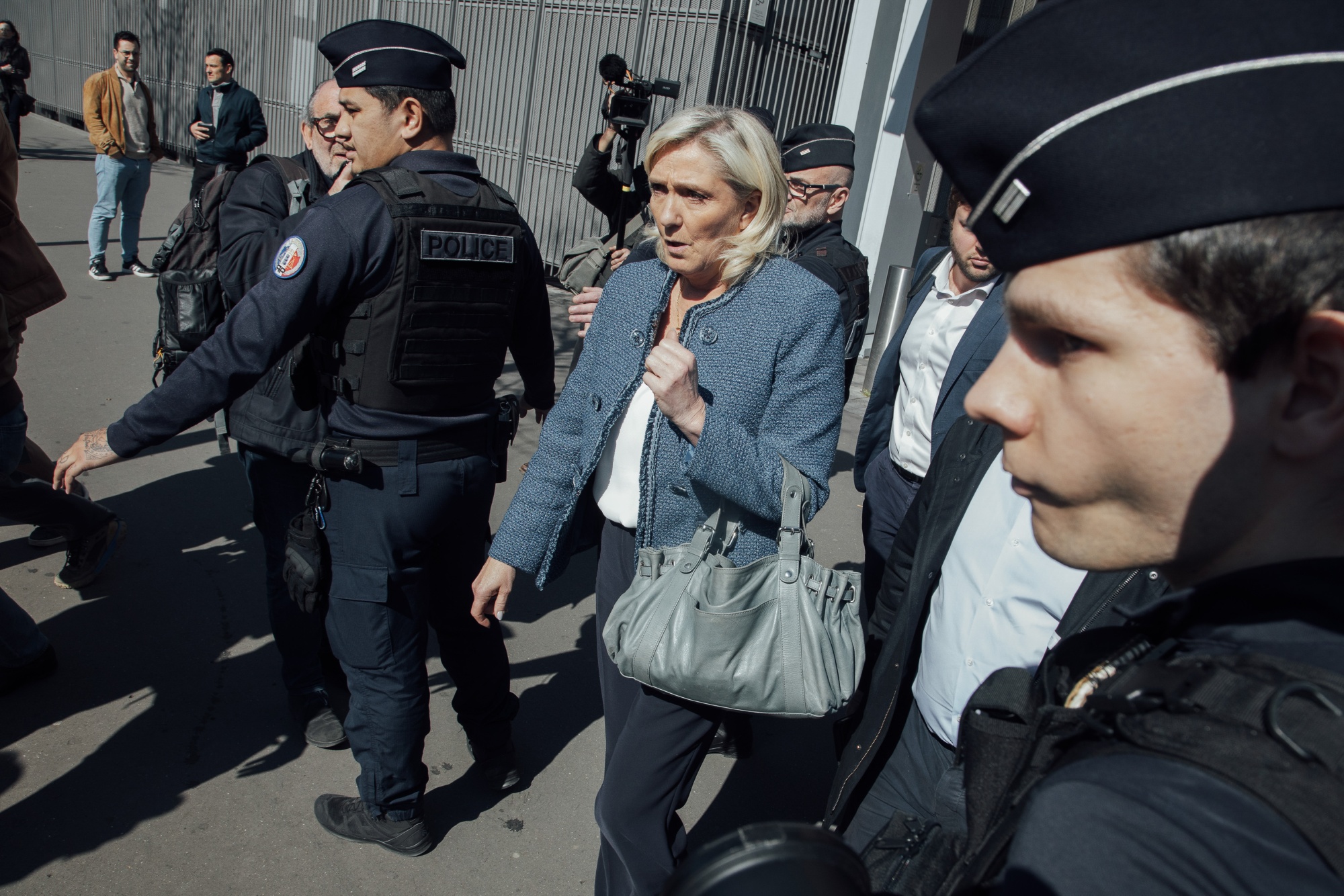
If French politics wasn't enough of a mess already, Monday brought the astonishing news that Marine Le Pen, leader of the hard-right Rassemblement National and currently leading polls for the presidential election in 2027, had been sentenced to a prison term and effectively barred from running. As with the various legal actions against Trump, there appears to be substance to her alleged offense, but the response seems drastic and political.

Le Pen called her sentence "unbelievable." Photographer: Cyril Marcilhacy/Bloomberg

Her reaction has been along the lines of a more emotionally controlled Trump, attacking the decision and denouncing it as political, but without lapsing into personal insults. She's a good politician, and her message will resonate. It's an extraordinary action that could transform French politics. The Rassemblement, and its previous incarnation as the Front National, have steadily grown in appeal and supporters will feel that the French elites have rigged the system against them.

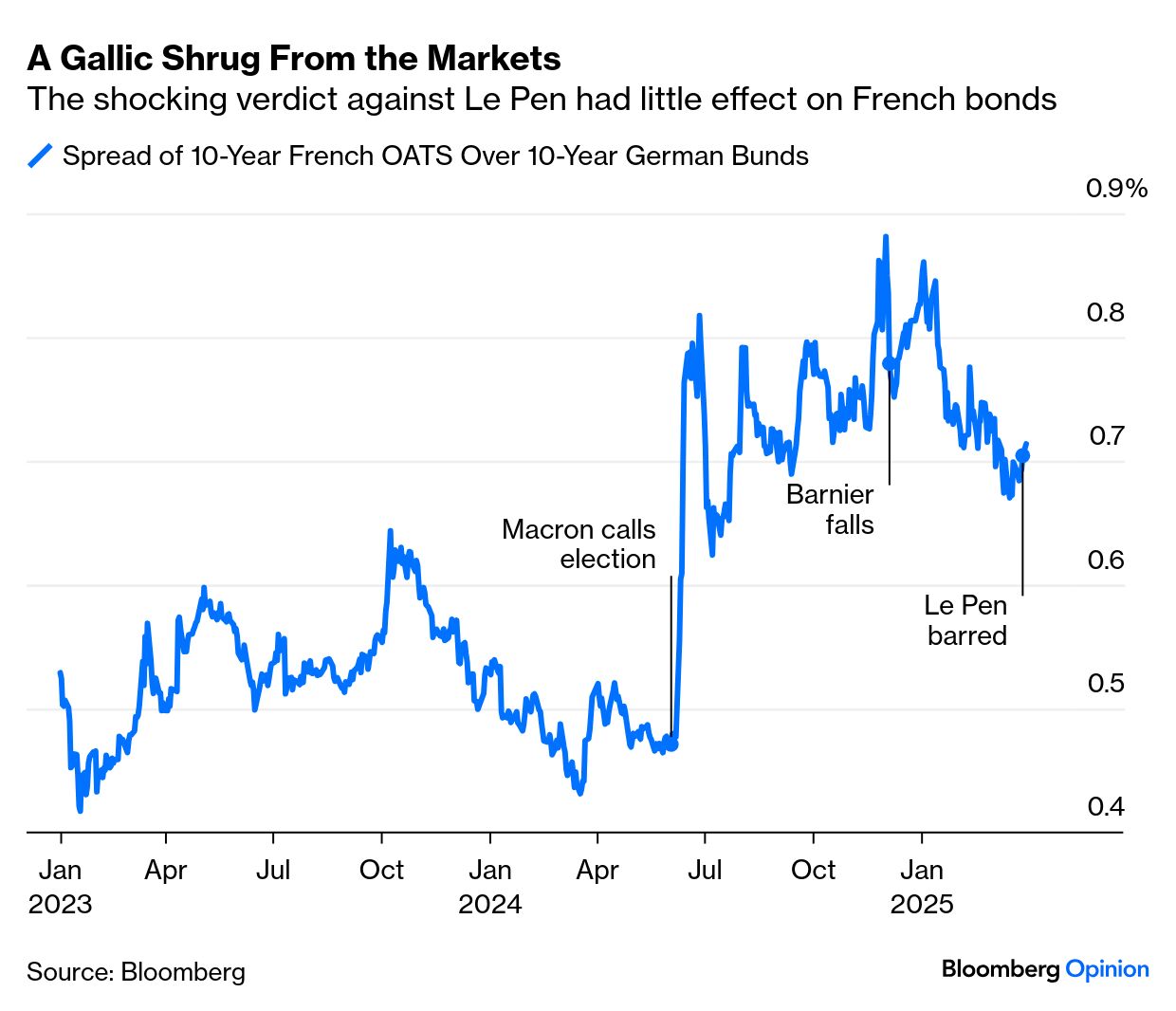
The judicial decision doesn't seem to have had much effect on markets. The spread of French 10-year OATS yields over equivalent German bunds ballooned last summer, after President Emmanuel Macron called snap elections that yielded a deadlocked legislature. It's never recovered, and grew even wider during the contretemps that brought down Michel Barnier, his first choice as prime minister. The Le Pen bombshell barely moved that spread:

Why the relative lack of concern? Here are some of the reasons:

  • France doesn't have to elect a president until 2027, unless Macron resigns (which he won't). With two years to wait, in an exceptionally uncertain environment, this seems like a risk so distant that there's little point in trying to price it.
  • The French risk premium was already very high and expectations for the next few months excruciatingly low. Nobody thought the budget would do anything more than muddle through.
  • This possibly does increase the risk that the Rassemblement brings down current Prime Minister Francois Bayrou — but nobody thought he would last long or get much done in any case.
  • Le Pen's exclusion may perversely improve her party's chances. There has been a Le Pen (father and daughter) on the presidential ballot for decades. They've never won and are neither fresh nor news. Her deputy, the 29-year-old Jordan Bardella, the enfant terrible of French politics, could now have two years to build himself up.
  • The geopolitical situation makes it unlikely that the rest of Europe would force any crisis over the French budget; unity is the watchword for now. 
  • There doesn't, as yet, appear to be any threat of civil disorder — and Le Pen probably grasps that her party's chances are better without it.
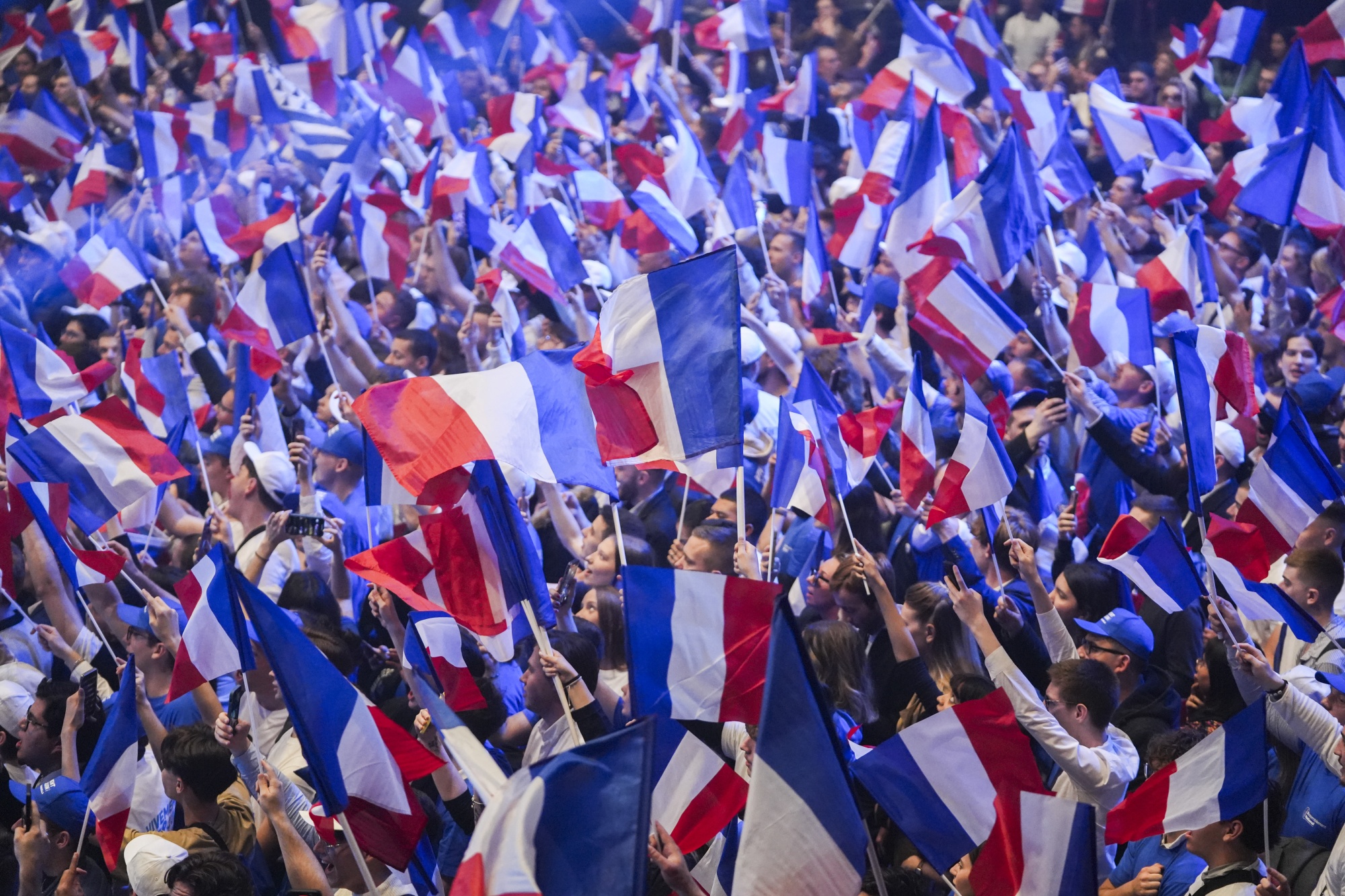
Le Pen supporters at an election rally last June. Photographer: Nathan Laine/Bloomberg

It's a shocking development. But in the French context, alas, things were terrible already. And the denouement of the presidential election is two years away, while Liberation Day is almost upon us. 

Survival Tips

It's time to say farewell to my old friend Gwen Robinson, the doyenne of foreign journalists covering finance in Asia, who has passed away from cancer at the cruelly young age of 65. Edward Luce, another former colleague at the Financial Times, wrote this beautiful obituary, which I recommend reading. A bundle of truculent energy, she lived hard, seemed to know everyone in the Asian financial world, and made for an exciting if exhausting colleague. I can't believe she's gone, but I strongly recommend to all of us that we live life full-on the way she did. 

More from Bloomberg Opinion:

Want more Bloomberg Opinion? OPIN. Or you can subscribe to our daily newsletter.

Like Bloomberg's Points of Return? Subscribe for unlimited access to trusted, data-based journalism in 120 countries around the world and gain expert analysis from exclusive daily newsletters like Markets Daily or Odd Lots.

Like getting this newsletter? Subscribe to Bloomberg.com for unlimited access to trusted, data-driven journalism and subscriber-only insights.

Want to sponsor this newsletter? Get in touch here.

You received this message because you are subscribed to Bloomberg's Points of Return newsletter. If a friend forwarded you this message, sign up here to get it in your inbox.
Unsubscribe
Bloomberg.com
Contact Us
Bloomberg L.P.
731 Lexington Avenue,
New York, NY 10022
Ads Powered By Liveintent Ad Choices

Brussels Edition: The storm after the verdict

The fragile peace in French politics looks increasingly unlikely to hold
View in browser
Bloomberg

Welcome to the Brussels Edition, Bloomberg's daily briefing on what matters most in the heart of the European Union.

The fragile peace in French politics that has allowed Emmanuel Macron's government to pass a budget for 2025 is looking increasingly unlikely to hold in the wake of the French court decision barring far-right leader Marine Le Pen from running in the country's 2027 presidential election. It augurs a new period of turbulence in Paris, possibly undermining efforts to stabilize France's creaky public finances and boosting anti-establishment rhetoric. Le Pen lashed out at the ruling, saying the rule of law had been "totally violated," while Donald Trump offered his backing, likening her legal woes to the prosecutions he faced before retaking power. The court decision also puts a spotlight on the largely untested 29-year-old Jordan Bardella, the de-facto candidate to replace Le Pen on the presidential ticket and the person who could take control of the party she has shaped

Max Ramsay

What's Happening

Pausing Cuts | Several European Central Bank officials are still wavering on whether to cut interest rates next month, we're told. It suggests the bank's next monetary policy decision remains far more open than investors are betting, with traders pricing a more than 80% chance that borrowing costs will be lowered once again on April 17. 

Tariff Countdown | The clock is ticking down to President Donald Trump's so-called liberation day, when the US is due to impose tariffs on a broad swath of global trade. Financial markets are already rattled and officials in world capitals are fretting the policies could spark a recession and even hasten the end of a post-war order. Here's our deep dive on what it means for Europe and the global economy. 

Frozen Assets | Spain is calling on the EU to move ahead with a discussion about seizing Russia's frozen central bank assets. We're told the country wants the bloc to consider legal options that would allow the use of the assets to support Kyiv militarily, as well as to provide compensation for the destruction that Russian forces have wrought.

Defense Investments | Allianz Global Investors will allow previously banned defense-related assets to be held in some ESG funds, a move it says reflects the new geopolitical reality gripping Europe. The changes apply to most of AGI's mutual funds classified as Article 8, an EU designation that requires asset managers to "promote" environmental, social and governance goals.

Around Europe

Bright Spot | Polish stocks are set to be Europe's best performers, powered by a big boost in dividends, in what has been a historic quarter of outperformance for the region's equities. Across the continent, defense stocks have dominated the gains, with some investors predicting more to come. 

Market Meddling | Hungarian stocks and bonds slid after the government expanded its interventions in the economy in a bid to revive growth and curb inflation ahead of next year's election. The country's economy minister proposed to freeze costs that Hungarian banks charge their clients and spoke about "voluntary" price cuts by telecoms companies.

Sahel Focus | Spain is urging EU foreign affairs chief Kaja Kallas to strengthen the bloc's engagement with Africa's Sahel region as part of a broader defense review, we're told. Madrid wants more focus on the region, which has seen radical Islamist movements become increasingly active in recent years and Russian mercenaries supporting some military-led governments. 

Over Budget | Austria won't be able to avoid being reprimanded by the EU for running an outsized deficit, according to the country's finance minister, after it reached 4.7% in 2024. The government is set to abandon ambitions to dodge the EU's so-called excessive-deficit procedure, one of few specific targets set down in a three-party coalition agreement last month. 

Chart of the Day

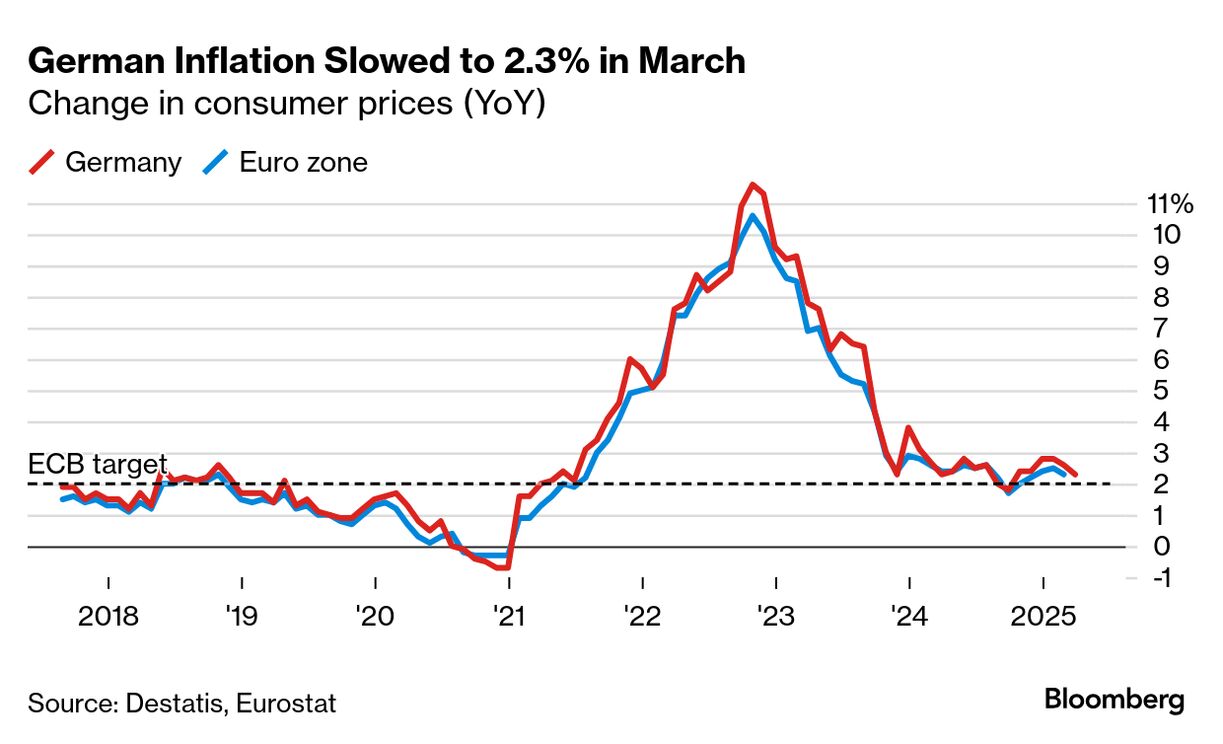
German inflation slowed more than anticipated in March, advancing 2.3% from a year ago. That brings the rate closer to the ECB's 2% target. Readings last week showed inflation in France and Spain were also slower than analysts had estimated, but in Italy inflation edged above 2% for the first time since 2023, driven by energy and food. Data for the entire 20-nation euro area comes later this morning. 

Today's Agenda

All times CET

  • 9 a.m. Commission President Ursula von der Leyen, Council President Antonio Costa take part in European Parliament debate in Strasbourg
  • 1 p.m. EU foreign affairs chief Kaja Kallas speaks on EU foreign and security policy at the European Parliament in Strasbourg
  • 2:30 p.m. National Rally's Jordan Bardella speaks at a press conference in Strasbourg
  • 3 p.m. EU Vice President Henna Virkkunen and migration commissioner Magnus Brunner hold news conference on new  European Internal Security Strategy
  • 3:30 p.m. EU Vice President Raffaele Fitto holds news conference on mid-term review of EU's cohesion policly

Like the Brussels Edition?


Don't keep it to yourself. Colleagues and friends can sign up here.

How are we doing? We want to hear what you think about this newsletter. Let our Brussels bureau chief know.
Follow Us

Like getting this newsletter? Subscribe to Bloomberg.com for unlimited access to trusted, data-driven journalism and subscriber-only insights.

Want to sponsor this newsletter? Get in touch here.

You received this message because you are subscribed to Bloomberg's Brussels Edition newsletter. If a friend forwarded you this message, sign up here to get it in your inbox.
Unsubscribe
Bloomberg.com
Contact Us
Bloomberg L.P.
731 Lexington Avenue,
New York, NY 10022
Ads Powered By Liveintent Ad Choices

They’ve been wrong about options this whole time

You don't need a 10% move anymore Sponsored ...