Wednesday, July 31, 2024

Supply Lines: WTO trade outlook

(Editor's Note: Hello and thanks for reading Supply Lines! We're taking a summer hiatus starting tomorrow and will return to your inboxes on

(Editor's Note: Hello and thanks for reading Supply Lines! We're taking a summer hiatus starting tomorrow and will return to your inboxes on Monday Aug. 12.)

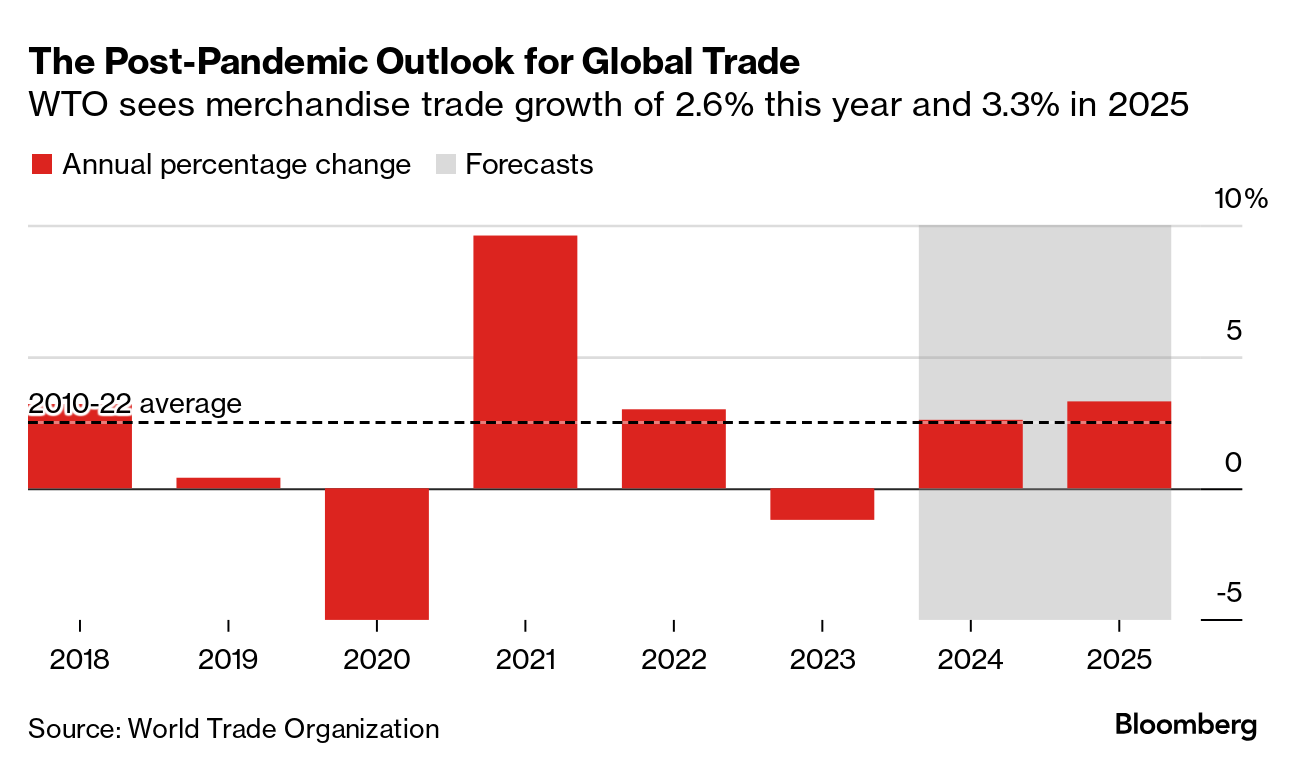
The WTO reiterated its expectation that merchandise trade growth is on track this year to exceed the longer-term annual average and is poised to accelerate heading into 2025.

The recovery from last year's slump in goods trade is patchy geographically, with Asia serving as the biggest engine of exports and imports, according to the World Trade Organization's annual report released Tuesday.

"The outlook for 2025 is more positive, with all regions contributing to export and import growth, although there is much more uncertainty associated with longer-term projections," the report said.

Services trade, especially digital commerce and travel, is growing much faster, it said.

Read More: WTO Members Signal Progress on Draft E-Commerce Deal

This comes despite economies that are struggling with wars and diplomatic tensions, the climate crisis and the rise of protectionism. "These are troubling times for global trade," WTO Director-General Ngozi Okonjo-Iweala said in the report.

Among the headwinds and uncertainties for the future is the way countries with foreign-policy differences are trading less with each other and more with their allies.

"The data suggest that after years of talk of decoupling, trade may be starting to fragment along geopolitical lines," the WTO said.

It was the second time in the past week that a European institution explored how trade flows are increasingly being redirected by geopolitical alignment.

Read More: Shipping Strains Spark Fears of an Inflation Comeback

A study from the European Central Bank, by authors Costanza Bosone and Giovanni Stamato, said a 10% increase in geopolitical distance between two countries — measured by the UN General Assembly votes — resulted in a 2.5% drop in their bilateral trade flows from 2012 to 2022.

Although the increasing friction between the US and China makes up a fair share of the effect, the results still indicate a broader effect on trade patterns for 63 observed countries. The paper finds that the impact of geopolitics is stronger in advanced compared with emerging economies.

Marilen Martin in Frankfurt

Click here for more of Bloomberg.com's most-read stories about trade, supply chains and shipping.

Charted Territory

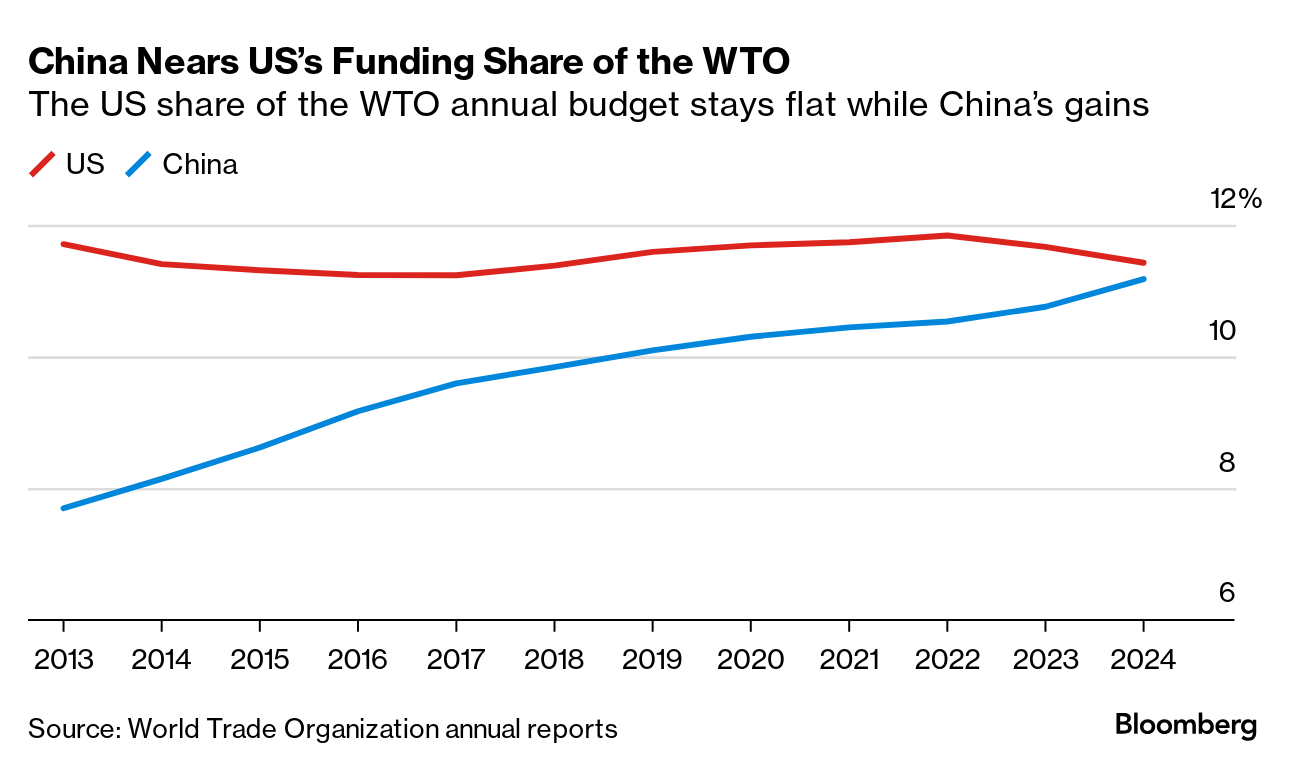
Gaining on US | Among the more interesting trends in the WTO's 2024 annual report is comparing the share of funding from the US and China for the Geneva-based organization's overall budget. The US's 11.4% is still higher than Beijing's share this year, but only barely and the gap has steadily narrowed in recent years. Collectively, the 27 economies of the European Union account for 31% of total assessments this year. The WTO secretariat employs about 600 people with a 2024 budget of $205 million.

Today's Must Reads

  • China's factory activity contracted for a third straight month in July, leaving the economy on a weak trajectory that's frustrating Beijing's efforts to sustain faster growth. Meanwhile, Japan's factory output dropped in June.
  • Mexico's economic growth unexpectedly slowed in the second quarter compared to the previous three-month period, as double-digit interest rates cooled demand.
  • Eurazeo is considering a sale of Elemica in a deal that could value the supply-chain software provider at more than $1 billion.
  • Italian Prime Minister Giorgia Meloni said she's "very satisfied" with her trip to China, the culmination of a charm offensive she mounted after snubbing the country's flagship Belt and Road initiative last year.
  • Airbus finds itself in a situation where it can't build aircraft fast enough to satisfy demand for fuel-efficient jets. Watch CEO Guillaume Faury discuss the company's space and defense businesses, supply chain issues and the interest-rate environment.
  • Major companies can bolster efforts to calculate Scope 3 emissions by helping entities across their supply chains build capacity to provide better data, according to Singapore Post.

On the Airwaves

Coming Up

Bloomberg Supply Chain Intelligence Webinar Series: Unpredictability in global politics, industrial policies, financial markets and climate patterns have heightened the need to understand the intricacies of supply chains – and pinpoint where risk lies. The goal of this series is to shine a spotlight on major trends and issues that are shaping global supply chains and how these trends are impacting corporations and investors in those corporations. Register here

On the Bloomberg Terminal

  • The prolonged crisis in the Red Sea has provided an earnings opportunity for Maersk and has masked weak supply-demand dynamics facing the liner industry, according to Bloomberg Intelligence.
  • Bolivian trucker unions launched an indefinite strike with road blockades to protest a fuel shortage in the country, according to a document sent by a union leader via text message.
  • Run SPLC after an equity ticker on Bloomberg to show critical data about a company's suppliers, customers and peers.
  • Use the AHOY function to track global commodities trade flows.
  • See DSET CHOKE for a dataset to monitor shipping chokepoints. 
  • For freight dashboards, see {BI RAIL}, {BI TRCK} and {BI SHIP} and {BI 3PLS}
  • Click HERE for automated stories about supply chains.
  • On the Bloomberg Terminal, type NH FWV for FreightWaves content.
  • See BNEF for BloombergNEF's analysis of clean energy, advanced transport, digital industry, innovative materials, and commodities.

Like Supply Lines?

Don't keep it to yourself. Colleagues and friends can sign up here. We also publish Economics Daily, a briefing on the latest in global economics.

For even more: Follow @economics on Twitter and subscribe to Bloomberg.com for unlimited access to trusted, data-driven journalism and gain expert analysis from exclusive subscriber-only newsletters.

How are we doing? We want to hear what you think about this newsletter. Let our trade tsar know.

No comments:

Post a Comment