Friday, June 30, 2023

ChatGPT, but for climate

Speeding up the hunt for new materials

Today's newsletter looks at how a small but growing number of startups are trying to use AI in the hunt for new clean tech materials. You can read and share the full version of this story on Bloomberg.com. Subscribe to Bloomberg for unlimited access to climate and energy news, and to receive Bloomberg Green magazine.

AI eyes new materials

By Mark Bergen

Ever since ChatGPT went viral last fall, companies have touted many ways artificial intelligence can make our lives easier. They've promised superhuman virtual assistants, tutors, lawyers and doctors.

What about a superhuman chemical engineer?

London-based startup Orbital Materials would like to create just that. The startup is working to apply generative AI — the method behind tools like ChatGPT — expressly for accelerating the development of clean energy technologies. Essentially, the idea is to make computer models powerful and sharp enough to identify the best formulas for products like sustainable jet fuel or batteries free of rare-earth minerals.

Jonathan Godwin, an Orbital Materials co-founder, imagines a system that's as accessible and effective as the software engineers use today to model designs for things like airplane wings and household furniture.

"That, historically, has just been too difficult for molecular science," he said.

Photographer: Josep Lago/AFP via Getty Images

ChatGPT works because it's adept at predicting text — here's the next word or sentence that might make sense. For the same idea to work in chemistry, an AI system would need to predict how a new molecule would behave, not just in a lab but in the real world. For many materials needed to decarbonize the planet, the technology isn't there yet.

It can take decades for a new advanced material to move from discovery to the market. That timeline is way too slow for the businesses and nations looking to rapidly cut emissions as they race to meet net zero targets. 

Before launching Orbital Materials, Godwin spent three years researching advanced material discovery at DeepMind, Google's AI lab. That lab released AlphaFold, a model to predict protein structures that could speed up the search for new drugs and vaccines. That, coupled with the rapid takeoff of tools like ChatGPT, convinced him that AI would soon be capable of conquering the material world. 

"What I thought would take 10 years was happening in a matter of 18 months," he said. "Things are getting better and better and better."

Godwin compares his method with Orbital Materials to AI image generators like Dall-E and Stable Diffusion. Those models are created using billions of online images so that when users type in a text prompt, a photorealistic creation appears. Orbital Materials plans to train models with loads of data on the molecular structure of materials. Type in some desired property and material — say, an alloy that can withstand very high heat — and the model spits out a proposed molecular formula.

National climate policy gets attention but local and regional governments can make a huge difference, especially in larger countries. This week on Zero, Akshat Rathi speaks with three US governors – Jay Inslee of Washington, Michelle Lujan Grisham of New Mexico and Eric Holcomb of Indiana – about how they navigate partisan politics and the need for climate action. Are they taking the right steps to make sure the US economy decarbonizes on time? Find out on this week's episode of Zero — and subscribe now on AppleSpotify, or Google to get new episodes every Thursday.

In theory, this approach is effective because it can both imagine new molecules and measure how they will work, said Rafael Gomez-Bombarelli, an assistant professor at MIT, who advised Orbital Materials. (He said he is not an investor.)

Some researchers, like those at the University of Toronto, have set up "self-driving labs" that pair AI systems with robots to search for new materials at unparalleled speeds. Dutch startup VSParticle makes machinery used to develop components for gas sensors and green hydrogen.

Think of it like a DNA sequencer in a genomics lab, said co-founder van Vugt, who believes his equipment can help shorten the 20-year time horizon of advanced materials to one year, and, eventually, "a couple of months." His company is currently raising investment capital.

Orbital Materials, which raised $4.8 million in previously undisclosed initial funding, is planning to start with turning its AI gaze toward carbon capture. The startup is working on an algorithmic model that designs molecular sieves, or tiny pellets installed within a device that can sift CO2 and other noxious chemicals from other emissions, more efficiently than current methods. (Godwin said the startup, which has several AI researchers, plans to publish peer-reviewed results on this tech soon.) Carbon capture has failed to work at the scale needed, though thanks to a slew of government incentives, particularly in the US, interest in deploying the technology is rapidly ramping up. 

Eventually, Godwin said Orbital Materials would like to move into areas like fuel and batteries. He imagines mirroring the business model of synthetic biology and drug discovery companies: develop the brainpower, then license out the software or novel materials to manufacturers.

But getting the AI right is only half the battle. Actually making advanced materials in areas like battery and fuel production requires working with huge incumbent enterprises and messy supply chains. This can be even costlier than developing new drugs, argued MIT's Gomez-Bombarelli. 

"The economics and de-risking make it just way harder," he said.

Click here to read the full version of this story on Bloomberg.com. 

Sometimes you don't need AI

$3.7 million
The cost of an experiment simulating mass timber buildings' ability to withstand earthquakes. Engineers didn't need AI to land on the low-carbon building material.

Does AI have a dirty secret?

"We're talking about ChatGPT and we know nothing about it. It could be three raccoons in a trench coat."
Sasha Luccioni
Researcher at AI company Hugging Face Inc.
While AI could help address climate change, training and using the models behind it use a massive amount of electricity. Just how much, though, is largely unknown. 

More from Green

The carbon removal industry is at a turning point. As more and more buyers commit millions of dollars to this still mostly unproven field, they're starting to demand proof that companies are delivering on those promises. This means the three most important words in carbon removal today are monitoring, reporting and verification (MRV), or the process of measuring how much CO2 has actually been removed, reporting the results to a third party and verifying that what was purchased was actually delivered. It's an incredibly complex process to pull carbon dioxide from the air, and every technique poses a unique set of MRV challenges. 

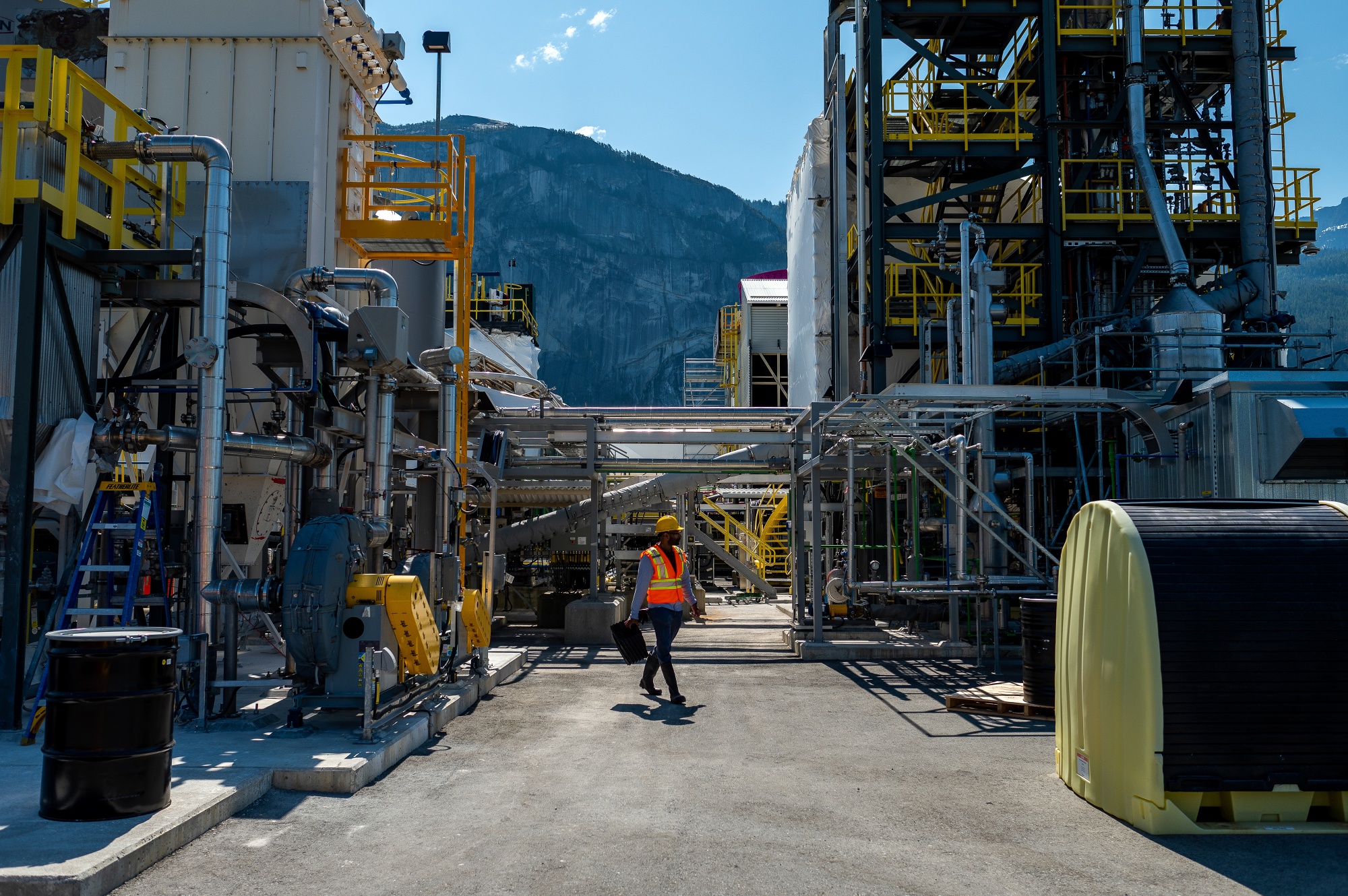
A worker walks through the Carbon Engineering Innovation Centre, a direct air capture research and development facility, in Squamish, British Columbia, Canada. Companies trying to pull carbon from the air are increasingly being asked to prove what they do and rely on a process known as monitoring, verification and reporting or MRV. Photographer: James MacDonald/Bloomberg

Turmoil continues in the UK. Climate Minister Zac Goldsmith quit Rishi Sunak's government on Friday, accusing the prime minister of retreating from environmental pledges. Meanwhile, the UK is heading for a potential water sector crisis and new figures show customers' bills are soaring

Biden rebuffs environmental activists' bid. The administration formally rejected a request to phase down oil and gas production on federal lands and waters, marking its latest nod to the endurance of fossil fuels in a warming world.

Asset managers don't normally do this: Apollo Global Management Inc. has for the first time revealed the carbon emissions linked to some of its investments, a rare step underlining the financial industry's plodding progress in making such disclosures.

Chocolate bars may get pricier. The EU is introducing laws that ensure that commodities aren't grown on deforested land. No. 2 cocoa grower Ghana has warned that buyers should be ready to pay more because of the investment needed to set up systems tracking beans back to farms.

Weather watch

By Brian K. Sullivan

Tropical Storm Beatriz will likely become a hurricane Friday along Mexico's Pacific coast where it could make landfall or at least menace the shoreline near Manzanillo, a large container port, the US National Hurricane Center said.

Beatriz is going to move over very warm water that will fuel its strength and possibly cause it to rapidly intensify, Jack Beven, a senior hurricane specialist at the center wrote in his forecast.

Its winds have already gained about 20 miles per hour in power in the last 12 hours rising to 60 mph in a 5 a.m. New York time advisory. Beatriz is forecast to become a Category 1 hurricane later, with its winds peaking at 80 mph on Saturday.

Rapid intensification is when a storm's maximum winds grow in power by at least 35 miles (56 kilometers) per hour in 24 hours. While this is a natural phenomenon, recent studies have shown rapid intensification has become more common in the last 30 years as the climate warms.

Beatriz is forecast to bring 3 to 5 inches of rain, with some areas getting as much as 8 inches, across southern Mexico. In addition, coastal areas could be hit by flooding storm surge and winds could damage buildings and cause power outages.

After it rides along Mexico's Pacific coast, it should weaken and could make a second strike at the southern tip of Baja California.

Meanwhile, the worst of the heat has shifted out of Texas into lower Mississippi River Valley. Excessive heat warnings and advisories have all shifted into Louisiana, Arkansas, Mississippi, Alabama, Missouri, Tennessee, Kentucky and Illinois. Memphis could get to 101F with a heat index of 115. 

Heat across the US isn't confined to the central US, however. California and the Pacific Northwest will face blistering temperatures through the weekend. The high in Sacramento is forecast to reach 107F on Saturday.

In other weather news: 

Smoke: New York City awoke Friday to poor air quality as Canadian wildfire smoke continues to seep south and east across the US, but conditions should gradually improve over the weekend. 

Europe: Temperatures are set to drop across large parts of western Europe this weekend as a cold front moves through Friday, bringing unsettled weather conditions, according to forecaster Maxar. Separately, meteorologists surveyed by Bloomberg said hot temperatures are set to return to northwest Europe in July, at a time when some parts of the continent are already under drought warning.

No comments:

Post a Comment

hillbilly AI? (inside a $100 trillion breakthrough)

Legendary investor Louis Navellier has found money-making opportunities for 40+ years by finding specific stocks that win regardless of wh...