| The stunning scenes emerging from across China over the weekend — ranging from hundreds of protestors chanting for freedom in the streets to neighbors banding together to stop officials from locking down their housing compounds -- are extraordinary in an authoritarian country where people can face grave danger for speaking out. From the perspective of my team of health reporters, who've been covering this pandemic since rumors of a mystery pneumonia in Wuhan emerged in December 2019, the outcry is also the culmination of the Chinese government's strategic missteps in handling Covid-19 — most damningly, a failure to adapt to an ever-mutating virus. China's stance on the coronavirus is well-documented. After the Wuhan crisis in which thousands died in early 2020, it ushered in a Covid Zero playbook that has largely held until now: mass testing and strict curbs whenever a flareup occurred, comprehensive contact tracing, and lockdowns to quickly stamp out spread. The principle was that all of society must play a part in sacrificing daily freedoms — and some economic growth — to protect people's lives. The scenes of devastation in Western countries strengthened this resolve and hardened it into ideology. It worked, and worked well, for a long time. China's per capita death toll is far lower than anywhere else, no mean feat for such a vast and underdeveloped country. For much of 2020 and 2021, as the rest of the world grappled with the virus, life in many parts of China was a virus-free paradise. But as the virus evolved and adapted, along with the ability to fight it with groundbreaking vaccines, China did not. While the rest of the world opened up, and countries like Singapore and South Korea did so with minimal fatalities thanks to extensive vaccination campaigns, China continued acting like it was 2020. 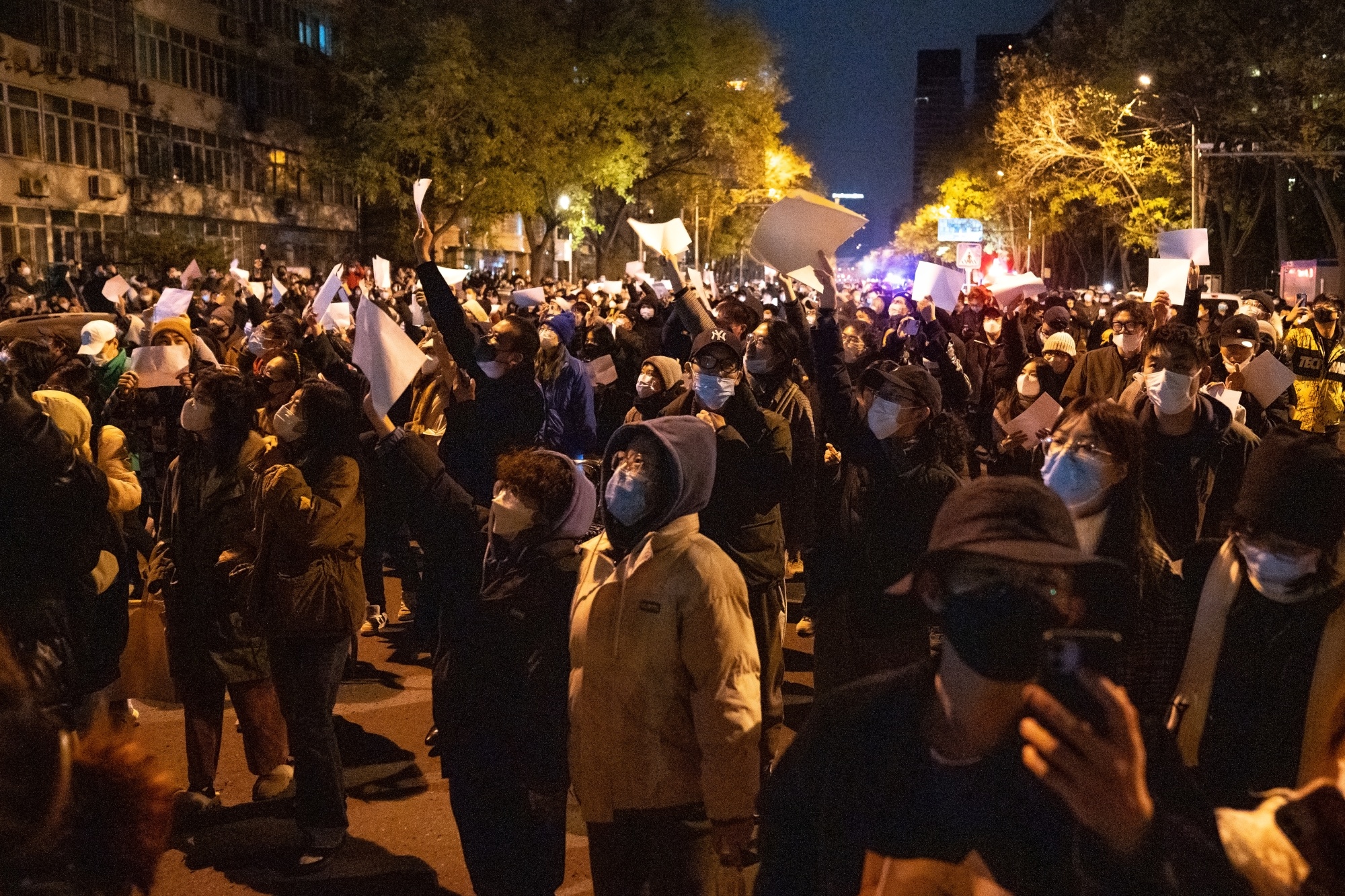 Demonstrators hold blank signs during a protest in Beijing, China, on Sunday, Nov. 27, 2022. Source: Bloomberg/Bloomberg As closed off as the country can be, with sealed borders, state-controlled media and Internet censorship, there was no way that some of its 1.4 billion people wouldn't notice that they were being asked to live in an alternate reality, at an ever-growing social and economic cost. The central government's concessions to these questions — a muddled 20 point plan announced earlier this month that presented local officials with the contradictory goals of minimizing disruption to people's lives while still extinguishing the virus's spread — has only supercharged anger on the ground. As cases rose this month with cold weather, those who thought the new approach would usher in a gentler regime were dismayed to see people locked downs and hauled off to government isolation facilities. That dismay has now curdled into anger and spilled onto the streets. In the final reckoning of China's Covid-19 missteps, many questions will likely remain unanswered. Why, in a country so accustomed to top-down, coercive policies, were its elderly not made to get vaccinated at higher numbers to minimize fatalities when the virus inevitably spread? (It's not about the efficacy of its homegrown shots, which are still highly effective in preventing serious illness and death). Why, in a country with the resources to erect hospitals overnight, were its intensive care units and health care services not beefed up earlier to prepare for an onslaught of Covid? Why, as the virus evolved to become more contagious but less deadly, was there no recognition that prevention — but not treatment — would become harder? Why, from a government able to pull off the greatest economic growth story of our generation, has there not been a properly formulated exit plan from Covid Zero, after so many other places have shown that it can be done relatively safely? In the protesters' chants and their visceral frustration, these and many other mysteries remain. —Rachel Chang | 







No comments:
Post a Comment