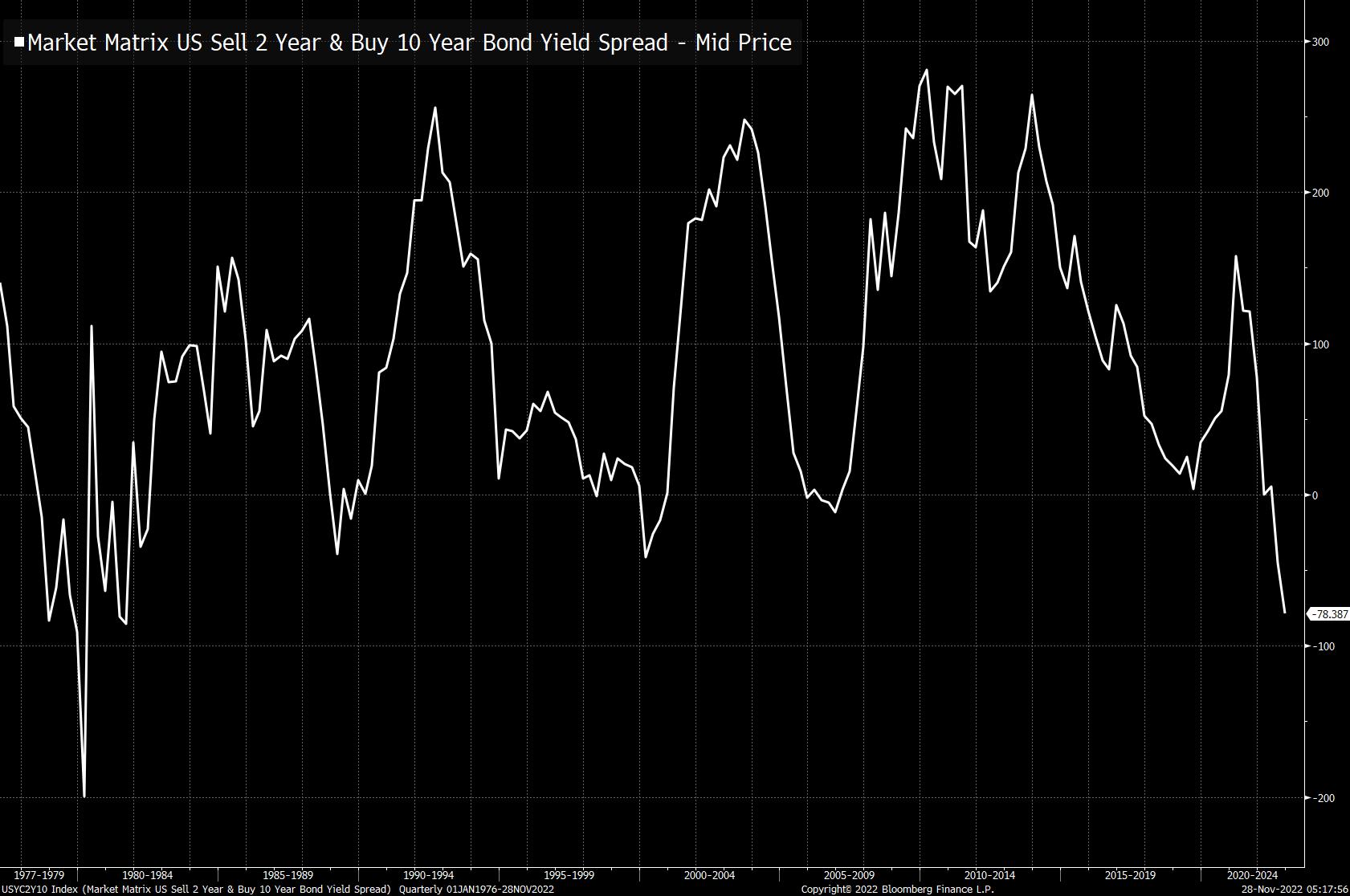
| China protests erupt over Covid Zero, US jobs are expected to slow and stagflation is the big economic risk in 2023. Chinese stocks and the yuan dropped Monday as protests erupted against China's Covid Zero strategy. The historic unrest, one of the most significant challenges to Communist Party rule since the Tiananmen crisis more than 30 years ago, has sparked uncertainty by complicating the nation's path to reopening. The turmoil is also hurting companies, with disruption at Apple's key manufacturing hub of Zhengzhou likely to result in a production shortfall of close to 6 million iPhone Pro units this year, according to a person familiar with assembly operations. Goldman Sachs says China may end Covid Zero earlier than expected. This week sees the November US jobs data. Payrolls are estimated to slow modestly to 200k, from 261k for October, while the unemployment rate is expected to stay at 3.7%. The Fed would soon like to see some cooling in the jobs market to give it confidence its policy is working, with Chair Powell this week expected to confirm expectations the bank will start to slow its pace of hiking. Meanwhile, the bond market is beginning to price in a recession next year, with long-dated Treasury yields already below the Fed's overnight benchmark range -- currently 3.75% to 4% — and the yield curve continuing to invert.  | Stagflation is the key risk for the global economy in 2023, according to investors who said hopes of a rally in markets are premature following this year's brutal selloff. Almost half of the 388 respondents to the latest MLIV Pulse survey said a scenario where growth continues to slow while inflation remains elevated will dominate globally next year. The second most likely outcome is deflationary recession, while an economic recovery with high inflation is seen as least probable. Stocks slid and oil tumbled on the growing unrest in China. A soaring euro meant the dollar lost its status as the haven of choice, at least for today. The yen outperformed while the yuan fell. S&P 500 futures dropped 0.8% as of 5:48 a.m. New York time as modest customer traffic and heavy discounting by American retailers on Black Friday added to the downbeat tone. All eyes will be on the US jobs report this week and on Powell and New York Fed President John Williams, who are among central bank officials scheduled to speak. Traders will hear from the Fed's Williams and James Bullard while the ECB's Christine Lagarde testifies in the European Parliament. US data include Dallas Fed manufacturing outlook. Here's what caught our eye over the weekend: Everyone is still talking about rate hikes. But what people are thinking about, more and more, is rate cuts. This is evidenced by the steepest inversion of the 2-10 spread in decades. The more inverted the curve, the more it implies that in the future the Fed will be lowering rates below where they are in the short term. In other words, as Bloomberg's Michael Mackenzie notes, traders are making a big bet on a forthcoming recession.
This could get treacherous. While "pivot" talk has picked up, inflation is still extremely high. There are reasons to hope or believe that inflation has peaked, but not a ton of hard evidence yet. The fear, of course, is that economic activity starts turning lower before price gains really start to moderate, putting the Fed in a bind. That said, it's gonna be a big week for the US economy. Among other reports, we'll get Dallas Fed Manufacturing Activity, Case-Shiller home prices, personal income and spending, JOLTS, initial jobless claims, ISM manufacturing, construction spending, vehicle sales and a jobs report. We'll see if there are any indications of slowing momentum. And we'll see if the market perceives cooling strength to be bullish (because it brings the pivot closer) or bearish (because of downturn fears). Follow Bloomberg's Joe Weisenthal on Twitter @TheStalwart | 







No comments:
Post a Comment