| China rolls out more economic relief policies. The EU fails to agree on revised Russia sanctions. Stocks rally as May draws to a close. Here's what you need to know today. With stocks rallying as May draws to a close, investors are wondering if the worst of this year's collapse is over. The S&P 500's 13% drop so far this year is its biggest since 1970, fueled by recession fears as the Federal Reserve tightens monetary policy to fight inflation. And rising interest rates dented the allure of tech and growth shares, with the Nasdaq 100's 22% plunge ranking as its largest ever. So where are we now? Last week the S&P was up 2.5%, on less-hawkish remarks from Fed officials and upbeat corporate earnings. But analysts say stocks may have yet to hit a final low. As the new week begins, futures are up in Japan, Australia and Hong Kong Shanghai offered some tax rebates for companies and allowed all manufacturers to resume operations from June as authorities rolled out scores of policies to revitalize an economy impacted by Covid lockdowns. The financial hub will accelerate approvals for property projects and supply new residential developments, according to a plan issued by the Shanghai municipal government. Meanwhile, Beijing says its outbreak is under control, while Hong Kong has eased the flight-suspension mechanism for carriers that bring in a certain number of people who test positive on arrival.  | Ukraine President Volodymyr Zelenskiy visited front-line troops in the Kharkiv region in his first trip away from Kyiv since Russia's invasion.
Zelenskiy earlier called conditions in the Donbas region to the east as "indescribably difficult" as Russia presses to take more ground approaching the invasion's 100th day. Meanwhile, European Union nations on Sunday failed to come to an agreement on a revised package of sanctions over Moscow's invasion of Ukraine, and Russian President Vladimir Putin promised Serbian President Aleksandar Vucic an uninterrupted natural gas supply. In the five years since Park Ji-hyun's 21st birthday, the South Korean activist has busted an online sex crime ring, published a memoir, revealed her identity to the masses, and become a senior advisor to a leading presidential candidate. He lost, but she didn't. At just 26, Park has emerged as a leader of South Korea's opposition and a torchbearer for women fed up with the country's longstanding gender divide. She granted Bloomberg a rare interview. Get the full story here. Sri Lanka needs a new government to tackle its economic crisis, according to the leader of the main opposition party, as its prime minister proposed a system to make the nation's president and cabinet more accountable. The South Asian island nation has been in the worst economic tailspin of its independent history, with shortages of everything from fuel to medicine, power outages and inflation seen rising to 40% prompting angry protests and turning into political risk for the ruling Rajapaksa family. Sri Lanka is currently negotiating for a bailout program with the International Monetary Fund, which is key to securing urgently needed funds from other lenders. Cash is king once more in the stock market, nowhere more so than in the US. Investors are piling into the shares of the most cash-rich companies at a pace not seen in years. As my colleagues Vildana Hajric and Katie Greifeld pointed out last week, assets under management for the Pacer US Cash Cows 100 ETF have risen to about $6 billion from $1.3 billion at the start of 2022. The fund, which tracks mid- and large-cap companies with high free-cash-flow yields, has seen an inflow every week so far this year, a run unprecedented in its history, according to data compiled by Bloomberg. 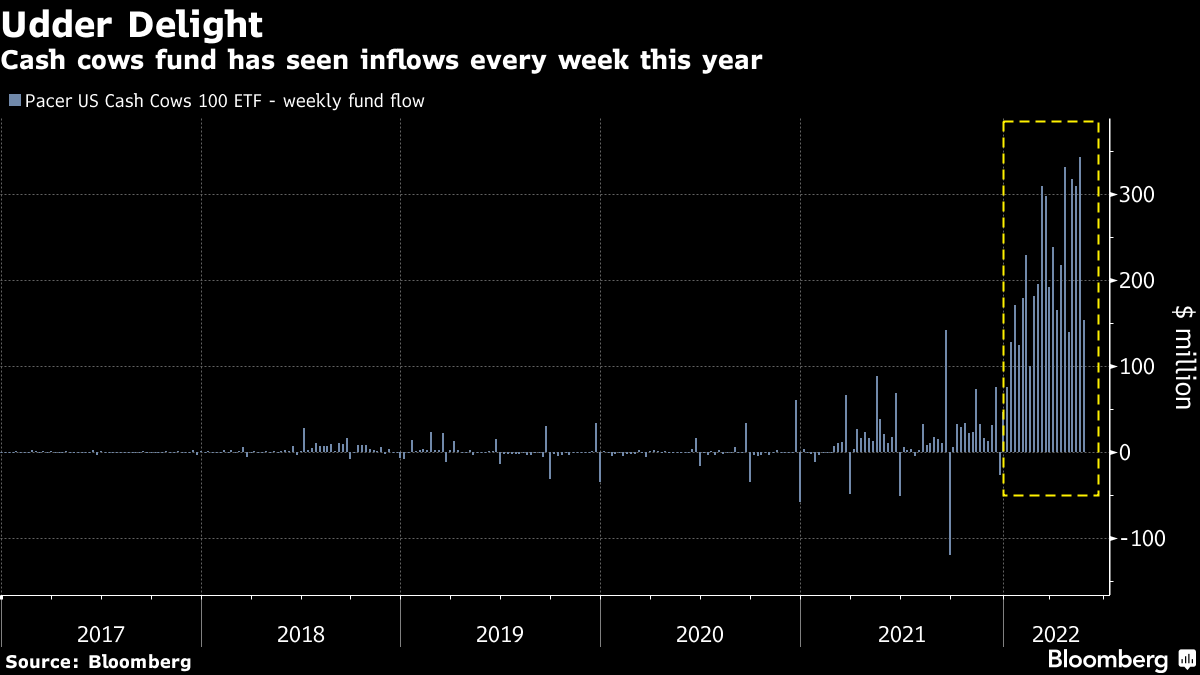 The ETF has climbed 6% this year through Thursday, crushing the 15% slump in the S&P 500 Index. That's even better than the performance of a gauge of high dividend yield US stocks, which has also outperformed. While the ETF has benefited from exposure to energy stocks, the inflows show that investors are once again focusing on firms with the strongest fundamentals, as the threat of recession looms. Smouldering default risk in the corporate sector as refinancing costs rise is also likely to continue to fuel demand for cash-rich companies. Cormac Mullen is a Deputy Managing Editor in the Markets team for Bloomberg News in Tokyo. | 






No comments:
Post a Comment