| Good morning. EU partially bans Russian oil, Telecom Italia plans to sell landline network, Biden and Powell's rare meeting, and Biden's limits on assault weapons. Here's what people are talking about. European Union leaders agreed to pursue a partial ban on Russian oil, paving the way for a sixth package of sanctions to punish Russia and its president, Vladimir Putin, for the invasion of Ukraine. The sanctions would forbid the purchase of crude oil and petroleum products from Russia delivered to member states by sea but include a temporary exemption for pipeline crude. Officials and diplomats still have to agree on the technical details and the sanctions must be formally adopted by all 27 nations. Telecom Italia is seeking a valuation of around 20 billion euros for the landline network it plans to sell to a state lender and international funds. The proceeds would allow the former phone monopoly to cut its multi-billion-dollar debt pile, accelerating Chief Executive Officer Pietro Labriola's turnaround plan. The valuation is preliminary and could change. President Joe Biden will hold a rare Oval Office meeting on Tuesday with Federal Reserve Chair Jerome Powell amid the highest inflation in decades, which has hurt his standing with voters. The two will discuss the state of the American and global economy. It's the first meeting between the two since Biden in November announced his intention to nominate Powell for a second term at the helm of the US central bank. President Joe Biden said there are limits to what he can do as he renewed calls for Congress to crack down on the kinds of assault weapons that were used to carry out a mass shooting at a Texas elementary school. "I can't dictate this stuff," Biden told reporters Monday. "I can do the things I've done and any executive action I can take, I'll continue to take. But I can't outlaw a weapon. I can't change a background check. I can't do that." European equity futures nudged lower and Asian shares wavered as inflation worries weighed on investors. ECB's Gabriel Makhlouf speaks at Irish Funds annual global conference, while Ignazio Visco gives remarks at the Bank of Italy's annual report presentation. Riksbank Governor Stefan Ingves discusses Sweden's inflation targeting policy. There's a slew of data ahead, including Dutch, Swiss and German retail sales, French inflation, as well as French and Italian GDP. On the earnings front, Opap, Salesforce and HP are slated to report. This is what's caught our eye over the past 24 hours. Investors in one of the key global value sectors -- banks -- have failed to get the bang for their buck this year that should have come with higher bond yields. The relative performance of an MSCI gauge of the world's banking stocks broke away from its tight relationship with 10-year Treasury yields -- the global bond benchmark -- in February, having closely tracked them for at least five years. Banks peaked relative to the broader market the day before Russia invaded Ukraine, suggesting that fears about economic growth are behind the move. A fall in loan demand and the potential for defaults from borrowers that would come with a recession would of course be bad news for bank earnings. Meanwhile, more investors seem to be warming to the idea that bond yields have peaked, removing one catalyst for bank stocks to close the gap. That suggests a couple of months of choppy trading lies ahead for the shares, at least until investors get a better sense of the global economic outlook. 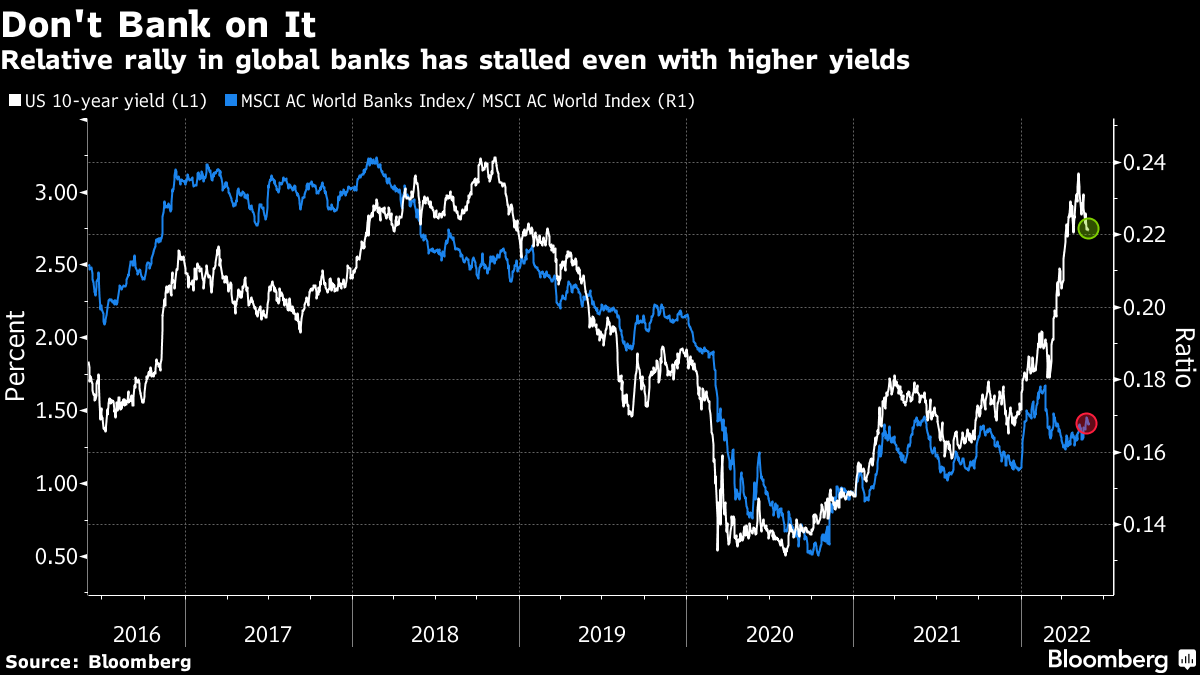 Cormac Mullen is a Deputy Managing Editor in the Markets team for Bloomberg News in Tokyo. | 






No comments:
Post a Comment