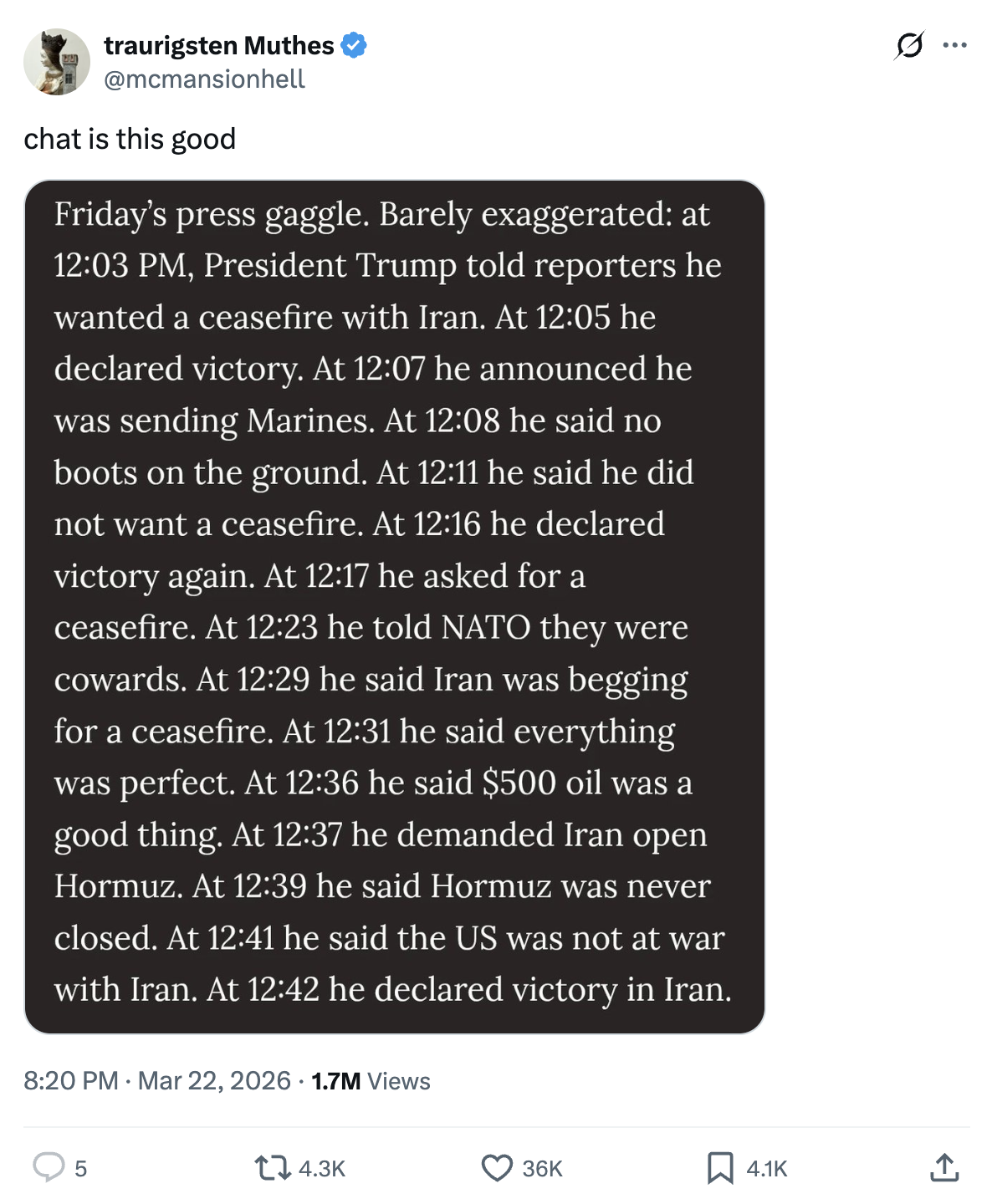
| I'm sure you can imagine how difficult it is to write a newsletter when this much can happen in the span of 39 minutes: As much as I'd love to tell you that I am "monitoring the situation," I do not have the mental fortitude to keep up with a president who can embark on an impromptu tour of Elvis Presley's mansion hours after saying "we'll just keep bombing our little hearts out" if talks with Iran sour. I say talks "with Iran," because it's unclear who President Donald Trump's administration is actually talking to. Iran's Foreign Ministry claims there's no dialogue between Tehran and Washington, but the US asserts that negotiations took place with a "top person" in Iran on Sunday night. Keeping his head on a swivel over the weekend, John Authers remarks, "Trump is far more considerate than people give him credit for … During trading hours he would have caused mayhem. As it was, everyone watched the blinding switchbacks with no new money at stake — and a cautious open to Asian trading suggests nobody feels much wiser." On Monday, the waffling continued. In the morning, Jonathan Levin said the TACO trade — Trump Always Chickens Out, as coined by Financial Times writer Rob Armstrong — was officially over. But by the afternoon, The Readout's Allegra Stratton said the TACO trade was "back on" after the president "took his capital letters to Truth Social to say he would not be attacking Iranian energy infrastructure, at least not for the next five days." Cue Marc Champion's sigh of relief: He said hitting Iran's power plants would invite a reckless escalation. Although it'd be easy to look at the events of the past 72 hours and chalk them up to the workings of a madman, Hal Brands says "Trump isn't simply reacting randomly to events or using foreign policy to distract from domestic problems. Rather, he is pursuing a highly ambitious, sometimes-hyperactive superpower strategy, one that has the potential — and certainly the intent — to reshape the globe." The goal, Hal argues, isn't to achieve any narrow objective but rather "to create a global wow factor," a wow factor he's apparently been plotting for quite some time. Looking at Kharg Island specifically, Javier Blas says the critical Iranian oil terminal "has fascinated Trump for 40 years. It's a shame this doesn't include a proper understanding of what it offers Iran and how the regime might get by without it." Really, it's a shame that we don't have a proper understanding of anything these days because everything keeps moving so fast. What if we kissed at the Atlanta airport in front of the seemingly bored ICE agents who were deployed by the president to assist with TSA staff shortages and five-hour security lines that wrap around the baggage claim amid a partial government shutdown? Oh, wait, somebody already did that. 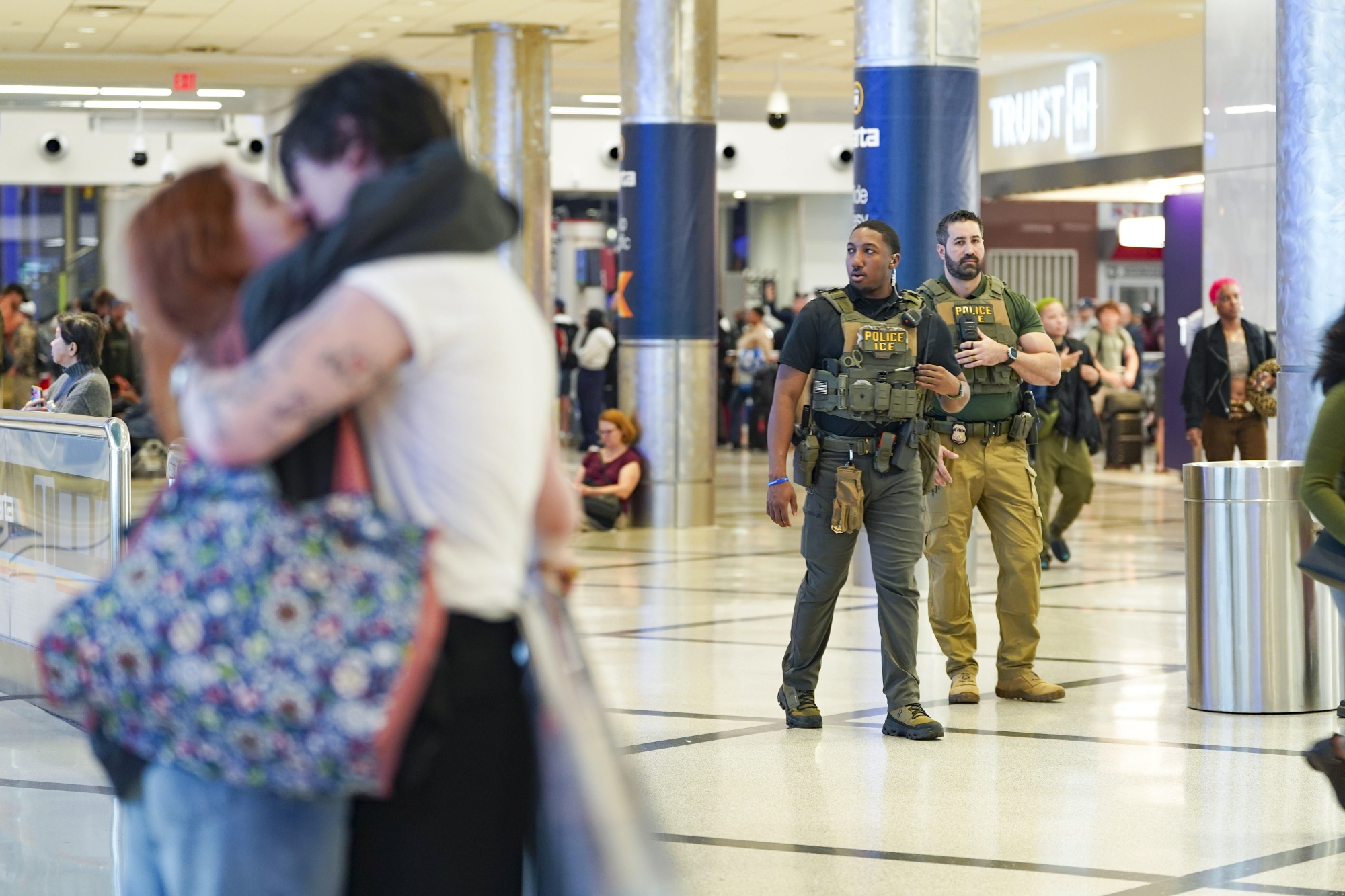 Photographer: Megan Varner/Getty Images North America Groups of unmasked officers descended on more than a dozen US airports on Monday. When asked whether they would be making any arrests, President Trump told the press, "Yeah. That's why the Democrats are going crazy. ICE loves it because they're able to now arrest illegals as they come into the country. It's very fertile territory." (On Sunday, a video of a woman and child being restrained by agents in the San Francisco International Airport went viral, but a spokesperson for the airport told NBC that the incident was unrelated to the broader deployment.) With ICE patrolling the terminals, it's starting to look like Mark Gongloff is the oracle of airport hell. His March 17 column, "Flying Is Abysmal and It's Only Getting Worse," feels especially prescient now. TSA lines are so bad that Atlanta — the world' busiest airport — has turned off its official wait time tracker. At New York's LaGuardia Airport, delays have been compounded by a tragic collision between an Air Canada plane and a Port Authority fire truck, that killed both the plane's pilots. The chaotic checkpoint process, coupled with the worldwide security alert that US officials issued Sunday, has some travelers second-guessing their spring break plans. Even the ultra-wealthy are rattled, but not in the way you'd think. Speaking to a former F1 owner who was unhappy about the price he was quoted while trying to extend his family's £45,000 vacation to Cape Town, Andrea Felsted says big spenders are experiencing a bout painful sticker shock. Such complaints may seem minor in the broader context, but Andrea says it's these customers who have kept airlines afloat since the pandemic. If they tire of high prices and hours-long security lines, she warns that even more problems could emerge for the already-beleaguered travel industry. | 








No comments:
Post a Comment