Monday, March 9, 2026

Enough cool heads are pulling back from the brink

To get John Authers' newsletter delivered directly to your inbox, sign up here. So far this week, Brent crude surged from $93.50 to $118.90
View in browser
Bloomberg
with John Authers

To get John Authers' newsletter delivered directly to your inbox, sign up here.

Today's Points:

Short, Sharp Shock?

Years go by with less activity in the oil market than we have witnessed in just the first day of this week. The lingering question is whether all's well that ends well. Crude prices surged almost to $120, in a sharper and more sudden rise even than ever occurred in the early days of the Ukraine invasion. Is it more important that traders took the price this high, or that they swiftly thought better of it, and brought it back below $90?
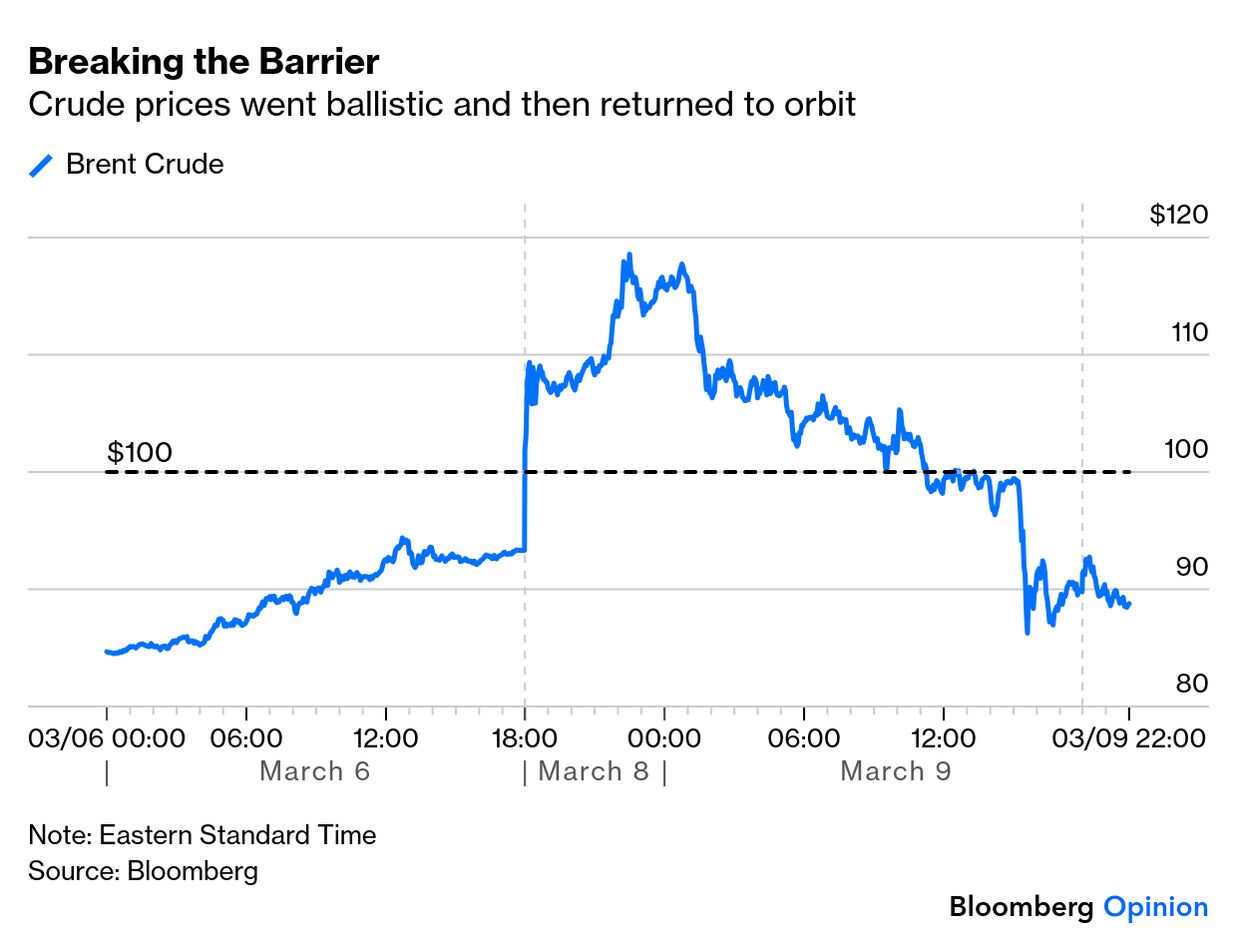
These are unusual events and while they were in part driven by exceptionally volatile news flow, it would be misleading to try to label the chart with events to explain the moves. Iran's choice of the son of the late Ayatollah Ali Khamenei as new supreme leader seemed a bad sign of intransigence to open the day. Reports that the G-7 was prepared to tap oil reserves if needed helped to bring the price under control, and then President Donald Trump's comment that the war would be short prompted the drop to $90. But it's impossible to explain all of the moves with news flow. Sentiment is driving this, and some traders were evidently willing to panic. But it's equally true that they weren't comfortable leaving oil above the landmark of $100.

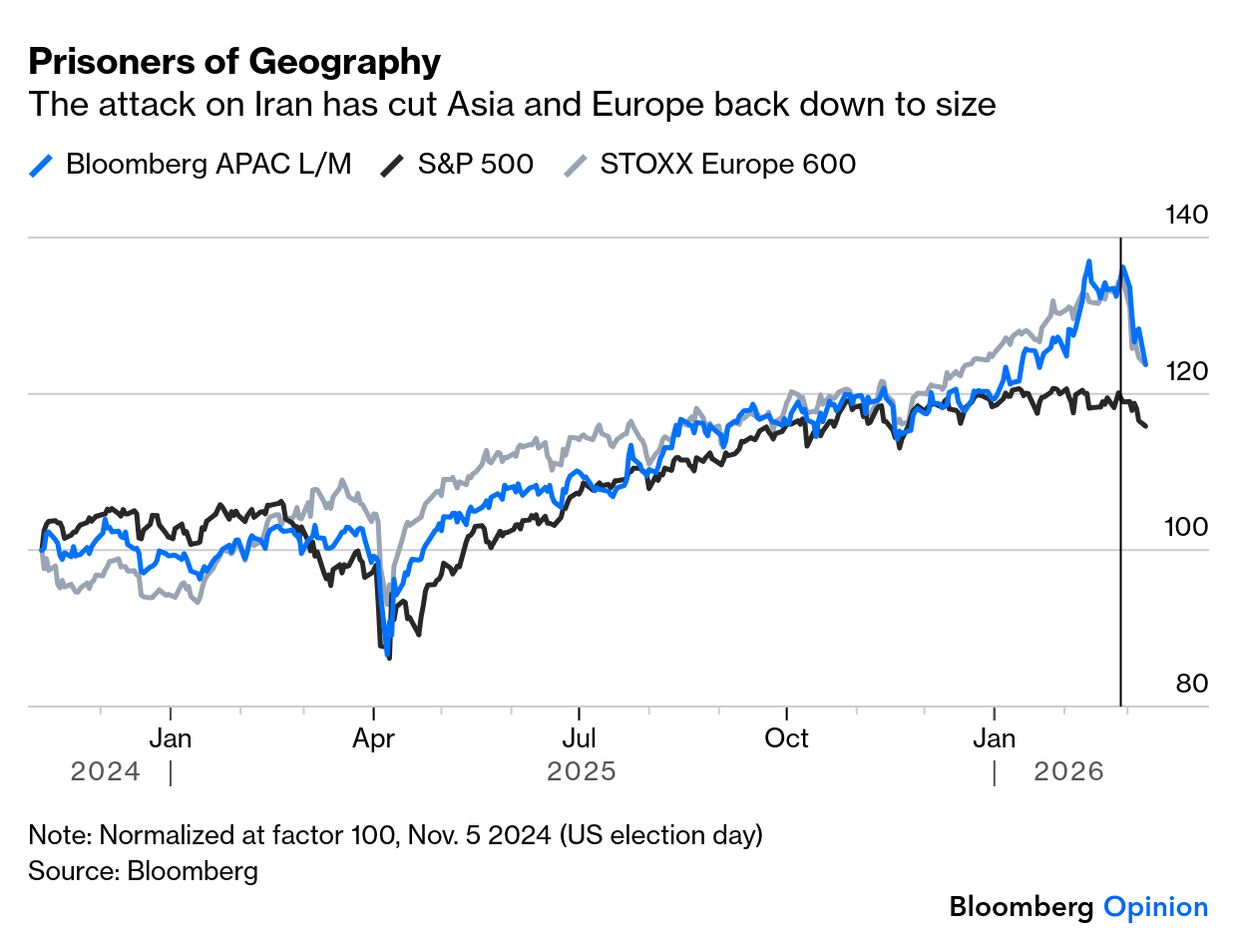
Oil is naturally giving a lead to other markets. Asian exchanges, open when the oil spike was at its worst, took severe damage, while the main US indexes were flat. Overall, the reaction in stocks continues to be surprisingly calm given the extreme goings-on in commodities markets. Geography has asserted itself with Asia and Europe, physically close to the conflict and in need of energy imports, sustaining greater losses than the US, which is neither. But all the last week has done is bring the rest of the world to heel somewhat. Asia and Europe have still outperformed the US since the election of Trump in November 2024:

Despite an exceptionally alarming spasm as trading opened Monday in Asia, then, markets remain orderly, and are still not greatly impacted by the terrible events in the Middle East. What would change this? And what if anything would provide a clear signal that it was time to buy?

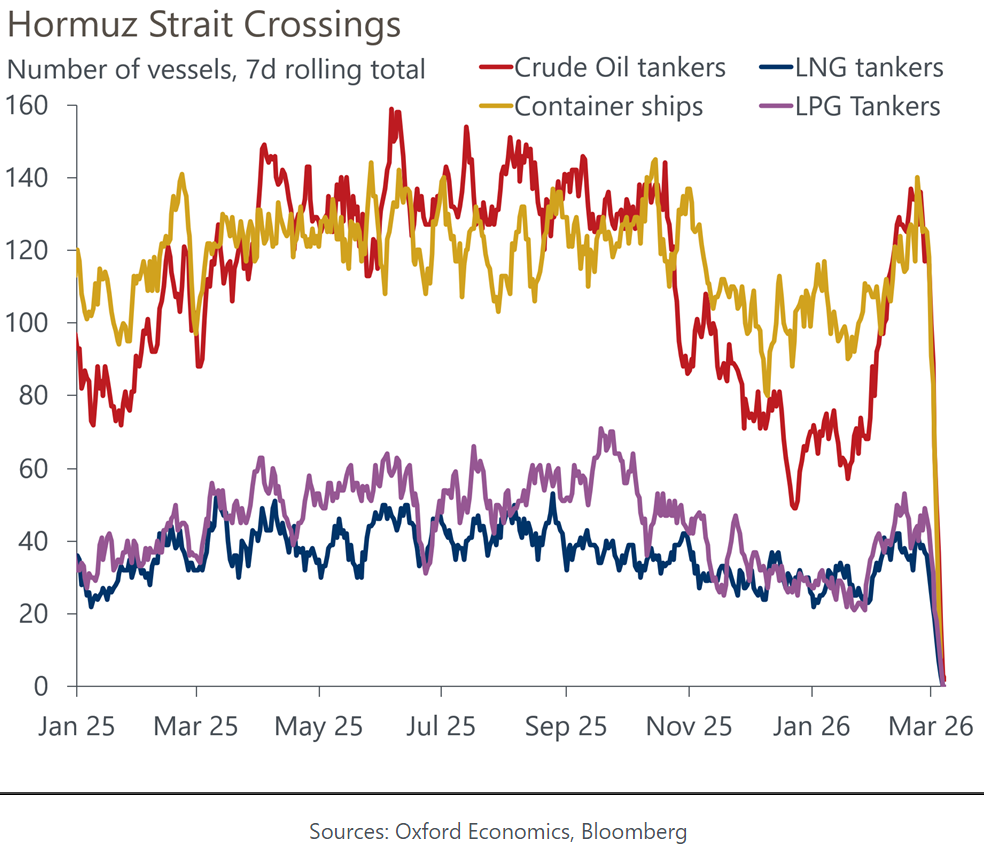
Disruption to oil supply is, we all know, critical to turning a geopolitical shock into a more serious economic event. That has already happened. As this dramatic chart from Oxford Economics demonstrates, trade through the Strait of Hormuz has dried up:

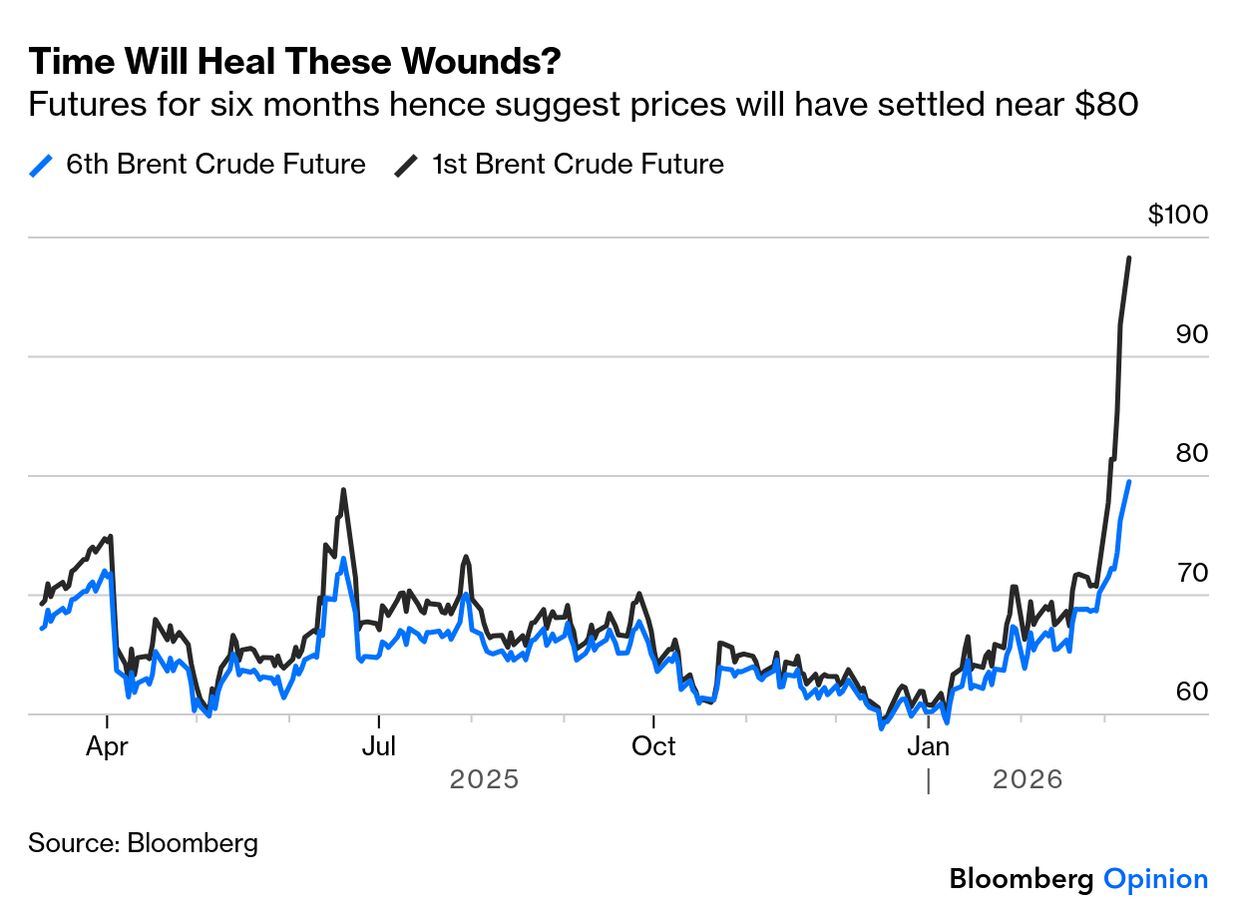
The issue is how long supply will stay stoppered up. And markets remained moderately positive on this front, even before Trump's comments were taken as evidence that he did not have the political appetite for a prolonged conflict. The 6th and 1st month futures on Brent crude, covering the price of a barrel at those points into the future, have been trading close together for most of the last year, but now a gap has opened. Futures are still pricing oil to be just around $80 in six months' time (about 10% above its $72 price on the eve of the conflict) — which would be significant, but not the economic game-changer that $120 oil would be:

We need to keep following developments on the war and on oil supply. Beyond the duration of the shock, we also need to monitor the impact on central banks and on the macroeconomy. Societe Generale's Manish Kabra lays out the criteria as follows:

An exogenous shock lasts beyond a week, but oil spikes usually peak in three months. That's the timeline and only two things matter: 1) shock duration and 2) the Fed's reaction function.

Alternatively, Henry Allen of Deutsche Bank suggests that for a risk-off bear market to follow an oil shock, three conditions need to be met:

1. Large and sustained oil price spike: An oil price spike of at least +50-100% that is sustained over several months.
2. Hawkish policy response: The shock forces a sharp, hawkish pivot from central banks to fight the resulting inflation (e.g. 1979, 2022).
3. Broader macro damage: The shock is big enough to tip an already-slowing economy into recession.

The duration of the shock will reveal itself over time, while the first hard macro data that will include the war's impact are still weeks away. So the chances are that next week's meeting of the Federal Open Market Committee is going to be far more interesting than at one point seemed likely. 

The Fed is currently in its pre-meeting quiet period, but any indication that it will respond hawkishly will have immediate repercussions. If it gives clear signs that it's more worried about the "stag" side of the stagflation that can follow an oil shock, markets will be that much calmer. 

Absent clarity on the length of the war, and on the central banks' likely response, it's impossible to say whether the market bottom is in. Monday's extraordinary gyrations in oil settled nothing, beyond showing that there's a lot of residual optimism in the US, which is still taking these events in stride.

Credit Where Credit's Due

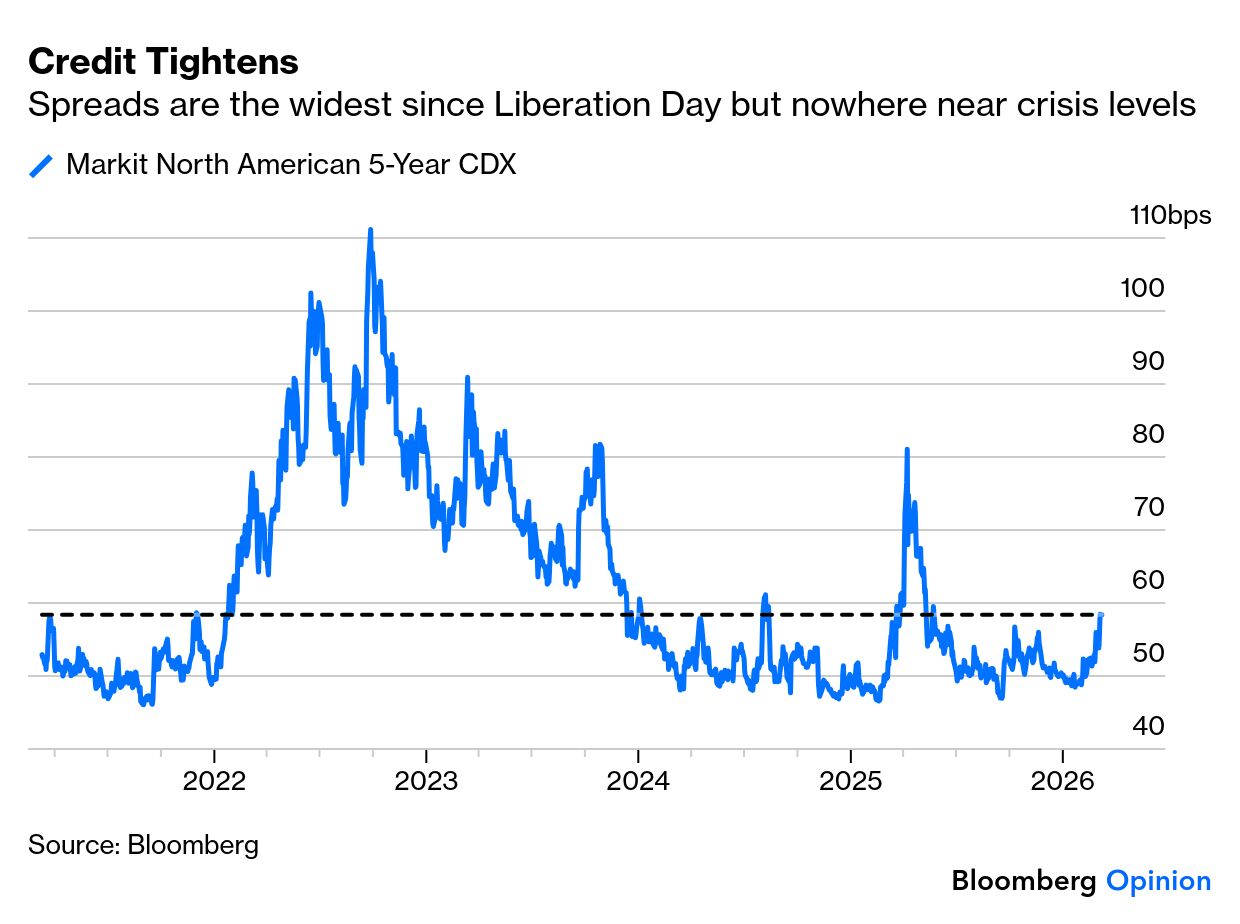
Credit investors' stress levels are far from healthy. Globally, measures of perceived risk continue to deteriorate. A weak US February jobs report is the latest catalyst in the Markit CDX North American Investment Grade Index's spread widening by the most since last May:

The raging war in the Middle East has combined with cockroaches in private credit to make creditors' lives unusually difficult. Their pain is slowly reverberating from Tokyo to New York

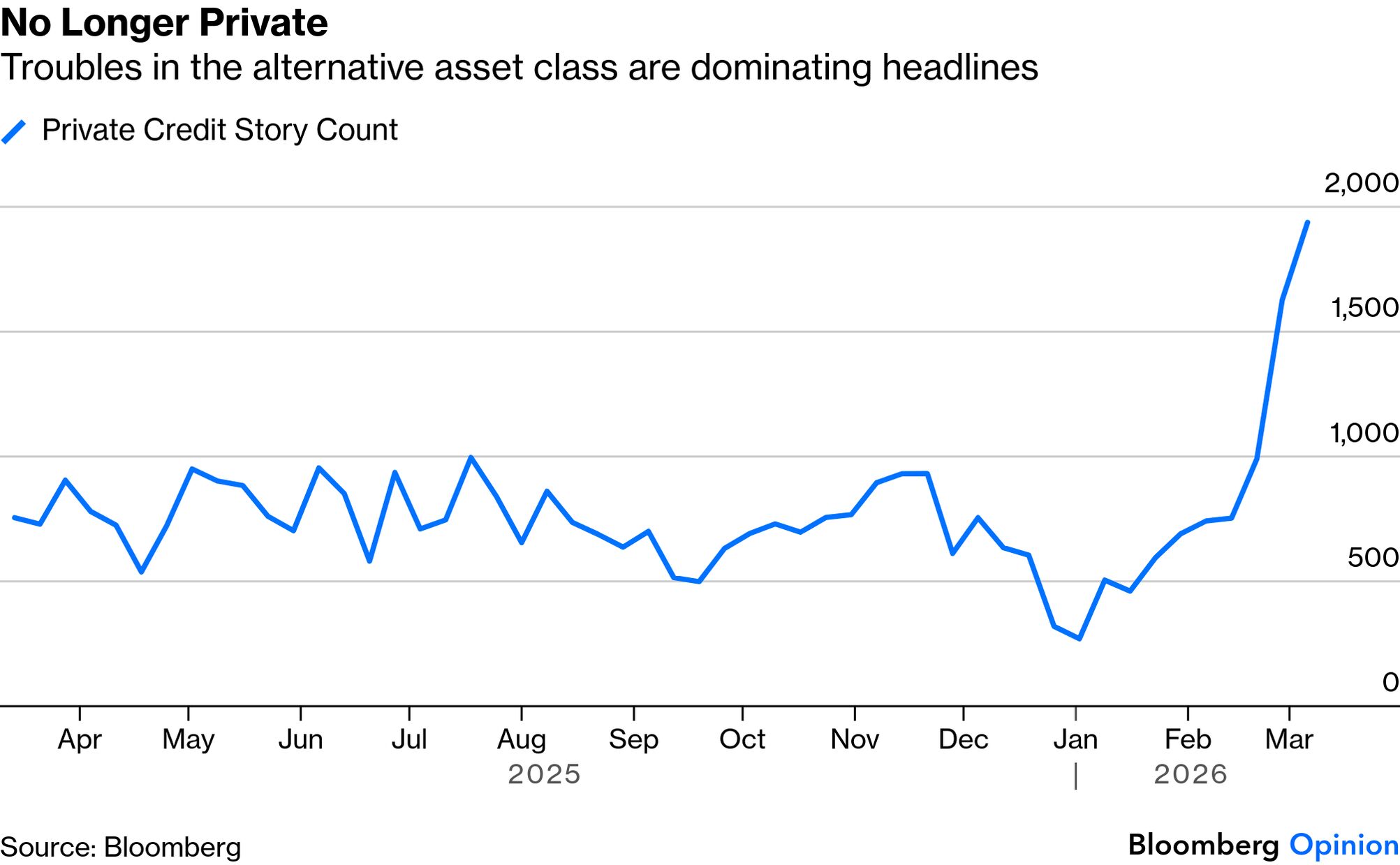
Worse, the meltdown sparked by AI's looming disruption of software firms is continuing to ripple through markets as investors scramble for safety and unwind crowded trades. The world's largest alternative asset managers now face an uncomfortable dilemma: Block investors seeking to exit private-debt funds and risk reputational backlash, or honor the redemptions and undermine the industry's promise of patient, locked-up capital. The recent episode at Blue Owl Capital is still fresh in investors' minds, and press scrutiny of the asset class is continuing at a far higher level than for most of last year:

The war piled on the strain last week, with the Bloomberg US Corporate Bond Index falling 0.95%. The rising yields pushed the investment-grade index's yield-to-worst to 4.9%, leaving year-to-date returns barely above zero. These are tough conditions, although certainly nowhere near crisis.

Indeed, it's possible to view the developments as positive, as they show that there is no complacency. Steven Ricchiuto of Mizuho Securities says:

The market's sensitivity to credit-related problems remains a very healthy development. It is only when market participants let down their guard and ignore the buildup of excesses in leverage that systemic risk actually accumulates in the economy. Limiting liquidity to private credit early on assures that the excess can be worked down through a series of idiosyncratic events, rather than trigger a credit crunch and the associated recession.

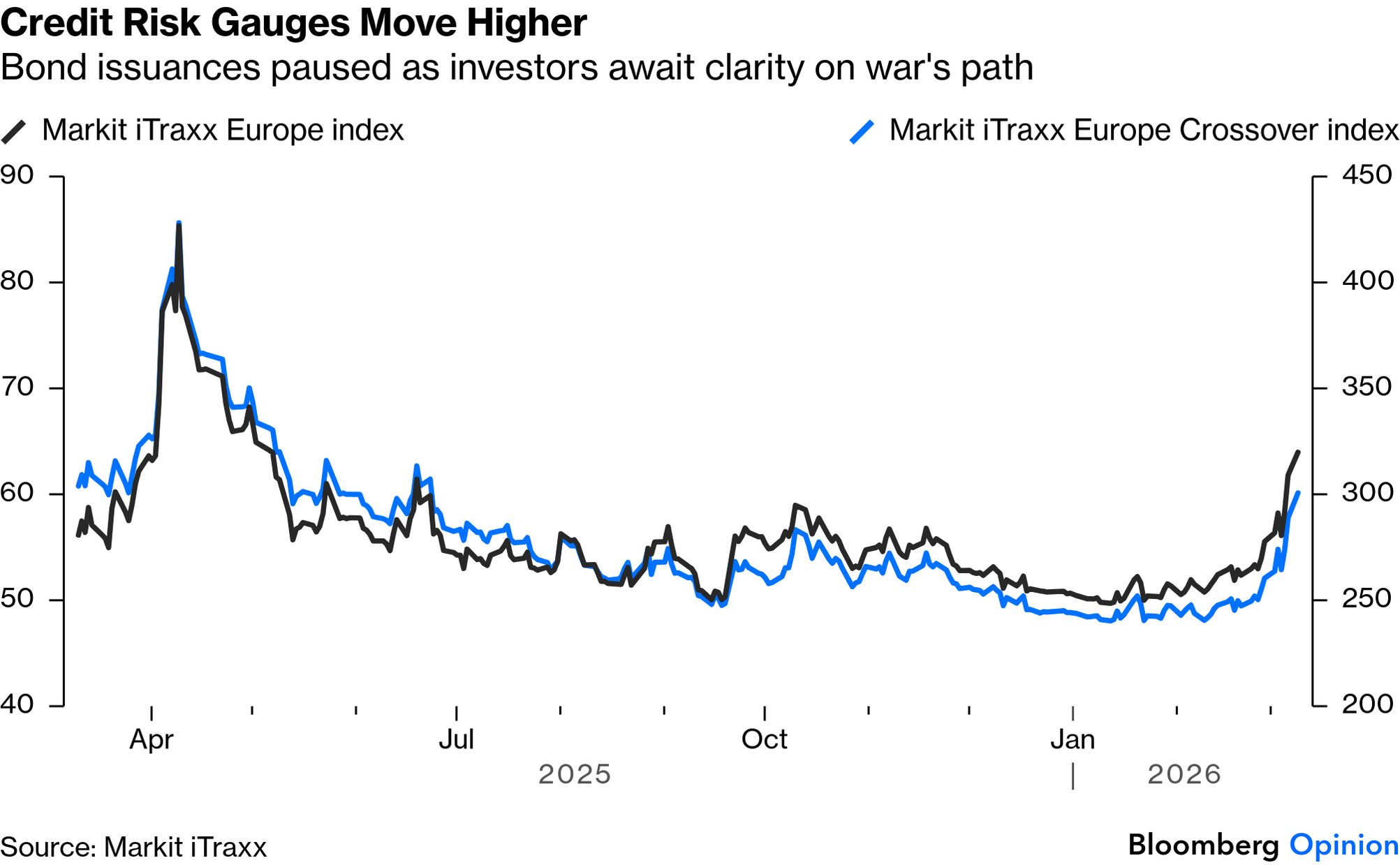
Across the Atlantic, the picture is less reassuring. Nearly 150 companies have already ceded control to direct-lending funds after they could no longer service their debts, according to Goldman Sachs Group, showing that private credit strains are spreading. On that basis, it is not surprising that Monday's surge in the credit risk benchmark culminated in a pause in bond sales. With oil prices soaring during the European session, there were concerns that this would weaken corporate balance sheets, and intensify repayment risks. A handful of corporate and financial-sector borrowers that had been looking to raise debt in Europe stood down. With deals already delayed last week, a pipeline of issuers is now waiting to tap the market when they get the chance.

Meanwhile, the cost of protection against corporate defaults, as measured by the iTraxx Europe index of investment-grade firms, reached the highest since May, while the Crossover index of junk-rated credits crossed 300 basis points for the first time since June:

Such moves aren't surprising in a risk-off environment. A closer look beneath the headline indicators shows that European oil companies' credit-default swaps have widened largely in line with the broader market, even though the sector has more direct exposure to the Iran conflict than most others. That suggests a relatively indiscriminate selloff, leaving room for a reassessment once there is greater clarity on the balance of risks, according to Bloomberg Intelligence's Paul Vickars:

Oil and gas producers are typically unhedged, so have full exposure to higher commodity prices, while LNG producers have lower exposure, as most sales are under long-term contracts with some indexation to commodity benchmarks. 

Still, analysts at Bank of America say liquidity for European credit investors remains "broadly supportive," though the tone has softened over the past year, according to Ioannis Angelakis:

Investment-grade and high-yield respondents overwhelmingly say liquidity is stable or improved. Yet, the share reporting deterioration has also ticked higher, reflecting the 2025 rise in fragility shocks on the back of tighter valuations. 

This is a fragile time for credit markets, but credit investors are no strangers to market stress. In the past, such incidents have often been followed by strong demand and a "buy-the-dip" mentality. That might yet happen this time — depending on just how deep the dip gets.   

— Richard Abbey

Survival Tips

It feels like time to listen to some songs about oil. There are surprisingly few, given how much we rely on the commodity, but you might try "Beds Are Burning" by Midnight Oil, A Gallon of Gas by The Kinks, I Asked Her for Water (She Gave Me Gasoline) by Howlin' Wolf, David Bowie's Cat People (Putting Out the Fire)North Sea Oil by Jethro Tull, The Price of Oil by Billy Bragg, Rock the Casbah by The Clash, Marvin Gaye's Mercy Mercy Me (The Ecology) or Bloc Party's The Price of Gasoline. There must be more?

More From Bloomberg Opinion

Want more Bloomberg Opinion? OPIN. Or you can subscribe to our daily newsletter.

Like Bloomberg's Points of Return? Subscribe for unlimited access to trusted, data-based journalism in 120 countries around the world and gain expert analysis from exclusive daily newsletters like Markets Daily or Odd Lots.

Like getting this newsletter? Subscribe to Bloomberg.com for unlimited access to trusted, data-driven journalism and subscriber-only insights.

Want to sponsor this newsletter? Get in touch here.

You received this message because you are subscribed to Bloomberg's Points of Return newsletter. If a friend forwarded you this message, sign up here to get it in your inbox.
Unsubscribe
Bloomberg.com
Contact Us
Bloomberg L.P.
731 Lexington Avenue,
New York, NY 10022
Ads Powered By Liveintent Ad Choices

No comments:

Post a Comment

Preference center link

...