Fruit Slop vs. Val Kilmer | I wonder if future scholars will chronicle how during the First AI War, mankind chose to distract itself from the bloodshed by creating even more AI. I can picture the chapter in a high school history textbook already: "Fruit and Veggie Slop: Dissociation, Digital Escapism, and the Birth of the Talking Banana." The opening would read like this: On February 28, 2026, the same day American and Israeli forces commenced military operations against Iran, TikToker @trombonechef uploaded the inaugural installment of what would become a watershed moment in cultural history: an animated series depicting an anthropomorphized strawberry engaged in a clandestine affair with her eggplant supervisor. 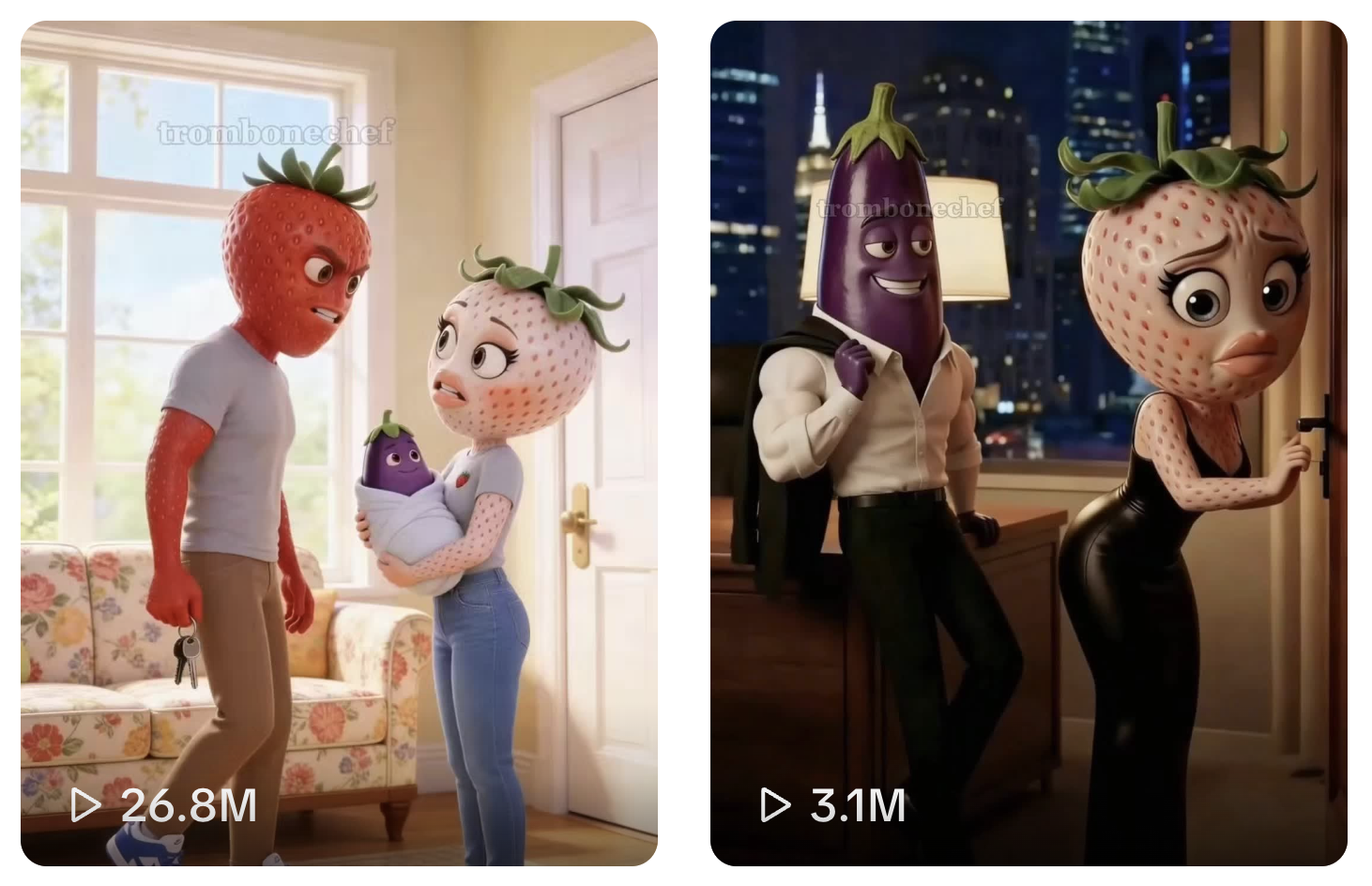 Source: @trombonechef What followed was not merely a viral trend, but a mass psychological phenomenon. Within weeks, raunchy "AI slop" videos starring fruit and vegetables had overtaken social media algorithms, garnering hundreds of millions of views as civilians sought refuge from the anxieties of wartime.
Given all the madness of this year, I'm not surprised that a cartoonized version of Love Island has captured the hearts and minds of the chronically online. But it doesn't change the fact that a lot of people still don't trust AI, which so often blurs the lines between what's real and what's fake. Yet maybe that's why talking fruits and veggies struck a chord with the public in the first place: There's no way they're real. The same cannot be said for this man:  Source: First Line Films Bryan Reesman says that before actor Val Kilmer died last year, he'd been cast in the movie As Deep as the Grave to play Father Fintan, a Catholic priest and Native American spiritualist. But his battle with throat cancer prevented him from ever stepping onto the set. Enter: his AI-generated persona, pictured above. "Neither his initial involvement nor reports that his family has sanctioned the use of his image and voice in the film — citing his strong personal connection to the material — have been enough to dissuade fans from expressing their outrage online," Bryan writes. The question now is whether more deceased celebrities will be resurrected via artificial intelligence. "Artists in Hollywood and beyond fear for their livelihoods because of the technology's ability to replicate their work, even if the output often lacks the depth and originality of human genius," writes Bryan. "Skeptics, believing that a shared sense of unease will be strong enough to prevent the normalization of artificial experiences, might argue that audiences will resist. I certainly hope so, but as Hollywood continues to look for more ways to cut costs, economic pressures can override creative and ethical concerns." The debate over whether AI will displace the living extends well beyond the movie industry. In the tech world, Catherine Thorbecke says companies are thinning their ranks to account for the new AI reality. "What's lacking in these pronouncements is the evidence of how, exactly, AI is replacing workers," she writes. Is it reshuffling tasks? Lifting productivity? Replacing mundane workloads? Comprehensive data on those questions "remain patchy at best," she writes. "Tech leaders who want [AI] widely adopted should stop selling every restructuring as proof that humans are becoming obsolete and machines more powerful." The one thing about fruit slop is that it probably sucks up a lot of energy. But perhaps not as much as people think: Carrying out a query on an existing AI model is energy-intensive, explains Parmy Olson, but it doesn't require the continuous use of thousands of Nvidia chips for weeks or months on end. "The energy load is much lower, more distributed and easier to manage than training the next generation of models." In a war where energy is precious, Parmy says the AI upstart labs that have "sticky enterprise contracts" — think: ChatGPT and Claude's paying customers — will fare better than those that don't. "Hyperscalers like Amazon, Google, Microsoft, Meta Platforms Inc. and Oracle Corp. are more at risk given how much their $1.15 trillion buildout relies on cheap, reliable energy, especially natural gas. It's the dominant single energy source for US data centers, providing about 40% of their power," she writes. According to Liam Denning, that gas is still incredibly cheap for the US, but the war might inadvertently change the calculus. "Iran's effective closure of the Strait of Hormuz and damage inflicted to Qatar's flagship Ras Laffan LNG export complex have affected roughly a fifth of the world's LNG flows," he writes. "A grim irony of this war is that the US may not merely be insulated from its immediate impacts on natural gas prices, but it may also be able to capitalize on it if competing capacity in the Middle East gets delayed or canceled in the new environment." If higher prices manifest in the US, hyperscalers are not going to be happy, which is why Liam warns there might be a backlash against American energy dominance itself. Bonus Fuel Reading: | 










No comments:
Post a Comment