| DAILY ISSUE Big Tech Takes the AI Bill: What It Means for Investors VIEW IN BROWSER Hello, Reader. Typically, “bearing the cost” of a situation is not a coveted position. Whatever the toll may be, if you have to foot the bill, it’s natural to prefer the shoe be on another foot. That is to say, nobody wants the responsibility of financial obligation. That is, all but Big Tech. On Wednesday, Big Tech companies signed a “Ratepayer Protection Pledge.” The goal is to prevent passing AI data center-related electricity costs on to households. The seven major companies that signed the pledge are Amazon.com Inc. (AMZN), Microsoft Corp. ( MSFT), Alphabet Inc. (GOOG), Meta Platforms Inc. ( META), Oracle Corp. (ORCL), OpenAI, and xAI. The septet is comprised of the biggest builders of AI infrastructure and data centers in the world. And their large-scale AI buildouts consume massive amounts of electricity. This has put pressure on the electric grid and, in turn, hiked up electricity bills. But now Big Tech is prepared to bear the cost of its AI data centers. The shoe reportedly fits. Whether this is a true Cinderella-story remains to be seen. It is so far unclear how Big Tech will be held to its promise. But hyperscalers paying the power bill could give AI data centers the green light – and spark a boom for the backbone that makes AI run. So, in today’s Smart Money, let’s take a look at costs that Big Tech has pledged to bear, investment opportunities that could follow, and the best way to get in early. The High Cost of Data Centers Data center deals alone hit record $61 billion in 2025, and Alphabet, Microsoft, Meta and Amazon spent around $350 billion on capital expenditures (CapEx). This massive investment was largely driven by AI infrastructure needs, including data centers. This year, those same four hyperscalers are expected to spend nearly $700 billion. The capital expenditures in projects like data centers by the five major hyperscalers now consume more than half of their pre-CapEx cash flow. 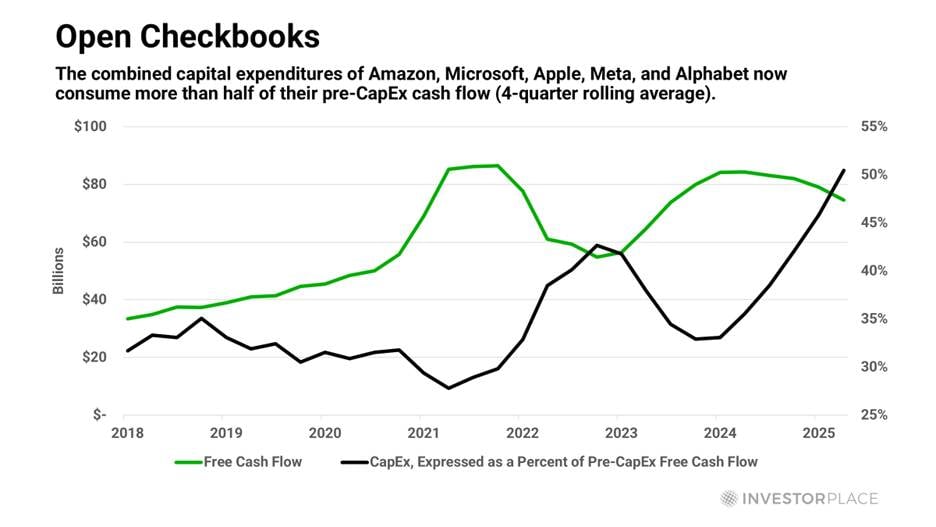
The popular storyline seems to be that these titanic investments, while onerous over the short term, will reap major benefits over the long term. While that remains to be seen, there is no denying that data centers are already reshaping the national power grid. A single hyperscale campus typically draws 50–100 megawatts (MW), the equivalent of tens of thousands of homes. Dominion Energy Inc. (D) serving Virginia’s “Data Center Alley,” forecasts 7 gigawatts (GW) of new demand by 2035 from data centers alone. That’s larger than the entire load of some regional utilities. Looking nationwide, Bain & Company estimates that AI compute in the U.S. will require 100 GW of new power capacity by 2030, half of which will be in the U.S. That’s like adding the entire power generation capacity of South Korea in just five years. More energy consumption means higher energy costs… and higher power bills. According to the U.S. Energy Information Administration, data centers accounted for 4% of total U.S. electricity use in 2024. Future data usage is expected to increase 6-12% by 2028. In the electricity market run by PJM Interconnection, which covers a large portion of the eastern United States, demand from new data centers has already begun pushing up power costs. In the region’s 2025-26 “capacity market” (the advance payment to power plants to guarantee future electricity supply), data center demand drove an estimated $9.3 billion increase. As a result, monthly electricity bills could rise $18 in western Maryland and $16 in Ohio. Americans may see more widespread price hikes in coming years. A study from Carnegie Mellon University estimates that data centers could lead to an 8% increase in the average U.S. electricity bill by 2030. Hikes in energy prices have already caused public backlash against data centers. In September 2025, Google dropped plans for a new data center in Franklin Township, Indiana, after residents organized a months-long campaign against the project. One of their biggest concerns was the potential rise in electricity costs for local households. Big Tech’s “Ratepayer Protection Pledge” is aimed at drawing support from towns and cities, like Franklin Township, that oppose the foundational AI infrastructure. And if local backlash is calmed, it could speed up approvals for new AI data center buildouts. The pledge could effectively give Big Tech a “social license” to expand, especially if the expansion doesn’t raise household electricity prices. To restate, if the pledge produces concrete commitments or remains largely symbolic remains unknown, at least for now. But it could spell a bullish run for a specific group of stocks. And it’s best to get in early… | Recommended Link | | | | Big institutions MUST own the Magnificent 7 tech stocks even when it’s a bad idea. But you have much better options right now. Get Eric’s free trade ideas for “upgrading” your portfolio from AI Victims to AI Survivor Stocks right here. |  | | The Hidden Engine Powering Data Centers More data centers means that the entire physical infrastructure behind AI – chips, electricity, servers, cooling – will benefit if construction accelerates. These companies will be the obvious, and earliest, beneficiaries of AI data center expansion. But there is also one component that makes everything in the AI world work. Without it, even the most powerful AI chip, including Nvidia is just expensive silicon. See, when you build an AI data center, thousands upon thousands of servers must be installed. But here’s the kicker: Those servers are useless unless they can talk to and learn from each other. And the way they communicate is through fiber-optic cables. New AI hyperscalers need 10X more cables than regular data centers. That’s enough fiber to circle the globe eight times – in a single facility. To harness that growth, I’ve got a pick that fits squarely in the category of stock I love the most – overlooked and underhyped. This company quietly built the backbone of the internet, while scores of companies boomed and busted. And now, as AI explodes, it is a leading supplier of what every data center desperately needs. High demand means customers are inking deals with the company to reserve product ahead of time to edge out competitors. Already, 80% of the AI fiber-optic cable this company makes over the next five years is spoken for. And it is manufacturing most of it right here in America. This means virtually no tariffs and no trade restrictions for its U.S. customers. Here’s the best part… While Nvidia’s biggest customers are turning into competitors, nobody is trying to manufacture their own optical-fiber cables. So, AI hyperscalers are all fighting to get more cables from this company, not replace them. That’s continual, compounding reward. I share the name of this company in my free, special broadcast. Click here to learn more. Regards, | 






No comments:
Post a Comment