| Plus: How the EU could unravel | |
| |
| Welcome to the weekend! A dystopian scenario posted on Substack from a little-known firm called Citrini Research went viral this week, and helped spark a selloff in Uber, DoorDash and American Express. It was titled, "The 2028 _____ Crisis." See if you can fill in the blank with this week's Pointed quiz. Speaking of filling in blanks, Bloomberg This Weekend launches today on Bloomberg TV, Bloomberg Radio, Bloomberg.com, YouTube and wherever you get your podcasts. Starting at 7 a.m. ET each Saturday and Sunday, David Gura, Christina Ruffini and Lisa Mateo host in-depth conversations with lawmakers, business leaders and cultural icons. Don't forget to train your brain with today's Alphadots word puzzle, and check out tomorrow's Forecast on Apple's visual intelligence dreams. For unlimited access to Bloomberg.com, please subscribe. | |
| |
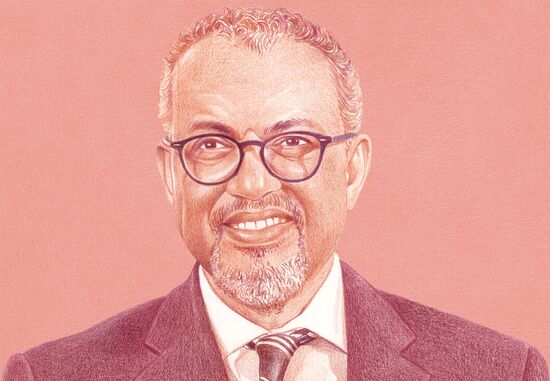
| When the World Health Organization was established in April 1948 to coordinate responses to shared health threats, the US was a founding member. Nearly 80 years later, it has carried out President Donald Trump's pledge to withdraw, exiting the WHO as its largest donor and leaving $260 million in unpaid fees. Trump has floated creating a parallel global health body, but WHO Director-General Tedros Ghebreyesus says his office remains in contact and hopes the US will one day return. "It's not about the money," he tells Mishal Husain. "[The US] can continue [its leadership] for the benefit of humanity." | |
| |
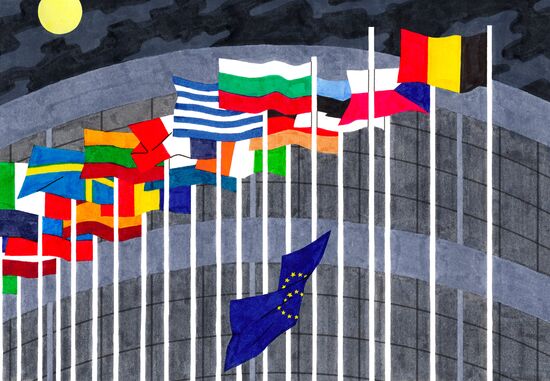
| The strain on institutions built to manage shared threats extends beyond health. In Europe, the project of shared sovereignty under "ever closer union" is cracking. Ben Sills outlines three ways the European Union could unravel: US pressure forcing countries to choose between Washington and Brussels; nationalist governments hollowing out the bloc from within; or a slow drift into irrelevance. There may be no single switch to undo decades of integration, but the combination of Trump, euroskepticism and political inertia are testing whether the EU can still act as one. | |
| |
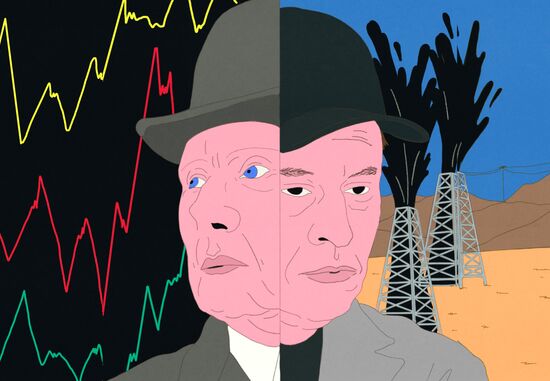
| Power isn't only pooled; it can also be concentrated. As Elon Musk edges toward the world's first $1 trillion fortune, Ben Steverman looks back at the first billionaire, John D. Rockefeller. By 1915, Rockefeller had assembled the largest private fortune in history — and helped reshape markets, politics and public opinion. The backlash it provoked ushered in trust-busting, taxes and a rethinking of how much power one person should wield. If a trillionaire is coming, history suggests the question isn't just how rich — but how influential — that person will be. | |
| |
| |
| United States
On Boston's South Shore, Kyle Donohue paints seascapes and walks the coast — nearly five years after doctors told her she likely had a year to live with glioblastoma, the deadliest brain cancer. After surgery and an experimental virus therapy, she's now one of a rare group of "long-term survivors" reshaping the science. Researchers have found the tumor doesn't just grow in the brain; it wires into it, forming networks that help it spread and resist treatment. By studying the lucky few, they hope to cut its power source. 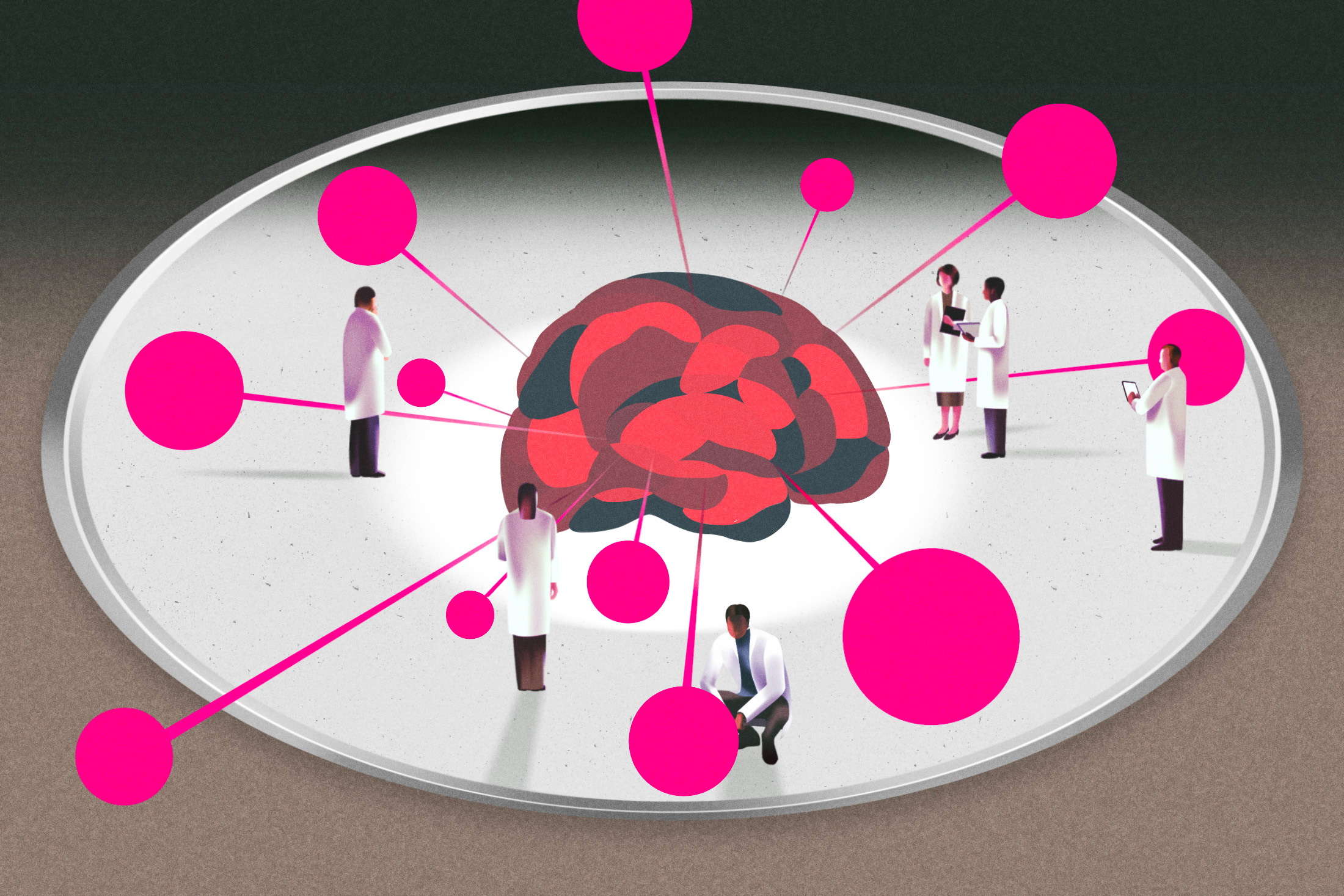 Illustration: Ard Su for Bloomberg Denmark
In a high-security farm in rural Denmark, $3,000 minipigs play with toys, roam pristine corridors and live under geothermal climate control — all in service of Europe's drug pipeline. Bred by Ellegaard Göttingen Minipigs, the animals have helped advance treatments from Ozempic to experimental therapies for cancer and Alzheimer's. After Covid-era monkey shortages exposed the fragility of supply chains, the EU is investing in minipigs as a hedge against geopolitical shocks — and in a bid to make its biotech sector more self-reliant.  Illustration: Ibrahim Rayintakath for Bloomberg | |
| |
| The legacy of Trump's tariffs isn't economic. The emergency levies raised hundreds of billions but barely dented the trade deficit or inflation. The Supreme Court drove home the bigger point: Taxing power rests with Congress. The real risk of AI is a loss of purpose. As technology eats into knowledge work, Keynes' old prediction of abundant leisure looks less fanciful. The challenge may be what replaces the identity, status and meaning that work once provided. | |
Galaxy Brain | | "Consciousness is to humans what water is to fish, omnipresent and largely unexamined." | | Tiffany Ap | | In his new book A World Appears, Michael Pollan doesn't claim to solve the "hard problem" of consciousness; he explores it. Moving from neuroscience labs to a Zen cave retreat, he asks what it feels like to be a mind — and whether machines could ever share that inner life. | | |
| |
| Steak in a time of beef-flation: Yes, with substitutions. Prices are up, and yet Americans are set to eat more beef than they have in 15 years. The shift isn't away from steak; it's swapping rib eyes for sirloin, chuck or clever "house cuts." $1,899 liquid rhinoplasty: If you want a subtle tweak versus a new nose. It's cheaper than the $7,637 average surgical rhinoplasty — but it's temporary, off-label and carries real risks. For refinement, maybe. For permanence, save for surgery. $4.99-a-pound ube puree: Maybe! The nutty, vanilla-adjacent yam is quite versatile, and US demand is booming. But prices have doubled since 2019 and supply is strained. Worth it for real cooks. But if you just like the color? Maybe skip. Scarpetta (Prime Video): If crime dramas are your jam. Nicole Kidman plays Patricia Cornwell's forensic pathologist, with Jamie Lee Curtis in tow and a serial killer to catch. Not groundbreaking, but gripping. Sweetgreen's Ripple Fries: Too late — but you didn't miss much. The concept sounded clever: air-fried crinkle cuts in avocado oil. In practice, they were labor-intensive, inconsistent and ultimately pulled after bogging down kitchens. A $2,899 Samsung Galaxy Z TriFold: Not yet. The 10-inch foldout screen is dazzling for video and multitasking, but it's heavy and nowhere near a true laptop or tablet replacement. For most people, a cheaper foldable is the smarter buy.  Photographer: Chris Welch/Bloomberg | |
| |
| |
| |
| |
| Enjoying Bloomberg Weekend? Check out these newsletters: - Businessweek Daily for fresh perspectives on business, economics, politics and tech.
- Business of Food for a weekly newsletter on how the world feeds itself in a changing economy and climate, from farming to supply chains to consumer trends.
- Pursuits for a guide to the best in travel, eating, drinking, fashion, driving and living well.
- Screentime for a front-row seat to the collision of Hollywood and Silicon Valley.
Explore all newsletters at Bloomberg.com. | |
| |
Like getting this newsletter? Subscribe to Bloomberg.com for unlimited access to trusted, data-driven journalism and subscriber-only insights. Before it's here, it's on the Bloomberg Terminal. Find out more about how the Terminal delivers information and analysis that financial professionals can't find anywhere else. Learn more. Want to sponsor this newsletter? Get in touch here. | | | You received this message because you are subscribed to Bloomberg's Bloomberg Weekend newsletter. If a friend forwarded you this message, sign up here to get it in your inbox. | | |









No comments:
Post a Comment