Friday, February 13, 2026

Send flowers to men too

Advice from the UrbanStems CEO
View in browser
Bloomberg

Tomorrow is Valentine's Day, and, if you opened this newsletter in time, UrbanStems says it isn't too late to order flowers for your sweetheart. Bloomberg Businessweek senior editor Anne Riley Moffat talked with the company's CEO about the economics of flowers. Plus: Why public money boosted Heated Rivalry, how Chinese spies accumulated plane-building know-how, and what the Epstein files say about missing art. And a new episode of the Everybody's Business podcast.

If this email was forwarded to you, click here to sign up. Programming note: Businessweek Daily will be off Monday for Presidents Day. See you Tuesday.

Florists are in the final sprint ahead of Valentine's Day, the industry's second-busiest holiday of the year (behind only Mother's Day). Meenakshi Lala, chief executive officer of UrbanStems Inc., an online flower-delivery company started in 2014, spoke with Bloomberg Businessweek about lower-income shoppers increasingly sitting out, the challenges of managing suppliers all over the world and her uphill effort to persuade customers to buy bouquets for the men in their lives. This interview has been edited for clarity and length.
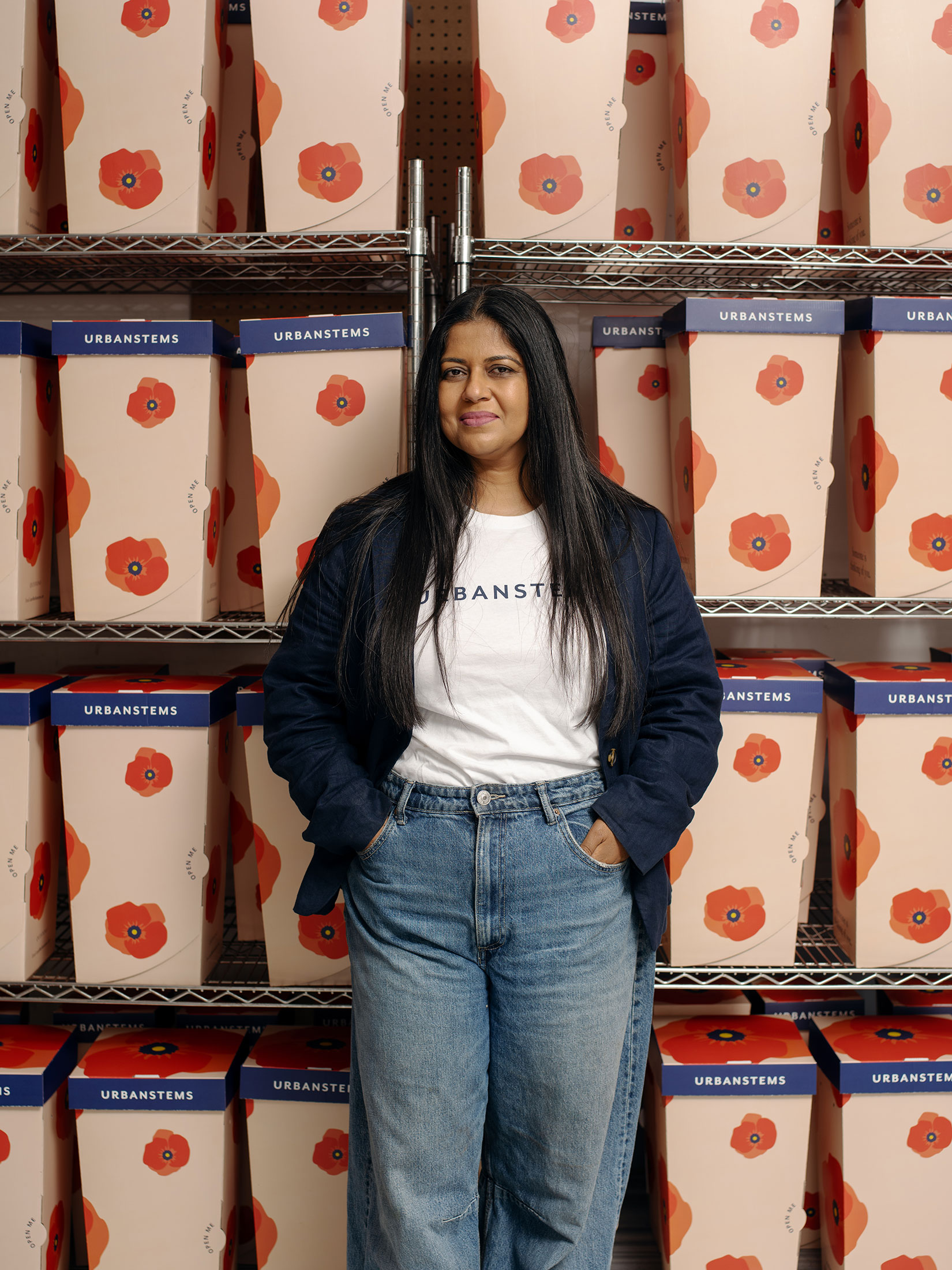
Lala at the New York distribution center for UrbanStems. Photographer: Bryan Thomas for Bloomberg Businessweek

① What can you tell about the American consumer today based on their online flower purchases?

The financial data shows that 59% of all consumer spending is being led by 20% of earners, and we are absolutely seeing that behavioral trend. We see our premium products and average order value being significantly higher year-over-year. But we are definitely seeing a decline in the more commodity purchases, which in moments like Valentine's Day are really critical for scale. That's the consumer who's having a harder time purchasing groceries and paying bills, and at the end of the day, gifting becomes discretionary. It's a choice they have to make, and we see a lot of people opting out of that choice.

② Your flowers come from 13 countries, primarily in South America and Europe. How have President Donald Trump's tariffs and supply chain issues affected that part of the business?

I spent 20 years of my life in fashion retail before coming to UrbanStems, and tariffs are something that fashion retail has dealt with for many years. Businesses that have the ability to be agile and pivot and be smart about how they can tackle these headwinds are the ones that eventually survive. It was definitely challenging: The South American tariffs went into effect three weeks before Mother's Day, our biggest week in the year. Tactically, of course, we had to pivot our supply chain. We had to move around, source farms in alternate locations, farms that are more agile, have a higher scale and are able to offer us better pricing options.

③ In terms of trade, if a T-shirt sits in a box at a port for two weeks while they figure things out, the T-shirt's going to be OK. But flowers obviously have a shelf life. Does it take longer to import stems today?

Flowers absolutely are susceptible to shelf life. From the time the farmer decides the flowers are ready for cutting to the time they reach your coffee table, it's a 21-day lead time. The flowers cannot last beyond that point. Once they land in country, clear customs and arrive at our fulfillment center, we have five days to get them to your doorstep. Day five, any product that is in our fulfillment centers that is unsold literally goes to the trash can. There is no T.J. Maxx for flowers. It has required a lot of close communication and management by our supply chain and logistics teams and partnerships with our farms and the airlines to ensure that there are no delays. During the government shutdown, if a team didn't show up at the facility to perform agriculture checks to release the shipments, we'd be at serious risk of losing that entire delivery. It didn't happen, knock on wood. But that was a very serious risk, and there were a lot of close calls.
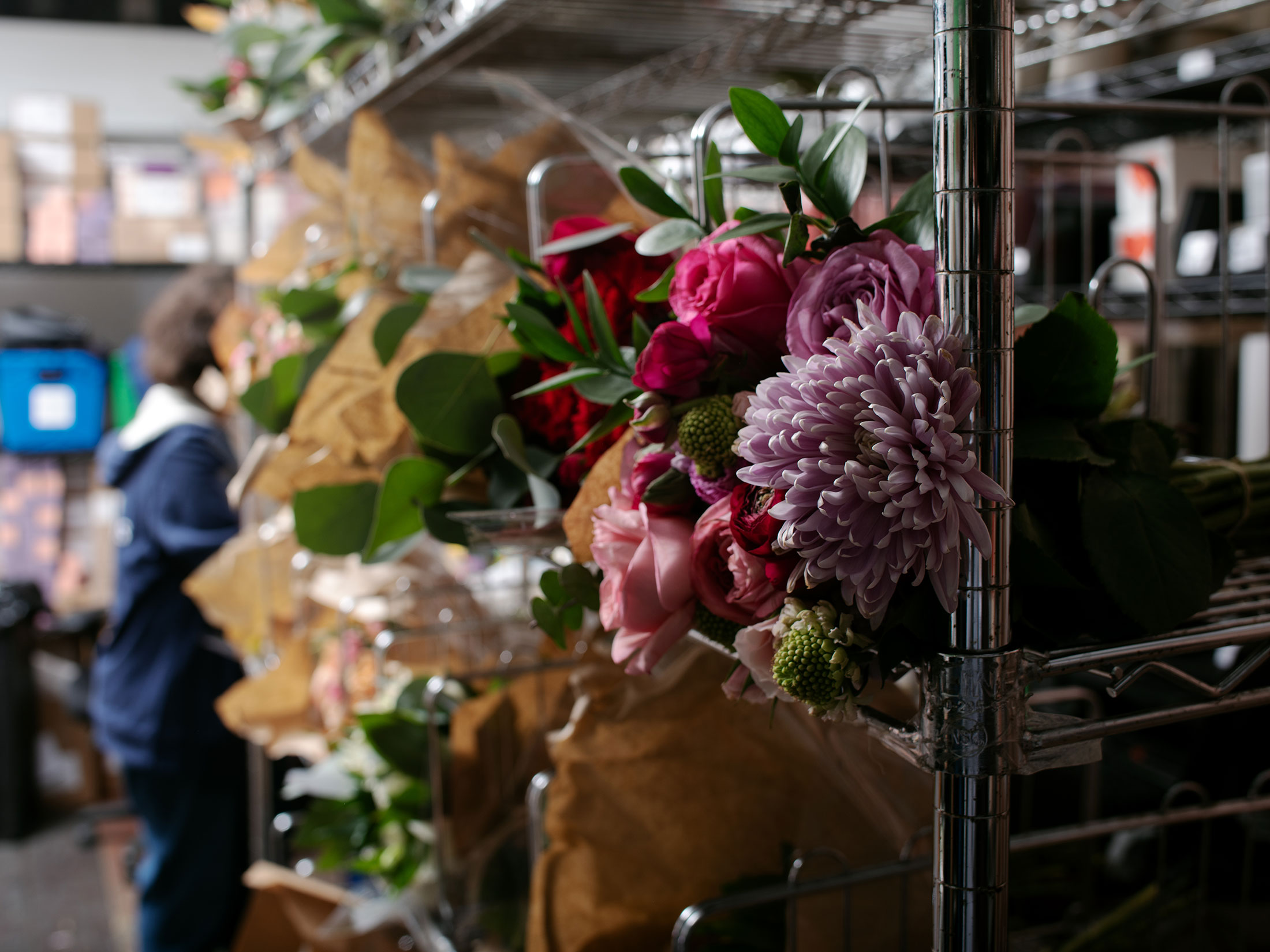
Bouquets prepared for delivery at the New York distribution center. Photographer: Bryan Thomas for Bloomberg Businessweek

④ I had wanted to ask you about what kinds of recession indicators we should look for in flower purchases, but UrbanStems wasn't around during the 2008 financial crisis, and the Covid-19 pandemic was actually good for online gifting companies like yours. So what are you watching for?

Right, the business doubled its revenue year-over-year in Covid. For our business, the Covid recession was just a tailwind. But what we watch for is behavior patterns that are traditional to any consumer packaged-good company: opening price point, shopping behavior, lifetime value. If you were a customer who shops five or six times a year, are you still shopping five or six times? What is your lifetime value? Has that shrunk? Is your repeat behavior—30-, 60-, 90-day behavior—still the same or are you switching and shopping for a card versus flowers? We haven't seen any obvious data signs yet that tell us that the customers are leaning one way or the other.

⑤ Women make up a huge portion of your customers. Do you ever see that changing?

There's a statistic that 80% of men don't get flowers in their life until their funeral. It's a devastatingly sad statistic. We are a very female business from a demographic and customer perspective, and our approach is to constantly speak to them about gifting to men in their life. We're trying to figure out ways to work with influencers and other partner brands that are going after that male consumer so we can create this change in behavior. If you think your boyfriend or your husband or your father or your brother deserves some fresh flowers in their life, send them flowers.

In Brief

  • Kathy Ruemmler is leaving her position as Goldman Sachs' top lawyer, ending the firm's monthslong attempt to defend her previous association with late pedophile Jeffrey Epstein.
  • Just weeks into a US pressure campaign to halt all oil shipments to Cuba, a Bloomberg News analysis of satellite imagery finds the level of light at night has dropped as much as 50%.
  • The attorneys general for New York and New Jersey said they expect the Trump administration to restore federal funding for the $16 billion Gateway tunnel under the Hudson River.

Get the Bloomberg Businessweek print magazine delivered to you and unlimited access to Businessweek stories on Businessweek.com. Annual subscription for $99.

On the Podcast

According to the latest jobs numbers, the economy is on fire, but who's benefiting and who's still struggling? On this week's episode of the Everybody's Business podcast from Bloomberg Businessweek, economist and author Anna Gifty Opoku-Agyeman joins co-hosts Max Chafkin and Stacey Vanek Smith to talk about the hidden costs of Black womanhood. And then, business journalist Lauren Sherman follows the thread on why designers and consumers are feeling worn out during New York Fashion Week.

Listen and subscribe on Apple, Spotify, iHeart and the Bloomberg Terminal.

Fraser's Payday

$42 million
That's how much Citigroup CEO Jane Fraser was compensated for 2025, putting her among the highest-paid US banking heads. The 22% increase, disclosed in a filing on Thursday, follows a year in which Citigroup's stock rose 66%, more than any other Wall Street bank.

Thank Taxes for Heated Rivalry

Photo illustration: Ryan Haskins; Photos: Getty Images (3)

For many Americans, Canada's publicly funded health-care system has long been a source of envy and fascination. But lately, millions of US consumers have been basking in the enriching benefits of another, quasi-socialized aspect of Canadian life—namely, its publicly funded entertainment system.

Heated Rivalry, the steamy Canadian series about a pair of pro hockey hunks who become romantically entangled, premiered late last year on the streaming service Crave in Canada and on HBO Max in the US. In the months since, the show has become a cultural phenomenon on both sides of the border, racking up surprisingly good ratings for a modestly budgeted drama, inspiring a remarkable amount of thirsty fandom on social media and transforming several previously unknown cast members into celebrities.

And, as Melissa Shin and Felix Gillette write, none of it could have happened without Canadian taxpayers: The Sexy, Steamy Canadian Public Funding System Behind Heated Rivalry

Superpowers and Secrets

China is rapidly closing the gap with the US as the world's biggest passenger aviation market, but it remains almost entirely dependent on the US and Europe for advanced airplane technologies. China has worked for nearly two decades to change this through homegrown innovation and, according to US authorities, rampant intellectual-property theft. (China's Ministry of Foreign Affairs said in a statement that "the accusations by the US are completely fabricated.")

The secret-stealing mission has fallen to China's Ministry of State Security, which is believed to be one of the world's largest intelligence agencies. Bloomberg News reporting has focused on a sprawling FBI investigation into a specific unit within the MSS, the Sixth Bureau. The bureau has been tasked with stealing these secrets that China needs to build its own commercial planes—one piece at a time.

You can read more from Jordan Robertson, Victor Yvellez and Drake Bennett here: How Do You Steal an Airplane? One Piece at a Time

Or you can listen as part of a new podcast, The Sixth Bureau. Subscribe on Apple, Spotify, iHeart or wherever you get your podcasts, and learn more about the project here.

A Hot Market

"We're selling in Mecca for Monte Carlo prices." 
George Azar
Head of Sotheby's International Realty for Dubai, Saudi Arabia and the UK
Saudi Arabia is opening up the Mecca real estate market as it faces lower oil prices and pivots away from parts of mega projects like Neom.

Antiquities in the Epstein Files

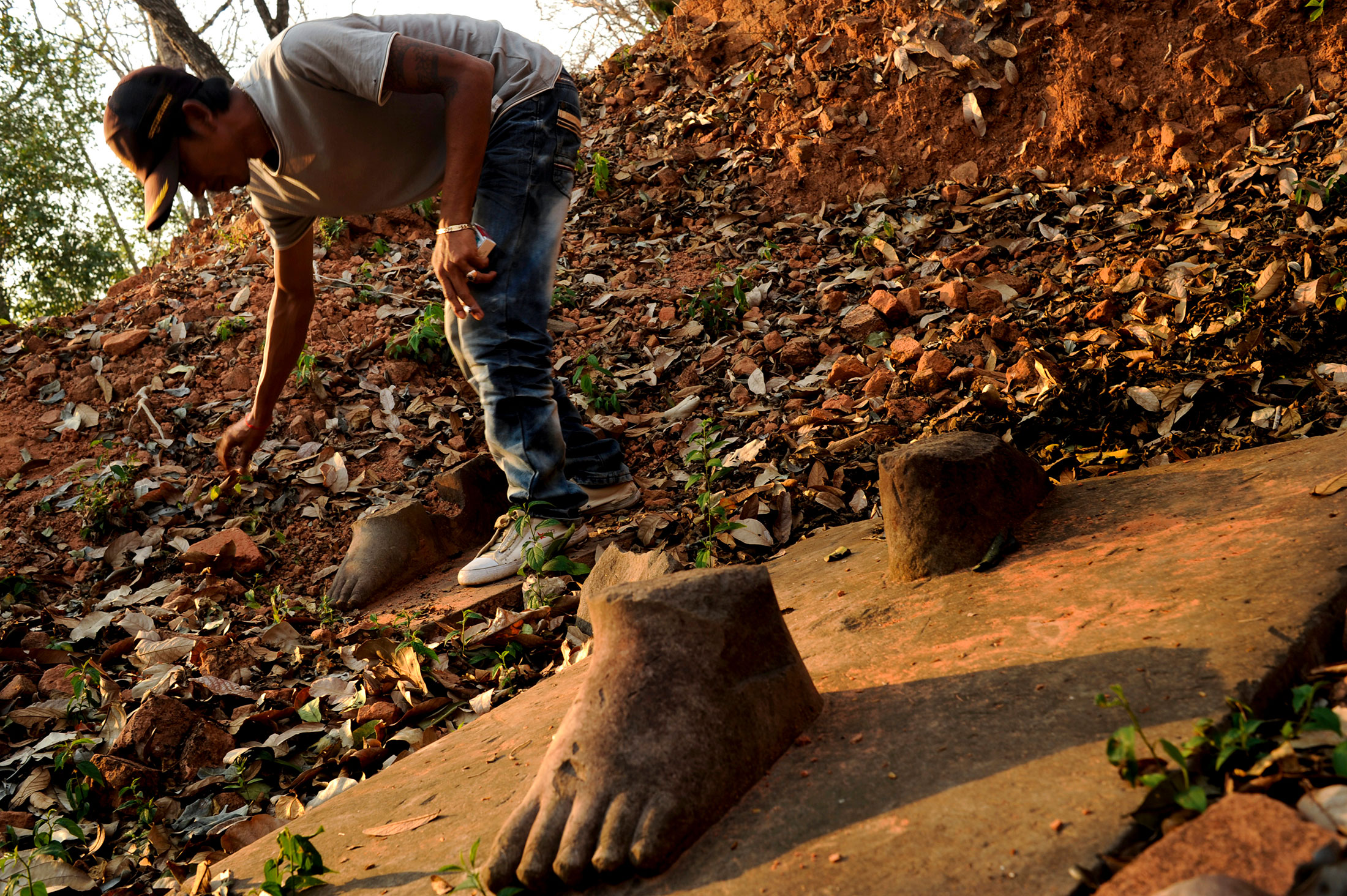
The pedestal and feet belonging to a Khmer statue in Koh Ker, Cambodia. Photographer: Agnes Dherbeys/The New York Times/Redux

For more than a decade, investigators for the US and Cambodian governments have been trying to trace the whereabouts of ancient sculptures stolen from the Southeast Asian country. In many cases the works were taken during Cambodia's civil war, by men associated with the communist Khmer Rouge. A significant clue just emerged from an unlikely source: the US Department of Justice's files on Jeffrey Epstein.

Among the millions of documents recently made public by the Justice Department are inventories of artworks held by Leon Black, the former chief executive officer of Apollo Global Management Inc., who paid Epstein for estate and tax planning advice and kept him apprised of plans for his art collection. They indicate that Black, a prolific buyer of marquee pieces such as a pastel version of Edvard Munch's The Scream, was also interested in the works of the Khmer Empire, the civilization that produced Angkor Wat and other spectacular temples in Cambodia.

Matthew Campbell, who's written about the country's trafficked antiquities, has the latest: Epstein Files Contain a Big Clue About Cambodia's Missing Masterpieces

Play Alphadots!

Our daily word puzzle with a plot twist.

alphadots

Today's clue is: Play favorites?

Play now!

More From Bloomberg

Like Businessweek Daily? Check out these newsletters:

  • Odd Lots, with Joe Weisenthal and Tracy Alloway, explores the most interesting topics in finance, markets and economics.
  • Power On, with Mark Gurman, has the inside scoop on all things Apple and consumer tech.
  • Washington Edition follows Trump's second term through the lens of business, markets and the economy.
  • Bloomberg Weekend discusses big ideas and open questions in the fascinating places where finance, life and culture meet.
  • Business of Food covers how the world feeds itself in a changing economy and climate, from farming to supply chains to consumer trends.

Explore all Bloomberg newsletters.

Follow Us

Like getting this newsletter? Subscribe to Bloomberg.com for unlimited access to trusted, data-driven journalism and subscriber-only insights.

Want to sponsor this newsletter? Get in touch here.

You received this message because you are subscribed to Bloomberg's Businessweek Daily newsletter. If a friend forwarded you this message, sign up here to get it in your inbox.
Unsubscribe
Bloomberg.com
Contact Us
Bloomberg L.P.
731 Lexington Avenue,
New York, NY 10022
Ads Powered By Liveintent Ad Choices

No comments:

Post a Comment

4 Hidden Gem Stocks Are Powering the AI Boom!

While chipmakers and software names dominate headlines, four under-the-radar infrastructure stocks have quietly surged 50% or more year to...