| Read in browser | ||||||||||||||
 Policy-wise, 2025 was a tough year for renewables in the US. But that still didn't stop them from setting records for power generation. Today's newsletter breaks down what new data shows us. Plus, Washington, DC, isn't the only global capital with a sewage spill problem. Wellington, New Zealand, is also contending with what its mayor called a "catastrophic failure." But that didn't stop him from taking a dip in the affected waters. With that, let's dive in (to the newsletter)! Powering upBy Kyle Stock US utilities generated a record amount of energy from renewable sources last year, even as the Trump administration implemented a range of policies to stymie green energy. Some 1,162 terrawatt-hours of the country's electricity was generated from renewable sources in 2025, a 10% increase over the prior year, according to federal data released this week. That represents 26% of all US electricity made — enough to power about 108 million US homes for a year. Some months were even greener; in March, for example, renewables generated nearly one in three of the country's electrons. 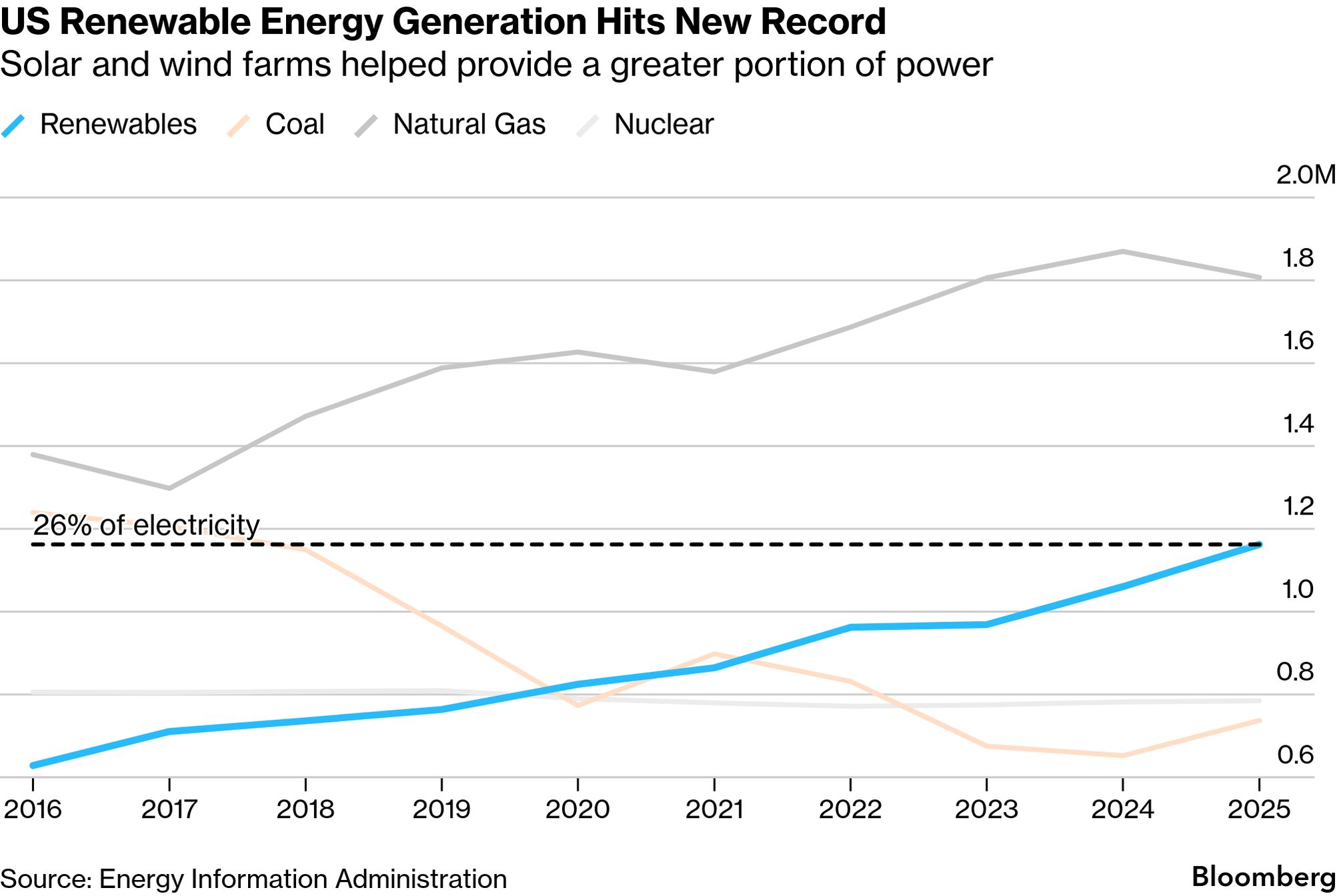 That stands in contrast to the Trump administration slashing incentives for wind and solar while gutting clean air regulations in a bid to help fossil fuels. The economics of renewables, though, have helped them generate a greater share of energy. "Renewables continue to grow, as much as headlines point to natural gas being king right now," said Patrick Finn, principal analyst at Wood Mackenzie, an energy research company. "Even though there's plenty of hurdles for renewables coming out of DC, we're coming out of four years where there weren't a lot of hurdles." While it was a good year for renewables, the surge in energy demand from data centers, electric vehicles and industry also boosted power generated from fossil fuels. That includes a 13% increase in electricity generated from coal. The Trump administration has also supported fossil fuel production and use with grants and orders to delay plant closures. However, renewables are outpacing those gains, driven by the falling cost of photovoltaic cells, wind turbines and giant batteries. Even without subsidies, renewable installations are now cheaper to build than alternatives in most scenarios, according to Lazard. Amanda Levin, director of policy analysis at the Natural Resources Defense Council, said the pace of green energy construction may actually accelerate as utilities race to beat deadlines for expiring federal incentives. 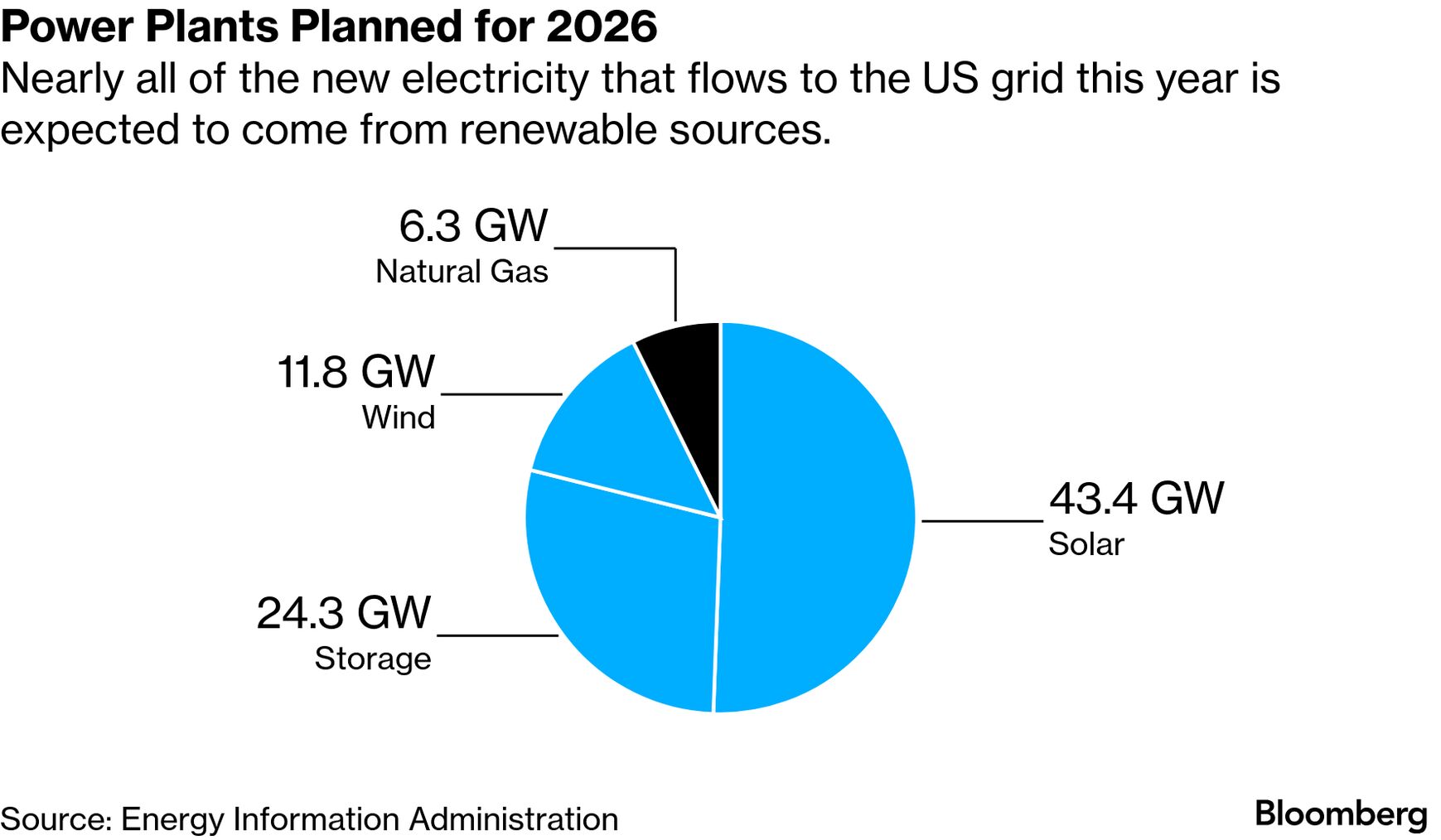 The government estimates that 93% of new generation capacity expected to be added to the grid this year will come from wind, solar and batteries. That sets renewables up to generate an increasingly large percentage of all US power. Wood Mackenzie expects renewables, including hydroelectric power, to account for nearly one in three US electrons by 2030. "The only technologies to be deployed today at scale and at cost are wind, solar and battery storage," Levin said. "No matter what Trump tries to do, he's not going to see this resurgence of fossil fuels." Read the full story. You can subscribe to Bloomberg News for the latest on the energy transition and climate policy. Winds of change12.7 The number of gigawatts of wind power in the pipeline for 2027, according to Wood Mackenzie and the American Clean Power Association. The outlook for wind dims after that, though, as Trump's policies take their toll. Transition talk"The second part of the energy transition, and the one that's most frequently forgotten, particularly in the West, actually, is electrification. You have to electrify everything." Kingsmill Bond Strategist, Ember The first step, of course, is winding down the use of fossil fuels. Eww ZealandBy Ainsley Thomson About 70 million liters a day have been discharged since an incident Mayor Andrew Little has called a "catastrophic failure" on Feb. 4 at the city's main wastewater treatment plant, which serves about 180,000 residents. Strong winds and swells have threatened to whip the effluent closer to the shoreline, while residents have been enduring a sulfurous odor. It's been a surprising environmental hiccup in a country better known for its pristine natural beauty, and one that so far remains unexplained. An initial assessment has shown 80% of equipment at the Moa Point wastewater plant has been irretrievably damaged, and there's no timeframe yet on when the site will be operational again. While similar breakdowns are often linked to aging infrastructure, Little noted the Moa facility is less than 30 years old, well within its expected lifespan. "There's something else that has happened," he said. "We still need to get to the bottom of that." 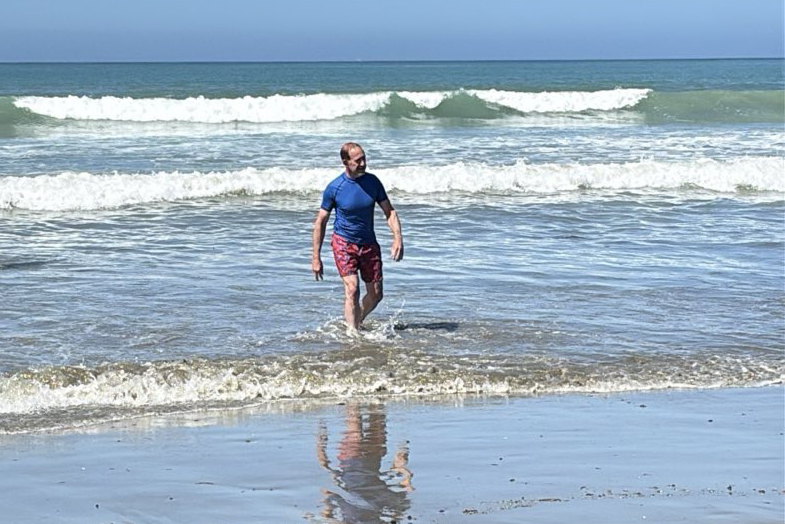 Wellington Mayor Andrew Little. Source: Office of the Mayor of Wellington New Zealand's government is setting up an independent review to work out what caused the failure. A spokesman for Veolia Environnement SA, which has a contract to operate the facility, declined to comment. In the meantime, beaches have reopened and Little is attempting to assure residents that the spill no longer poses risks to public health, with contamination well within safety standards. On Wednesday, he even took a dip himself at Lyall Bay, one of the impacted locations. "I don't want to give the impression that discharging millions of liters of untreated sewage into the sea is ok. It never is," Little said. "But we've got to be realistic with Wellingtonians too. If the testing is showing there's no real risk, we can't credibly keep saying to people to stay away from the beach." More from GreenFirefighters in southwest Florida are battling an expansive blaze on a federal nature preserve as an unusually intense winter drought grips the state. The National Fire has burned more than 25,700 acres — an area larger than Manhattan — since Sunday in the Big Cypress National Preserve south of Naples. The region is a popular tourist destination known as "Alligator Alley" for its plentiful wildlife. Fire risk in the preserve has ramped up since a historic deep freeze hit Florida in late January, which brought rare snow and left citrus groves tinged with damaging frost. Temperatures in the state plunged low enough to kill off small plants and grasses that are now tinder-dry and rapidly burning, said Michelle Lewis, a public information officer for the preserve. Winds picked up early in the week, fanning the blaze. "What is abnormal is the combination of all those things," Lewis said. "That's made this a bit more challenging." Read the whole story to see what this weekend holds. 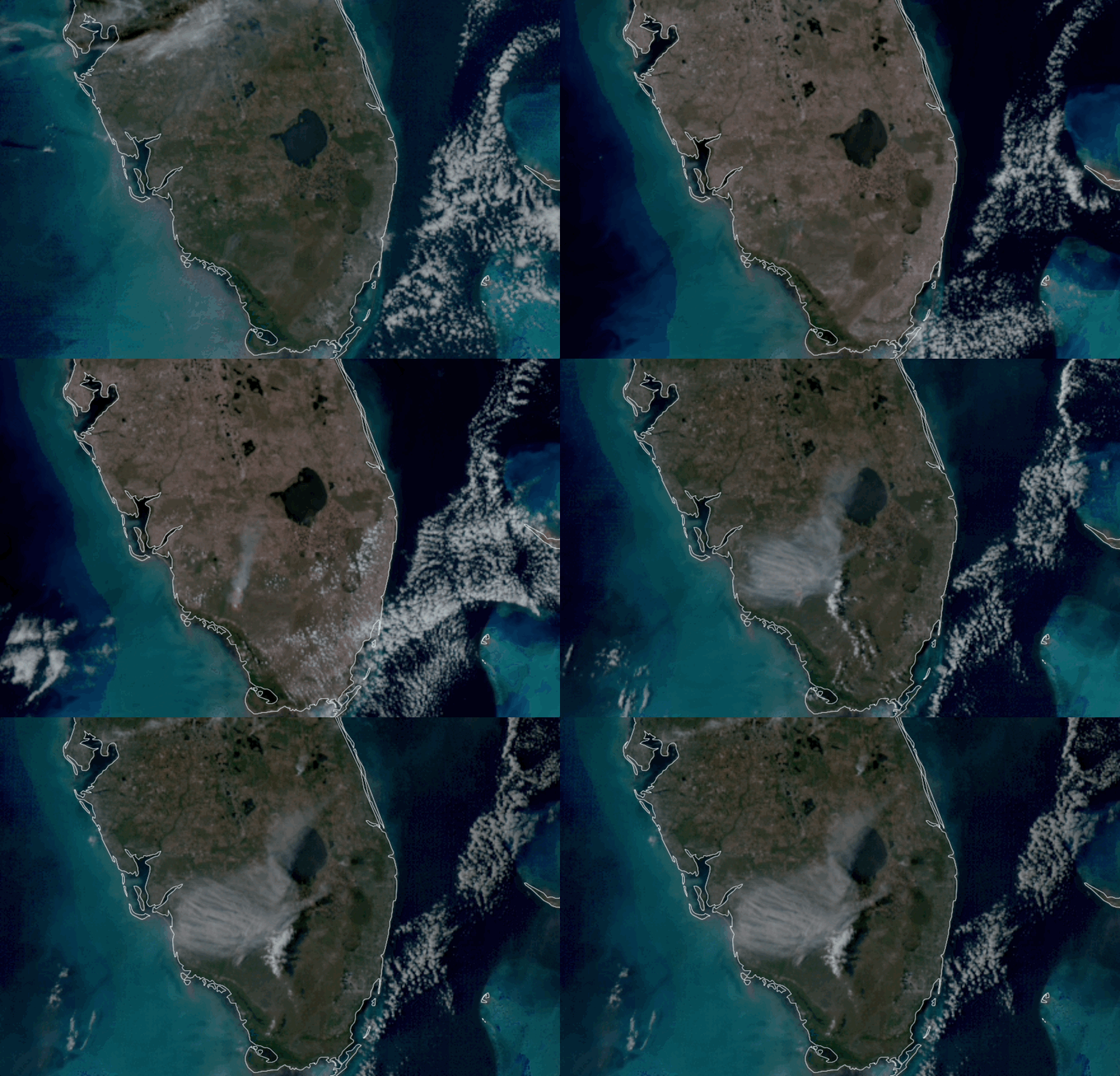 Satellite images show the large smoke plume rising from the National Fire on Wednesday. Photographer: CIRA RAMMB The US climate forecasting service will be absorbed into other federal departments as part of a reorganization announced to staff on Thursday. The changes come after a year in which the Trump administration has taken multiple steps to dismantle climate science programs and defund key research. Vanguard is paying $29.5 million to Texas, the state said. The settlement is in response to a lawsuit brought by a dozen states that accused the asset manager of colluding to manipulate the energy market and reduce coal output. Britain is planning to rely more heavily on the market to deal with floods. Flood Re, a state-backed insurance program, now plans to "layer up" on cat bonds, said Chief Executive Officer Perry Thomas. This week's Zero Societal collapses happen more often than you think, and there's much we can learn from the past to avoid or, at least, delay another one. This week's guest on Zero is Luke Kemp, author of Goliath's Curse, which draws lessons from the rise and fall of societies over 5,000 years of human history. Akshat Rathi asks Luke whether our current moment — with climate change and AI — makes us uniquely vulnerable to societal collapse or more resilient than we might think. Listen now, and subscribe on Apple, Spotify or YouTube to get new episodes of Zero every Thursday.  More from Bloomberg
Explore all Bloomberg newsletters. Follow us
You received this message because you are subscribed to Bloomberg's Green Daily newsletter. If a friend forwarded you this message, sign up here to get it in your inbox.
|
Friday, February 27, 2026
Renewables’ new record





Subscribe to:
Post Comments (Atom)
Where to Put $100 Before Trump's New Tech Law Rolls Out
Jeff Brown was consulted by Congress on this - here's what he says comes next ...

-
PLUS: Dogecoin scores first official ETP ...
-
Swaps, memes, homes, tokens. View in browser Unicorn bucket We have talked a fe...


No comments:
Post a Comment