Eli Lilly vs. Novo Nordisk: A Tale of Two Stocks VIEW IN BROWSER Walk into any grocery store, and you’ll see it immediately: Coca-Cola on one shelf, Pepsi on the other. For decades, the two beverage giants battled for dominance, fueled largely by sugary, calorie-packed drinks. While consumers chose their favorite, investors learned something more important: When rivals compete, one stock usually pulls ahead. Ironically, one of today’s fiercest corporate rivalries isn’t about selling calories – it’s about helping patients lose them. In the fast-growing GLP-1 weight-loss market, two pharmaceutical titans are locked in a high-stakes battle for global leadership: Eli Lilly & Company (LLY) and Novo Nordisk A/S (NVO). Both companies dominate headlines. Both control blockbuster drugs. Both have reshaped the landscape of obesity treatments. But just like Coke and Pepsi, the stocks aren’t moving in tandem. And recently, the scoreboard has shifted. That’s why, in today’s Market 360, I want to walk you through this evolving rivalry – and show you why identifying true market leaders is critical in an environment where the wrong stock can cost you dearly. How GLP-1 Became a Global Megatrend Before we look at the scoreboard between these two companies, it’s worth understanding how both companies got here. GLP-1 drugs were originally developed to treat type 2 diabetes. Scientists discovered decades ago that a naturally occurring hormone helps regulate blood sugar and suppress appetite. Drugmakers eventually created longer-acting versions to improve glucose control. For years, these drugs were niche. But everything changed in 2017, when Novo Nordisk launched Ozempic. Patients not only improved their blood sugar – they lost meaningful weight. That discovery turned out to be a game-changer. More than 40% of U.S. adults are considered obese. Globally, hundreds of millions qualify. Wall Street now estimates the GLP-1 market could exceed $100 billion annually within the next decade. In 2021, Novo introduced Wegovy specifically for weight loss. Soon after, Eli Lilly entered with tirzepatide – first as Mounjaro for diabetes and later as Zepbound for obesity – delivering even stronger clinical results. In 2024, Novo Nordisk generated roughly $30 billion from Ozempic and Wegovy combined. Eli Lilly generated well over $15 billion from its GLP-1 portfolio and is growing rapidly. They’ve added hundreds of billions in market value to both companies. But while Novo Nordisk had the early lead, Wall Street now expects Eli Lilly to overtake Novo in obesity drug sales as production ramps and superior clinical data drive market share gains. | Recommended Link | | | | Forget about building an AI business – this is better. According to the New York Times, Elon Musk says “individuals… will be able to make money when they are asleep or at work.” Elon’s estimates indicate that you could make between $30,000 and $50,000 a year. Click here to learn more… |  | | The Scoreboard Moves Just yesterday, Eli Lilly received U.S. Food and Drug Administration approval for a label expansion of its blockbuster obesity drug, Zepbound. The approval allows Eli Lilly to offer a four-dose, single-patient-use KwikPen – giving patients a full month of treatment in a single device instead of weekly injections. At the same time, the company expanded its self-pay options through LillyDirect, with certain doses starting at $299 per month. It’s a meaningful development. It means greater convenience, broader access and stronger competitive positioning. Investors responded accordingly. Eli Lilly shares rose about 3% on the news, extending an already impressive run. Meanwhile, Novo Nordisk delivered disappointing news of its own. In a closely watched head-to-head trial, Novo Nordisk’s next-generation obesity treatment produced 20.2% weight loss over 84 weeks – falling short of the 23.6% delivered by Eli Lilly’s tirzepatide. The market reaction was swift. Novo Nordisk’s stock plunged 16% following the announcement. And today, the company announced that it will be slashing prices of its GLP-1 drugs by up to 50%, beginning in 2027, in order to defend market share and compete. Eli Lilly up. Novo Nordisk down. In the span of a single session, the contrast couldn’t have been clearer. What makes this shift even more notable is that Novo Nordisk got the early start in the GLP-1 space. For a time, it appeared to own the narrative, and the market rewarded it accordingly. But markets don’t reward first movers forever – they reward execution and results. When Eli Lilly entered the field with tirzepatide and began posting superior clinical outcomes and strong earnings momentum, the competitive balance began to change. Both companies remain leaders in the global GLP-1 market. But when one stock rises while the other falls sharply on competing developments, investors should pay attention. A Shift That’s Been Building This divergence didn’t appear overnight. In fact, for a time, I recommended owning both Eli Lilly and Novo Nordisk as leaders in the rapidly expanding GLP-1 market. But on November 22, 2024, the data began to tip the scales. That week, I stated that I thought Eli Lilly had “surpassed Novo Nordisk in becoming the market leader in weight-loss drug sales.” Based on that shift in competitive positioning and underlying fundamentals, I recommended selling Novo Nordisk while continuing to hold Eli Lilly. Shortly thereafter, new head-to-head trial data reinforced that decision. Eli Lilly’s Zepbound delivered 20.2% weight loss compared with 13.7% for Novo Nordisk’s Wegovy – a meaningful clinical advantage. From there, the fundamental gap widened. By late 2025, Eli Lilly posted an earnings surprise of more than 19%, driven by strong sales of its weight-loss drugs, while Novo Nordisk announced plans to lay off 9,000 employees as it worked to defend market share. And as recently as February 11, 2026, I said it plainly: Lilly has definitely got the lead right now, but Novo is trying to fight back. Throughout this period, my Stock Grader (subscription required) system reflected the same transition. 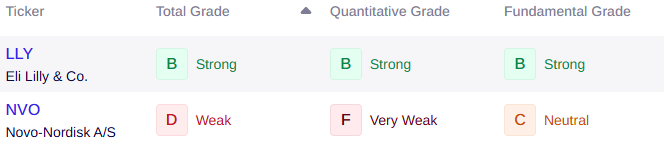
As you can see above, Eli Lilly currently carries a B-rating, while Novo Nordisk holds a D-rating – a clear divergence in earnings momentum, sales growth, relative strength and institutional support. Leadership Matters – Especially Now The market may debate narratives. But disciplined investors follow the numbers. The divergence between Eli Lilly and Novo Nordisk is a real-time example of what happens when markets begin separating leaders from laggards. For a while, both stocks benefited from the same powerful theme. But eventually, fundamentals take over. That’s when divergence begins. And once it starts, it can accelerate quickly. We’re seeing that separation clearly in the GLP-1 market. But this dynamic isn’t confined to healthcare. Across the broader market – especially in artificial intelligence – capital has become heavily concentrated in a narrow group of stocks. In Stage 1 of the AI boom, investors were rewarded simply for participating. Stage 2 is different – it’s when leadership narrows. When expectations collide with fundamentals. When the strongest companies continue advancing, and the weaker ones begin to break down. That transition is what I call the AI Dislocation. And I believe tomorrow, February 25, could mark a critical turning point in that shift. That’s why, in my latest presentation, I explain exactly why February 25 matters – and what could happen next. The divergence between Eli Lilly and Novo Nordisk happened gradually – and then suddenly. Market-wide dislocations tend to follow the same pattern. And when leadership narrows, capital moves fast. Investors who miss this shift risk holding yesterday’s winners in tomorrow’s market. So, if you haven’t watched the presentation yet, do it today. Because once this separation accelerates, repositioning becomes much harder. After tomorrow, the window to prepare may close quickly. Click here to watch now. Sincerely, | .png)
.png)






No comments:
Post a Comment