
How the Relationship Between XLK and XLP Reveals What's Coming Next
By Brandon Chapman, CMT
Hey trader,
Missing the shift from correction to bear market is one of the most expensive mistakes a trader can make.
By the time traditional indicators confirm it, the damage is already done.
Most traders rely on VIX spikes and chart patterns. But those tools measure reaction, not intention.
They tell you what already happened. Not what's about to.
There's a simpler signal hiding in sector rotation.
It lives in the relationship between two kinds of chips: silicon and potato.
This week I watched over 100,000 contracts hit XLP. That's not normal defensive positioning. That's someone preparing for something.
The "safe" sector is getting hedged hard. The place where scared money is hiding? Big money is buying protection against it.
I'll break down exactly what the options market is pricing in that most traders aren't seeing.
Join me this Monday at 2PM EST to see how it works.
Because when you understand what's happening between XLK and XLP, you're reading the market's actual intentions.
The Rotation Nobody's Talking About
Right now, money isn't leaving equities. It's hiding.
This creeping movement has been going on for months, but since the beginning of the year it accelerated greatly.
When money flows out of the technology sector, it flows into consumer staples. Plain as day, you see it in the chart.
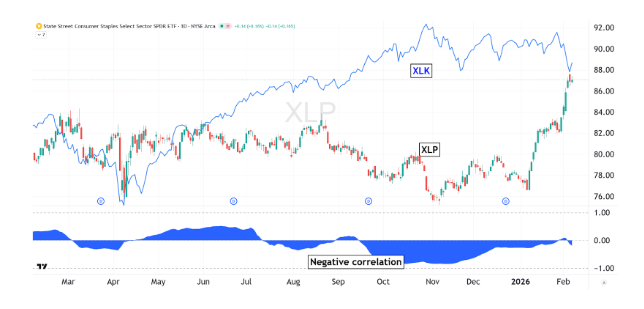
This dance reveals something critical. Institutional money is repositioning, not capitulating.
They're moving from growth to defense, from risk to safety. But they're not fleeing to cash. Not yet.
What Consumer Staples Tell You About Fear
Consumer staples are the market's bomb shelter. When investors get nervous, they rotate into Walmart, Procter & Gamble, and Coca-Cola.
These companies print cash regardless of economic conditions.
People still need toilet paper in a recession.
The past year shows this defensive rotation accelerating. XLP climbed from 76 to 86 while technology stumbled.
That's a 13% move in a sector that typically crawls.
Valuations are now stretched. Some staples trade at levels that would make even their CFOs blush.
But money keeps flowing in because fear trumps valuation.
This is not normal market behavior. This is preparation.
The Difference Between Rotation and Panic
In rotation, sectors move inversely. Tech down, staples up.
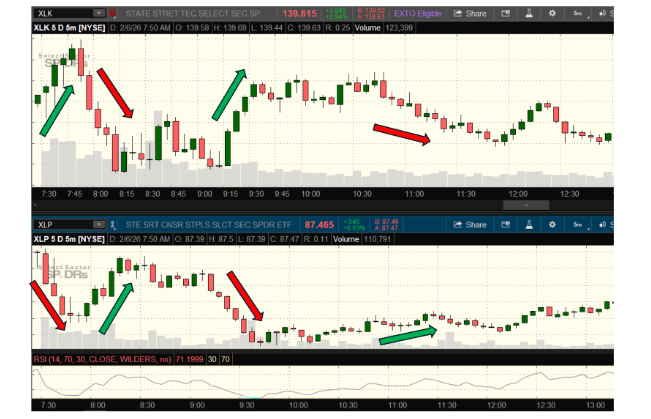
Money shuffles between asset classes but stays invested.
In panic, everything falls together. That is not what is happening right now.
Thursday's five-minute chart made this textbook clear. Technology rallied at the open while consumer staples sold off.
Minutes later, the pattern reversed. Heavy selling hit tech as staples surged higher.
Back and forth. Perfect negative correlation on a five-minute basis.
This pattern signals repositioning, not liquidation. Institutions are adjusting exposure, not hitting the exits.
But here's the crucial part. This behavior precedes bear markets more often than it prevents them.
When the Signal Breaks
The VIX can spike. The market can drop 1%.
None of it matters if money stays in equities.
Real distress looks different. When selling accelerates into genuine panic, the inverse correlation breaks.
Both sectors fall together. Tech and staples move in lockstep to the downside.
That's capitulation.
Thursday saw 2.4 times more volume in declining stocks than advancing. That's average for a down day.
Not exceptional. Not extreme. No capitulation. No bottom.
What This Means for Your Trading
Investors are nervous enough to seek safety but not scared enough to sell completely.
Bear markets often begin exactly like this. Gradual rotation. Defensive positioning.
Everyone thinks they're being smart by moving to staples.
Then something breaks. Credit spreads. Liquidity. Confidence.
When that happens, the inverse correlation flips. Both sectors fall together. Fast.
The Key Relationship to Watch
Forget the complex indicators. Watch XLK versus XLP.
When they move inversely, money is repositioning. The market can continue grinding in either direction.
But it means the market is in an elevated state of nervousness. A larger panic can start from here.
When they move together to the downside, money is leaving. That's your signal.
Right now we're seeing negative correlation. This can persist for months.
But when it breaks, it breaks fast.
The Bottom Line
Consumer staples are where scared money hides while still calling itself invested. They're the last stop before cash.
The real move comes when both sectors fall together. When staples can't hold.
We're not there yet. But we're getting closer.
Watch the relationship. When correlation flips from negative to positive, that's your signal.
Until then, understand what you're seeing. This isn't strength. It's fear dressed up as prudence.
The market always shows its hand through sector rotation. You just have to know where to look.
Ready to track institutional money flow in real-time?
Disclaimer: Neither TheoTrade or any of its officers, directors, employees, other personnel, representatives, agents or independent contractors is, in such capacities, a licensed financial adviser, registered investment adviser, registered broker-dealer or FINRA|SIPC|NFA-member firm. TheoTrade does not provide investment or financial advice or make investment recommendations. TheoTrade is not in the business of transacting trades, nor does TheoTrade agree to direct your brokerage accounts or give trading advice tailored to your particular situation. Nothing contained in our content constitutes a solicitation, recommendation, promotion, or endorsement of any particular security, other investment product, transaction or investment.Trading Futures, Options on Futures, and retail off-exchange foreign currency transactions involves substantial risk of loss and is not suitable for all investors. You should carefully consider whether trading is suitable for you in light of your circumstances, knowledge, and financial resources. You may lose all or more of your initial investment. Opinions, market data, and recommendations are subject to change at any time. Past Performance is not necessarily indicative of future results.


No comments:
Post a Comment