| Welcome to Bw Reads, our weekend newsletter featuring one great magazine story from Bloomberg Businessweek. Today Ana Castelain writes about a handful of new contraceptive methods in trials, but the big question is: Can companies get men to buy in? You can find the whole story online here. If you like what you see, tell your friends! Sign up here. "All I have is sperm," Akash Bakshi says. "I'm just looking at sperm counts." Every day the co-founder of YourChoice Therapeutics arrives at his startup's office in San Francisco to do this work. A biochemist by training, Bakshi could become the first biotech company chief executive officer to bring a hormone-free male birth control pill to market. The pill his team developed, YCT-529, works by blocking a vitamin-A-dependent protein essential for sperm growth, temporarily rendering men infertile without affecting their testosterone levels and thereby potentially introducing related side effects. Phase 1 human clinical trials showed it was well tolerated, and Bakshi says early results in Phase 2, which is focused on both safety and efficacy, are promising.  Bakshi outside his office in San Francisco. Photographer: Rachel Bujalski for Bloomberg Businessweek Currently the only widely used forms of contraception available to men are condoms and vasectomies. There's a substantial potential market for other methods. A 2018 study in Lancet Global Health found that almost half of all pregnancies in the US and worldwide are unintended. Another study, published in 2024 in the journal Contraception, placed the potential US market for new male contraceptives at 7 million to 15.5 million men. And an earlier assessment of the global market, from 2016 in Springer Nature, estimated it at anywhere from $40 billion to $200 billion. Alongside YCT-529, three other products are in human trials: a hormonal shoulder gel from Contraline Inc. and two hydrogel-based vasectomy alternatives classified as medical devices, one from Contraline and one from NEXT Life Sciences Inc. Both companies are aiming for their products to be approved within the next three to four years. For all the progress in the lab, though, money remains a major barrier. There's still widespread concern, however questionable, that men won't accept the trade-offs of new contraceptive methods, because they don't face the risks of pregnancy. Big pharmaceutical companies and major venture capitalists are interested in novel approaches but hesitant. Regulators are involved but haven't set clear standards. That's left researchers and startups to take matters into their own hands. Bakshi's company raised $15 million in Series A funding in 2022—a strong start, but far from the $100 million he estimates YourChoice needs to get through the remaining trials. "The biotech market has been quite challenging," he says. "But biotech CEOs are delusionally optimistic. If you focused on all of the possible risks, you would just give up." Scientists first explored a male birth control pill as early as the 1950s, as the one for women was advancing toward release. But side effects and underfunding kept any option for men from reaching the market. YourChoice's modern-day version, in kind with Contraline's shoulder gel, targets spermatogenesis, the process by which sperm develops, typically over 70 to 80 days. Sperm counts don't have to fall to zero to prevent pregnancy—one clinical trial published in 1996 found that getting the number down to 1 million per milliliter of semen was sufficient, which would make it about as reliable as female hormonal methods. Contraceptives acting on spermatogenesis take a few weeks to kick in, and fertility takes a few weeks to return when a man stops using them. YCT-529 is the first nonhormonal male pill to reach Phase 2. The last time a male contraceptive drug got that far was in 2011, when a trial of hormonal injections had to be halted over safety concerns. The new pill evolved out of work by University of Minnesota chemist Gunda Georg, who had for years sought a compound that could block sperm production without disrupting hormones. Scientists had long known that depriving mice of vitamin A caused infertility; the challenge was finding a safe, targeted way of inhibiting it. "YCT-529 was the winner," Georg says. The drug cuts off access to vitamin A in the testes by blocking a receptor known as RAR alpha. YourChoice licensed Georg's compound and brought it to human trials. Bakshi says that thus far participants in the Phase 2 trial, taking place in New Zealand, have shown steady sperm decline and that no safety issues have emerged. Phase 3, a large-scale study for which couples are recruited, will further assess pregnancy prevention as well as when fertility returns after discontinuation. One advantage the spermatogenesis-blocking approach has is that sperm decline is a clear, measurable end point. Paul Kudlow, co-founder and general partner at North South Ventures, an early investor in YourChoice, says this means "they can answer scientific questions for a lot less money than a typical biotech company." Bakshi estimates that, with funding, trial outcomes and potential additional requirements from regulators, bringing YCT-529 to market will take 5 to 10 years. Given what happens when contraception doesn't work and how important safety is, he says, "we have to hold ourselves to a high standard to build trust amongst women and men." 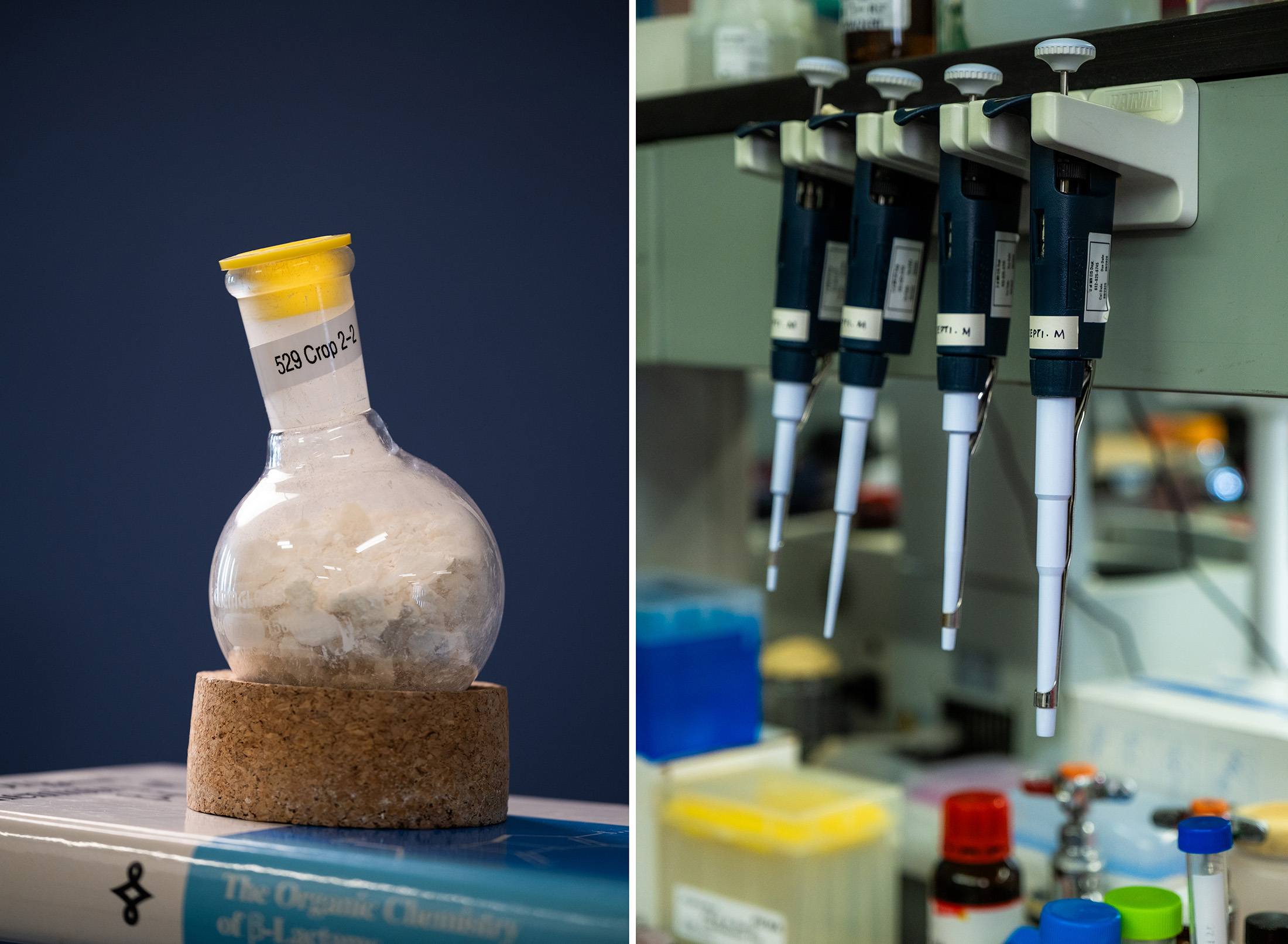 Flask containing YCT-529; equipment at Georg's lab. Photographer: Yasmin Yassin for Bloomberg Businessweek The other male contraceptive moving through the drug approval process is the shoulder gel, Nestorone/Testosterone, or NES/T, which was developed under Diana Blithe, head of the Contraceptive Development Program at the National Institutes of Health. Like YCT-529, NES/T suppresses sperm production, but it uses a hormone-based approach. Applied daily to the shoulder, the gel combines nestorone, a synthetic medication that suppresses the hormones needed for sperm and testosterone production, with synthetic testosterone, which regulates muscle mass and libido, among other things. The delivery method has the advantage of allowing direct absorption into the bloodstream without requiring an injection. As for a pill, "If we give testosterone orally, it's cleared very rapidly," Blithe says. That would mean three or four doses per day. Phase 2 trials, which wrapped in late 2024, showed NES/T to be fast-acting, reversible and safe, according to Blithe. "We're having very low side-effect problems," she says. "Many men have none, and some have a few, but nothing they consider a problem." The known ones include acne, headaches and mood swings. She expects a failure rate similar to that of the female pill, which is about 7%. (It's around 13% for condoms.) One of the trial participants, Andrew Butler, who's in his late 20s, says he experienced only mild weight gain. His main concern, he recalls, was that the gel would accidentally wipe off on his partner before being absorbed. The NIH and the Population Council, a nonprofit research organization, conducted the first two phases for NES/T, but Phase 3 proved too costly, leaving them looking for a private-sector collaborator to get it to market. In 2024 they licensed the gel to Contraline. CEO Kevin Eisenfrats was initially skeptical of the hormonal approach, but he changed his mind after reviewing the data. "The efficacy was extremely strong. And it's so easy to use," he says. Feedback from the US Food and Drug Administration on Phase 2 results will determine how Phase 3 proceeds. No male contraceptive drug has made it that far before. Eisenfrats says he hopes it goes well enough that Contraline can file a new drug application with the FDA in 2028 and release the drug soon after. Keep reading: The Future of Male Birth Control Could Be Pills, Gels and Implants | 









No comments:
Post a Comment