| Read in browser | ||||||||||||||
  Artificial intelligence will undoubtedly reshape business and the broader economy—but not in the apocalyptic way some predict. Over time, AI-driven efficiency will push costs lower and help ease inflation. That dynamic favors industries with high barriers to entry, supports the bond market, and ultimately benefits consumers.
AI is not a doomsday deviceDystopian scenarios around the disruptive effects of AI on a swath of businesses and jobs are roiling markets. Monikers such as SaaSpocalypse to denote the alleged demise of software as a service are testament to the fear currently gripping investors. I'm skeptical. Citrini Research distilled these fears into a newsletter, predicting widespread unemployment within two years due to AI disruption and the kind of debt deflationary scenario we witnessed in 2008. The scenario triggered a large fall in stocks on Monday and a few rebuttals. I asked Brook Selassie, Gartner's AI Strategy expert, about his thoughts. He said Citrini's "timeline is compressed, enterprise frictions are understated, and the macro outcome is more path dependent than the report implies." While the scenario is "directionally provocative and useful for stress testing," the timing and transmission of the disruption is up for debate. In short, companies and individuals aren't going to rip up existing relationships and habits overnight. Selassie said that a 2025 review of 231 companies representing 241,454 jobs showed less than 1% of announced layoffs were attributable to AI productivity gains. By 2029, Gartner expects AI will be creating more jobs than it eliminates. Even more eye-catching: Gartner expects over 40% of agentic AI projects to be canceled by 2027. Not only are companies unlikely to make immediate and wrenching company-wide changes, they won't even be able to extract enough benefits from the projects they have in place any time soon. Just as with the personal computer and Internet revolutions before AI, it will be years before households and companies work out how to get benefits from the new technology. Large moats provide a shieldSo, who can escape or mitigate the threat of AI disruption? One place I'd look is consumer staples — goods that people use every day which require significant capital to produce. The Campbell's Company competes fiercely with other big firms as well as generic brands for aisle space at the supermarket. An AI-powered mobile app or tool isn't going to decimate their business as it might at IBM. Capital-intensive businesses like Coca Cola, General Mills or Colgate-Palmolive rely on brand recognition as an additional hurdle to full AI disruption. Natural resources might be even more AI-proof. The capital required to compete is enormous. That makes companies like Occidental Petroleum, Albermarle or International Paper relatively impervious to obsolescence. AI will be a tool for cost reduction to pass to consumers via lower prices. In a geopolitically unstable world access to basic materials will be even more important. This is why these industries have outperformed as investors have shifted from rewarding AI winners to punishing perceived losers. 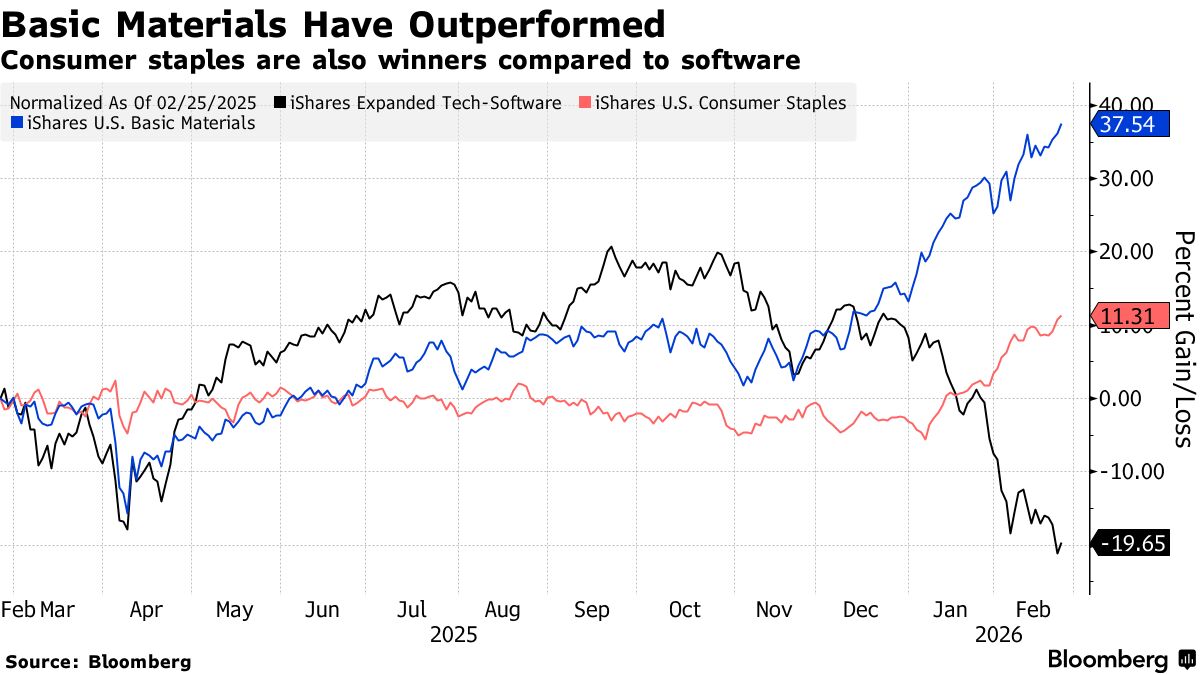 Some Hyperscalers Have Bigger MoatsThe need for enormous investment is a double-edged sword. Only a few companies can compete to achieve economies of scale from massive outputs. However when you have to plunk down huge sums to get up and running, the return on that capital is low. Traditionally, technology businesses have been low on capital invested, relying on innovation, know-how and the stickiness of their network to deter competition. This is changing with AI. That's certainly a barrier to entry but, the return on capital penalty may require de-rating the multiple of earnings assigned to these firms' stocks. Not everyone is affected equally. Apple is relatively secure with its closed ecosystem tying hardware and software together, combining the capital intensity, the daily utility and the brand of consumer staples with the network effects of a technology company. Alphabet is realistically the only competitor for Apple via Android handsets. Instead Apple will look to AI to help increase stickiness, hopefully driving incremental revenue. Alphabet is more exposed because most of its revenue comes from search advertising. Generative AI is web search on steroids. To the degree that Alphabet is successful in using its chatbot Gemini to enhance Google and YouTube search and move it onto Apple's handsets, it should be able to monetize consumer-facing AI. Many of the other megacaps are vulnerable though. AI can drive goods search away from Amazon and reduce its data center growth. Microsoft, SalesForce and Oracle, as software companies, are even more vulnerable. Their stock performance bears that out. 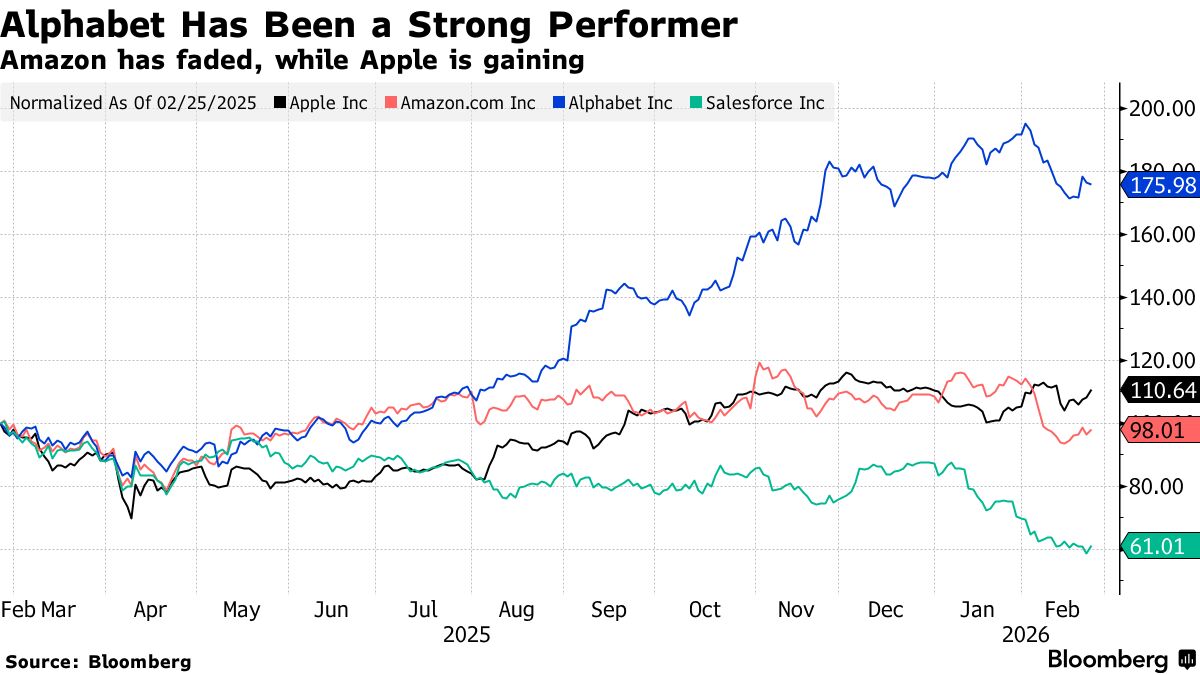 Disinflation is a boonOnce we're able to make good use of AI, like the Internet, it will be disinflationary. We're not talking about the slash and burn cost-cutting that leads to people losing work, cutting consumption and dipping into their retirement savings in a way that upends markets in Citrini's scenario. Instead, businesses will be able to cut costs and improve productivity while consumers will gain large amounts of price discovery, booking vacations, finding goods, buying cars and getting services cheaper. It won't happen immediately. The initial Internet boom ramped inflation up so high the Federal Reserve had to raise rates aggressively, eventually causing a recession. But, once it became embedded it helped to bring average inflation this century down to 2.2% from an average 4.0% through 2000. Once the boom has passed and the benefits of AI accrue to consumers, a lasting rally in Treasuries could follow, bringing yields down and with that costs on more consumer goods and services such as mortgages. AI will change a lot of things but the disruption will have lasting benefits, too. Things on my radar
More from BloombergEnjoying The Everything Risk? Check out these newsletters:
You have exclusive access to other subscriber-only newsletters. Explore all newsletters here to get most out of your Bloomberg subscription.  Follow us
You received this message because you are subscribed to Bloomberg's The Everything Risk newsletter. If a friend forwarded you this message, sign up here to get it in your inbox.
|
Wednesday, February 25, 2026
AI’s Beneficial Disruption





Subscribe to:
Post Comments (Atom)
-
PLUS: Dogecoin scores first official ETP ...
-
Hollywood is often political View in browser The Academy Awards ceremony is on Sunday night, and i...


No comments:
Post a Comment