Wireheading Too Close to the Sun | AI can ruin your Hinge date. It can detect cosmic anomalies. It can make history come alive. But it cannot suspend the basic laws of economics, says Allison Schrager. Elon Musk's recent prediction — that AI will make saving for retirement unnecessary — is complete hogwash in her eyes. Consider the following four scenarios. In the future, Allison says AI will either … - Make us more productive in the same way that railroads, the telegraph and electricity did in the past.
- Transform our lives in a completely novel way by speeding up and possibly even spurring innovation.
- Become a useful tool that won't boost productivity very much right away, but will disrupt society like the internet.
- Kill us all.
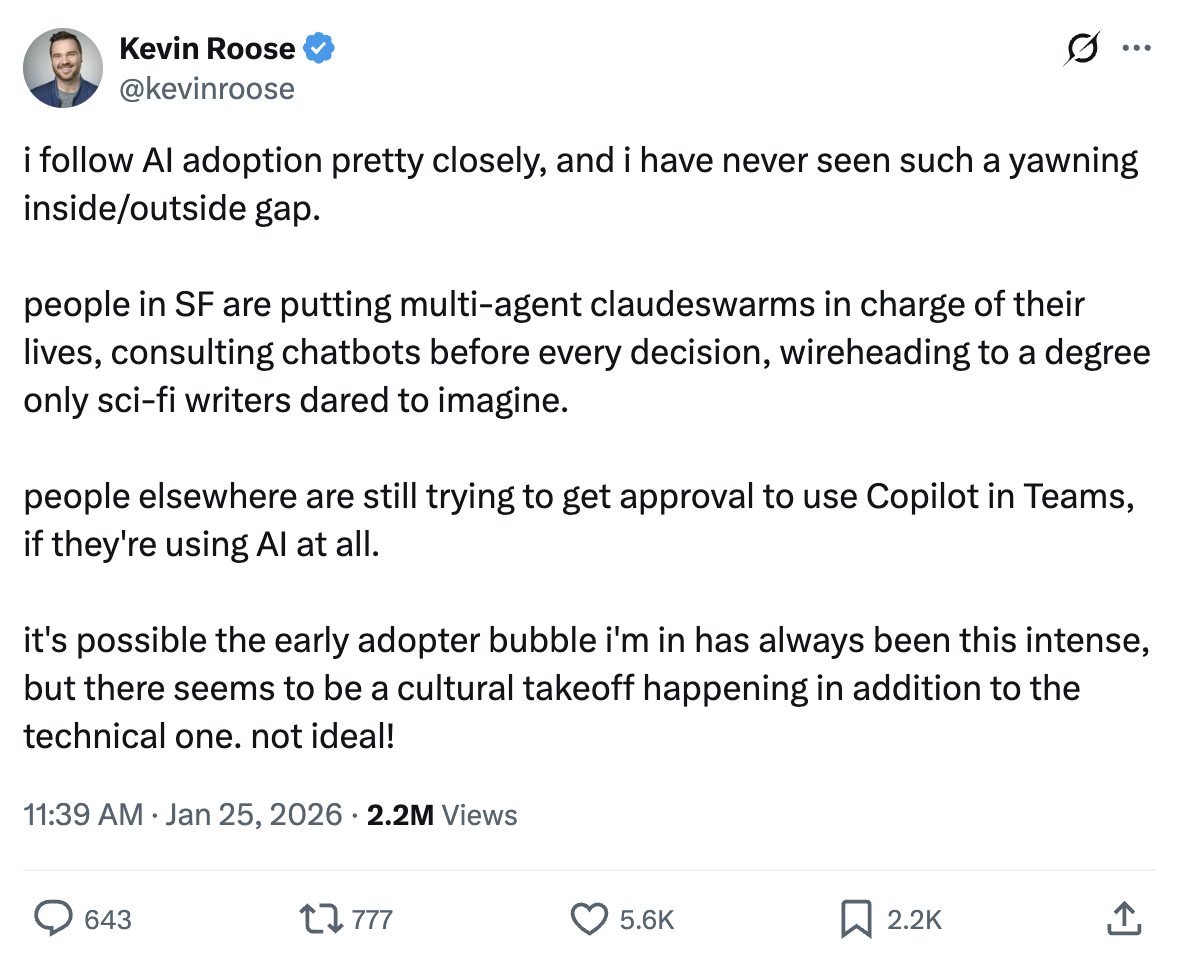
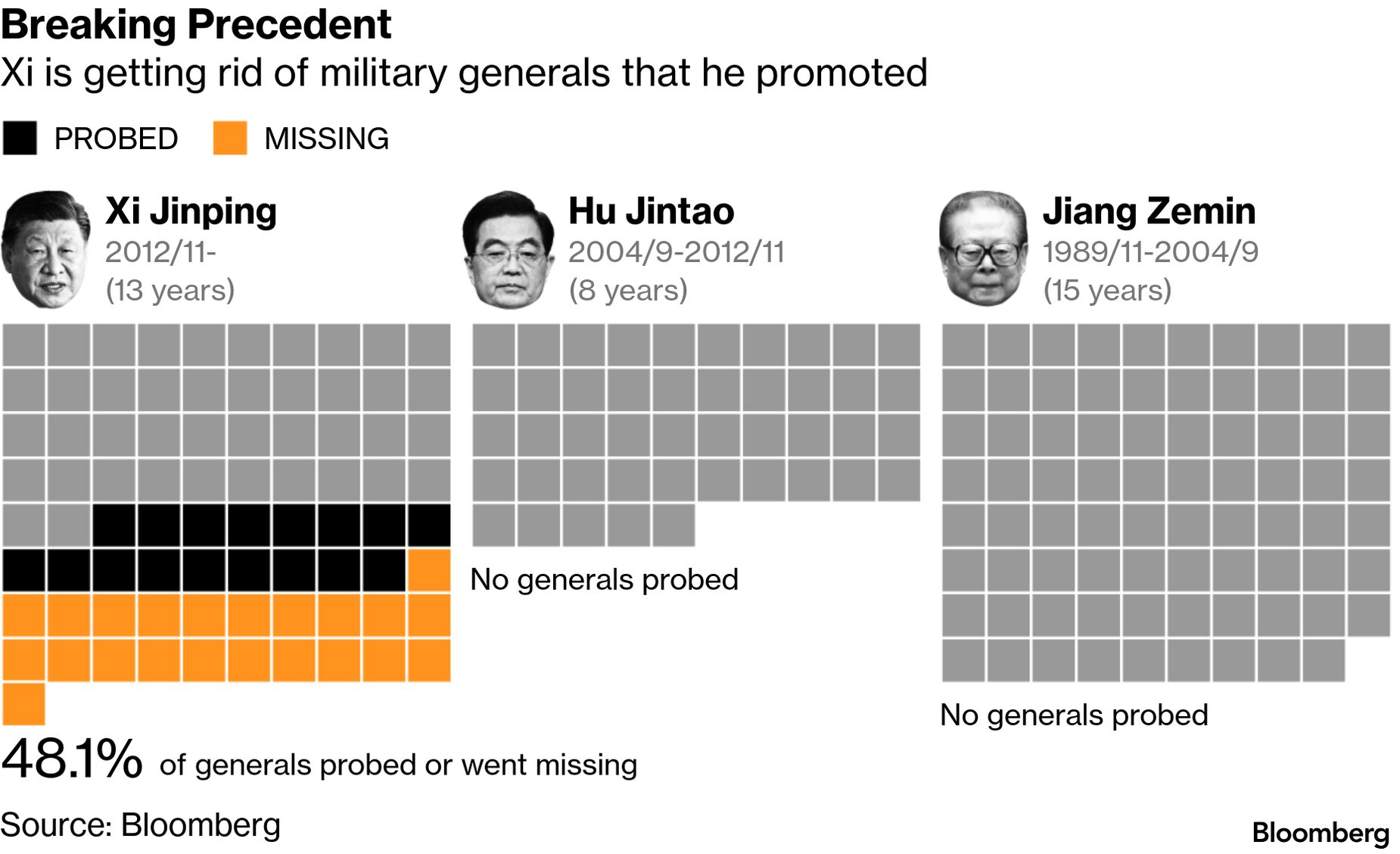
OK, fine. I guess if No. 4 happens, you won't be needing a 401(k). But Allison, who is bullish on the future of AI, says such apocalyptic forecasts are highly unlikely. Parmy Olson's experience using Anthropic's new AI toy, "Claude Cowork," suggests some corners of the tech-obsessed world are already headed in the direction of Allison's first scenario. "I recently pointed the app to a folder of interviews on my laptop, which I used to write my last book. Within minutes it had created a Power Point presentation of key trends from my files and a spreadsheet of my contacts and their areas of expertise. It also answered some direct messages on LinkedIn for me," she writes. Very productive! But there's a big difference between having Claude reply to a handful of recruiters wishing you a happy birthday on LinkedIn and, well, whatever this is: If the phrase "multi-agent claudeswarms" sounds like a prank being played on the English language, you're not alone. But just because you're not in the "early adopter bubble" doesn't mean AI won't impact your life. Dave Lee says a dire shortage of memory chips is going to hit consumers one way or another. "For some, it will be through rising utility bills as data centers strain the grid. For even more of us, it will be increasing costs of just about every electronic product you can think of: laptops, smartphones, televisions — perhaps even cars," he writes. "For the foreseeable future, the AI boom will turn on its head our expectation that technology gets both cheaper and more powerful as time goes on." It's no great wonder, then, why Gautam Mukunda says many AI skeptics are losing patience with Silicon Valley. Last week at Davos, Microsoft CEO Satya Nadella delivered a warning to Big Tech leaders: "If AI doesn't generate tangible improvements — in health, education, government efficiency and business competitiveness — companies will 'quickly lose even the social permission' to consume scarce energy to build it." Enter … South Korea? Catherine Thorbecke says it's the first country to enact a comprehensive AI law. "As the US and China compete to build the best models, South Korea is stress-testing a more immediate question: how an advanced, hyper-connected economy can roll out AI rapidly without letting scams, deepfakes and slop wallop public trust. Seoul is betting that rules don't have to kill adoption, but legitimize it," she writes. "The result is a society leaning into the revolution with unusual enthusiasm." While you weren't paying attention, Chinese President Xi Jinping kicked two more high-ranking military officials to the curb in a move that Bloomberg News is calling "the most stunning development yet in China's biggest military purge in roughly half a century." Watching the drama unfold, Karishma Vaswani wonders: "Is the Chinese leader prioritizing political loyalty at the expense of his long-stated ambitions over Taiwan and military proficiency, and if so why?" "China's elite politics are shrouded in secrecy. Beyond what has been released officially, it's impossible to know the precise trigger," she writes. Now, Western diplomats are scrambling after losing a critical contact with Beijing. "While the removal of General Liu Zhenli over the weekend has drawn less attention than that of his more senior counterpart, Zhang Youxia, Liu's absence is of more immediate concern," according to Bloomberg News. "Unlike other senior Chinese officials, Liu, 61, had been more willing to hold meetings with Western counterparts and keep channels open." Now, those channels have gone dark as Xi consolidates his power. The timing, Karishma notes, is more than a little bit strange: "Xi has repeatedly said that bringing Taiwan under the mainland's control is central to his vision of national rejuvenation, but this shakeup leaves the [People's Liberation Army] operationally weakened." Perhaps Xi's inner history buff won out over his imperialist side. As Zi Yang, a research fellow at the Nanyang Technological University, reminded Karishma, "Most strongmen — and most Chinese emperors who lost power prematurely — fell to internal coups." Xi, obsessed with his own political survival, doesn't seem like the kind of guy to forget that. |











No comments:
Post a Comment