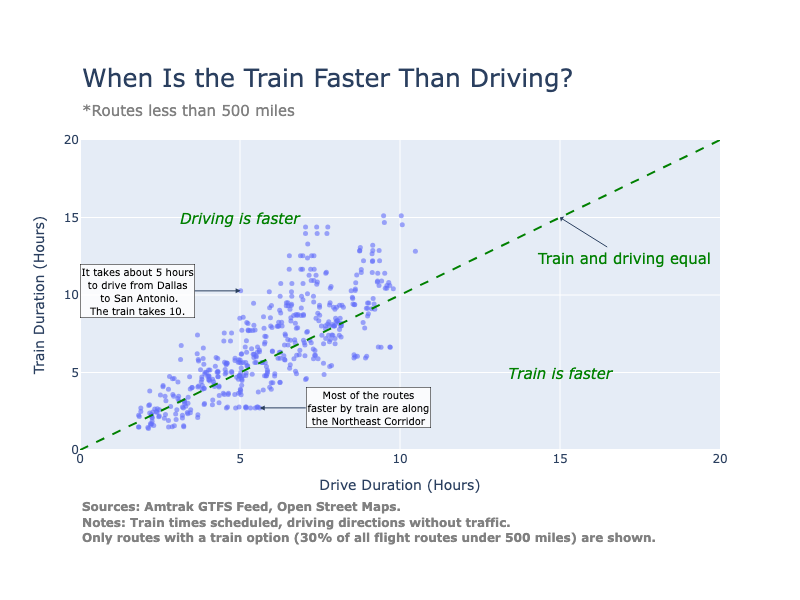
| Today we're bringing you a special edition of MapLab from Aaron Gordon, our colleague on Bloomberg's data journalism team. It's no secret America's rail options outside the Northeast Corridor leave a lot to be desired, with limited routes and frequent delays that often make it less appealing than flying or driving. But when the government shutdown in November resulted in thousands of canceled flights across the country, it got me wondering: How many travelers even have the train available as backup? There is no one answer to this question. What constitutes a viable travel option to one person — say, a 19-hour train trip from Chicago to New York — is a one-way ticket to insanity for another. It also depends on one's circumstances, such as how badly you want to get to where you're going. But for those who want to know just how inflexible the US transportation system is in the event of another shutdown, say, next month, I crunched the numbers on the types of routes where a train could be a good option, if only the US invested in them. About 1,500 routes across the US are 500 miles or less, a distance that could be replaced with a train trip for roughly the same travel time when factoring in the airport rigamarole. Some 70% of those flights have no train option at all. Out of those that do, 65% would likely be faster by car. And it's usually not close. On average, driving is three times faster than the train, although some extreme examples skew the average, like Salt Lake City to Palm Springs — 11 hours by car, versus a very circuitous 95 hours by train via San Francisco and LA. There are, however, three regions where the train is competitive with driving. In addition to the well-known Northeast Corridor from Boston to Washington, DC, which includes the Acela not-quite-high-speed train, there's the Pacific Northwest route from Portland to Seattle. Recent investments have also added some short routes out of Chicago back to the list, after years of neglect in what was once a flourishing rail hub. The US had one of the world's best rail systems through the middle of the 20th century. It collapsed under competitive pressure from cars, trucks and airplanes. As the number of travelers has exploded, more and more people are relying on an increasingly brittle system. But the good bones of the train networks of yore are still there. Of course, comparisons with Europe or China put even these fastest regions to shame. Whether considering a transportation landscape in a large metro area, a region, or a country, the most successful ones offer multiple options and flexibility. Subway down? Walk to another subway line. Or take the bus. Or use bikeshare. Flight disruptions? Consider the train. Or a bus (speaking of, the less said about American intercity buses the better). The US does the opposite. The vast majority of Americans have one choice for short trips — the car — and another for long trips — the plane. There is no Plan B. The Secret Formula for Faster Trains
A report shows how Amtrak and commuter railroads can reduce "dead time" and increase speeds for less than it would cost to build new high-speed rail lines. European Commission Sets Goal to Slash Train Times Across the Continent
The high-speed rail plan would more than halve travel time between cities like Madrid and Lisbon by 2040. But executing the vision will take €345 billion. Where Train Dreams Meet Reality in Texas
Dallas and Houston are 250 miles apart. But if you want to take a train between them, prepare for a 23-hour odyssey that says a lot about where US passenger rail is heading. | 







No comments:
Post a Comment