| Each year, Bloomberg Businessweek produces a series of stories focused on The Year Ahead. (See the sensible guide to 2026.) But here at Businessweek Daily, we're not ready to give up on 2025 yet. We asked some of our regular newsletter writers to review major themes, moments and players in the news for a series we're calling The Year Behind. Today, Max Chafkin, Businessweek senior reporter and co-host of the Everybody's Business podcast, picks up the story of Elon Musk after he left government to focus on his five other jobs. Let us know what you think by emailing the editor here. If this newsletter was forwarded to you, click here to sign up. Programming note: Businessweek Daily will be off Thursday for New Year's Day. See you Friday. It is, at this point, hardly controversial to say that Elon Musk's tenure as the Trump administration's chainsaw-wielding budget czar ended in failure. This is the assessment of Democrats, members of President Donald Trump's staff and, to some extent, even the man himself. Musk recently conceded that he was only "a little bit successful" during his time running the so-called Department of Government Efficiency and that he wouldn't do it again knowing what he knows now. By the time he left the White House in May, there were nationwide protests against him, and he was sporting a literal black eye. Musk responded with threats and insults—accusing Trump, accurately as it turns out, of showing up in the Epstein files and suggesting that SpaceX, Musk's rocket company, might pull its services from the federal government. The president shot back, threatening to remove Musk's businesses, which have benefited tremendously from government support, from the federal dole. Trump also canceled the nomination of Jared Isaacman, a Musk ally who'd been tapped to lead NASA. If that were the end of the story, you'd be forgiven for thinking that 2025 wasn't Musk's year. And yet somehow he managed to float above it all, getting past the feud with Trump and becoming way, way richer in the process. Musk's net worth went up by roughly 45% in 2025, to about $630 billion, according to the Bloomberg Billionaires Index. As of Dec. 29, he was more than twice as wealthy as the next closest person, Google co-founder Larry Page (who had a pretty decent year himself). The roughly $194 billion increase in Musk's net worth in 2025 means he added almost a Bernard Arnault (the chairman of LVMH Moët Hennessy Louis Vuitton and the seventh-richest person) to his personal bank account. Arnault is worth $205 billion, which used to be considered a lot of money. 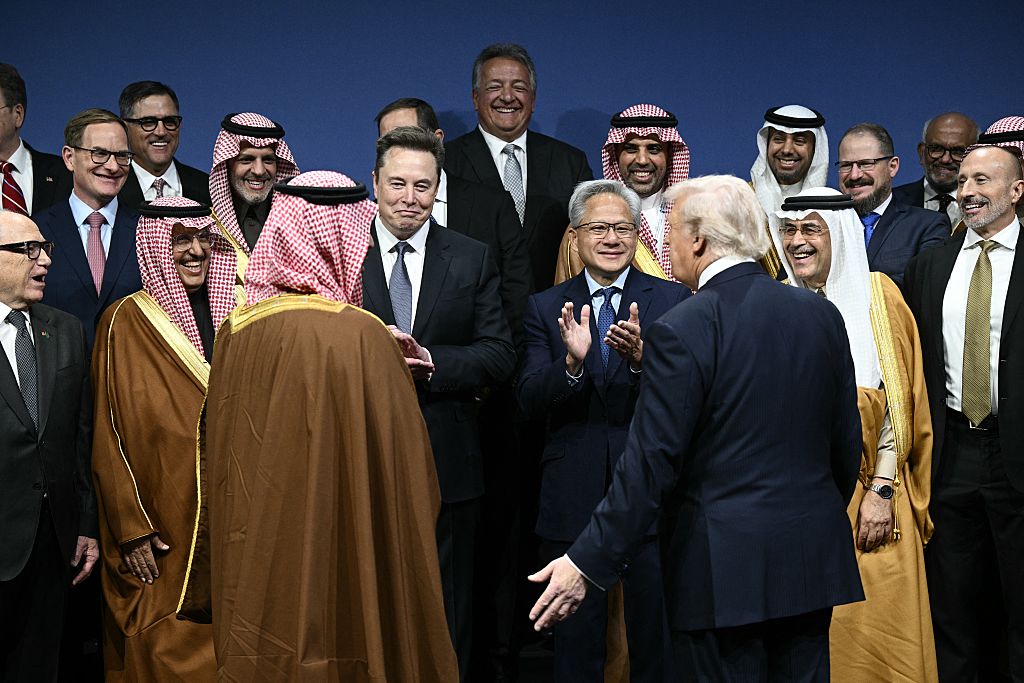 Musk and Trump at the US-Saudi Investment Forum, held at the John F. Kennedy Center for the Performing Arts on Nov. 19. Photographer: Brendan Smialowski/AFP/Getty Images What happened? Part of it is that, despite Trump and Musk being known for their combativeness, they're also quick to forgive—and both had reasons to do so. Musk needs a good relationship with the American government to keep his companies healthy, and Trump's political party will need Musk's money during the midterm elections in 2026. And so, almost as quickly as the insults started flying, both men went quiet. The two appeared to reconcile at Charlie Kirk's funeral, and Musk abandoned threats to start a third political party. He attended a dinner at the White House in honor of the Saudi Crown Prince Mohammed bin Salman and posted a semicontrite message on social media after Trump cheekily demanded Musk thank him. Isaacman was renominated and in mid-December sworn in as the head of NASA in a boost to SpaceX. On Christmas Eve, the US State Department announced visa sanctions on a handful of Musk adversaries in Europe, including a former European Union official. The end of the feud probably helped boost Tesla's stock price, as well as the prospect that SpaceX might go public next year. But a bigger factor pushing up the value of Musk's portfolio has been the unbridled enthusiasm among investors for anything related to artificial intelligence. Tesla's automotive sales remain in the doldrums, and the company faces an investigation over the safety of its car doors, but Musk has successfully convinced his shareholder base that his cars don't matter much given the coming AI revolution. The future of the company, he has said, depends on the rollout of Tesla's robotaxis and humanoid robots. It's debatable just how much progress there's been in either domain. The robots still seem, uh, less than human, and Tesla is far short of the autonomy goals that Musk himself set earlier this year, when he promised the company would cover half the country in robotaxis by New Year's Eve. At the moment, the company operates ride-hailing services in Austin and the Bay Area, where its supposedly driverless vehicles are still overseen by human safety drivers. Even so, Tesla investors are bullish enough that a video of a single car driving in Austin with no one in it helped send the stock soaring in December. Musk's other companies have also benefited from AI exuberance. The valuation of xAI jumped to $200 billion, padding Musk's net worth and making his acquisition of Twitter—which he renamed X and has used to train xAI's large language models—look like a winning deal. SpaceX isn't an AI company, but it's probably no coincidence that its recent valuation of $800 billion coincided with Musk talking up the potential of turning the company's Starlink satellite network into a massive AI data center in space. Although the idea may seem far-fetched, Musk has made his fortune keeping investors focused on the distant future and away from the problems of the here and now. I haven't mentioned the enormous pay package Tesla investors approved in November, which could be worth $1 trillion if Musk hits a series of extremely ambitious goals. The package would be, by far, the most money a CEO has ever been paid—and it's for only one of his five current jobs. Those goals are far from being realized, however, and Musk's standing seems to depend on the AI hype continuing forever, which it almost certainly won't. Moreover, his companies are increasingly intertwined, meaning his empire is less stable than it might seem. If the AI bubble bursts, or if Musk somehow stumbles into another political dispute, or if there's a shift in power in Washington, he might find himself once again navigating a major crisis. Musk has thrived in these circumstances in the past, though never with this much at stake. The upshot is that 2026 could wind up being even more chaotic for him than 2025 was. |











No comments:
Post a Comment