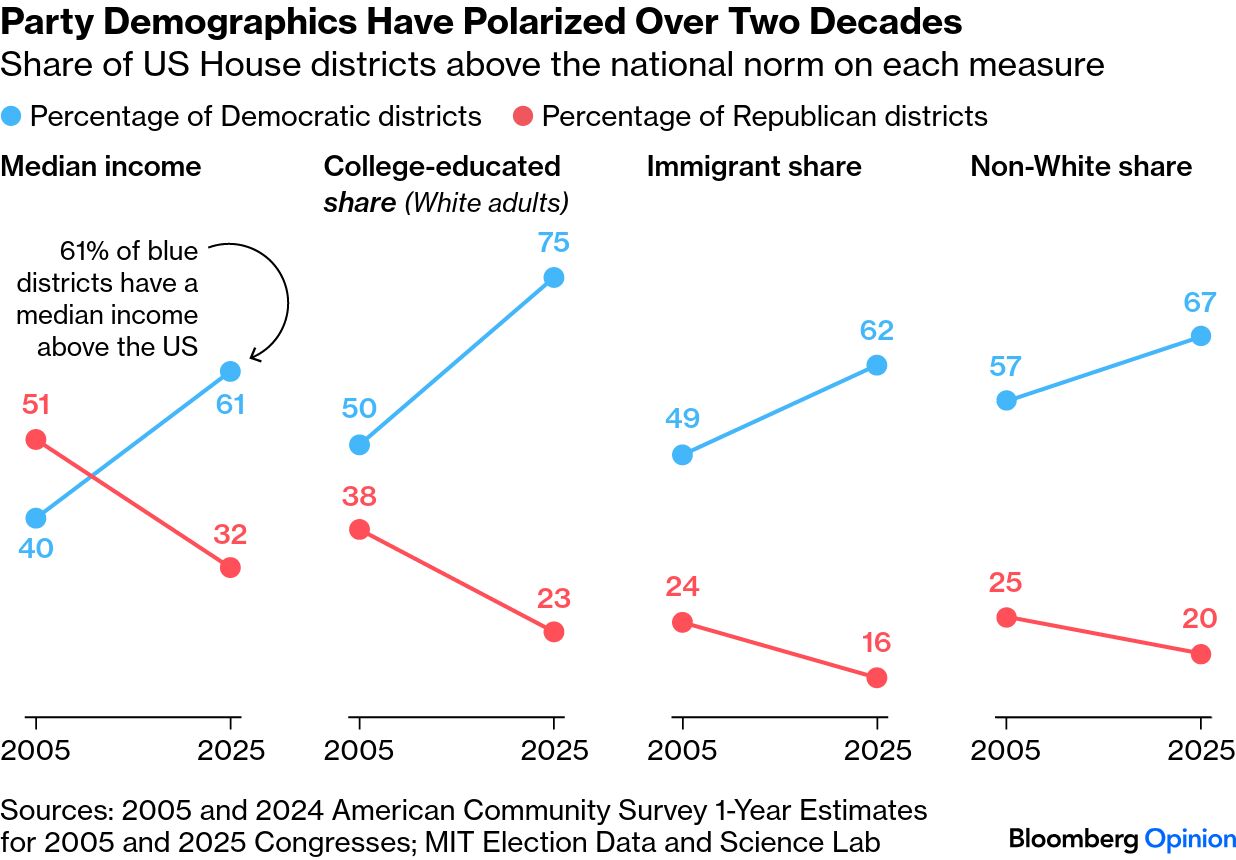
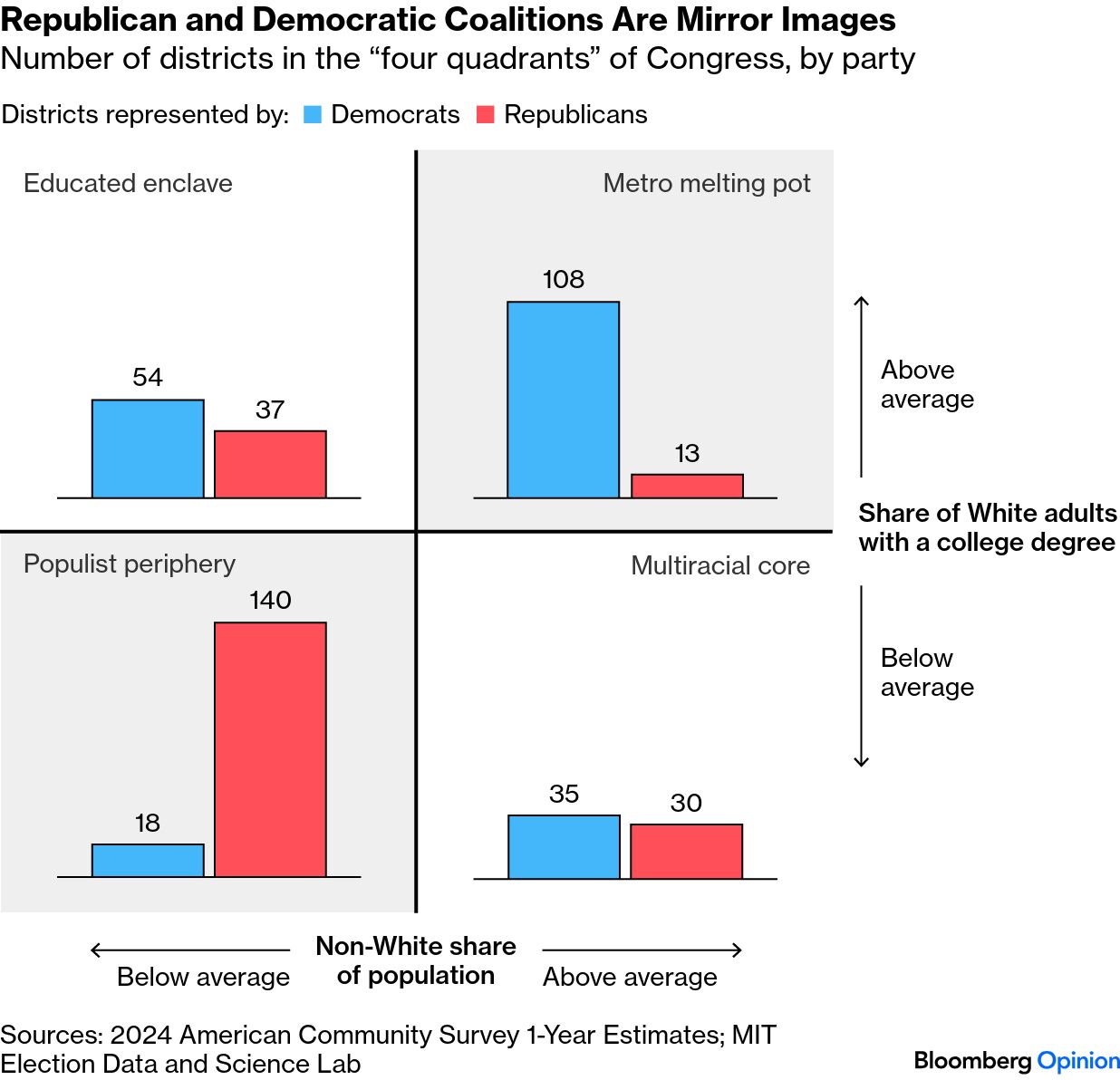
America's Two-Party Doom Loop | While you were busy staring into the depths of Marco Rubio's pores in the Vanity Fair exposé of the White House's inner circle that Nia-Malika Henderson calls a "portrait of chaos," Ronald Brownstein and Carolyn Silverman were preoccupied with a different display of dysfunction just up the road on Capitol Hill. "The House of Representatives is divided closely, bitterly and precariously," they write. Due to what they call a "profound demographic transformation" over the past 20 years, control over the House now rests "on a knife's edge," widening the gap between the parties' legislative priorities and motivations. Democrats and Republicans are so divided that former Representative Steve Israel says "members of the House are living two completely separate lives." How can anything be "bipartisan" with this kind of setup? In their analysis, Ronald and Carolyn "found that the parties not only sharply diverge from each other in the educational, racial and economic characteristics of the House seats they represent today, but also differ radically from their own composition back in the early 1990s." Using a simple 2×2 matrix, they broke House districts into four categories: the "metro melting pot" (higher than average racial diversity and White college attainment), the "multiracial core" (high diversity but below-average White education), the "educated enclave" (fewer minorities and higher White college attainment), and the "populist periphery" (below-average shares of minorities and Whites with college degrees). "Though Republicans hold the overall House majority, Democrats now lead the GOP in three of these four quadrants," they write. Gerrymandering certainly plays a role here, but they point to a series of "hinge-point elections" — the Republican landslide in 1994, the Tea Party election of 2010 and the 2018 blue wave — that dismantled old alliances and rearranged the balance of power. Could 2026 provide a similar seismic shift? Don't hold your breath. Ronald and Carolyn say "the odds that either party can establish a sizable or lasting House majority across this starkly divided electoral landscape appear small." Bonus US Politics Reading: The Trump Corollary exposes the caprice of a geopolitical bully who lacks a coherent strategy. — Andreas Kluth In 2017, a strange sartorial trend took New York City by storm: gorpcore. Suddenly, everyone was cosplaying a hiker hitting the Appalachian trail. Park Slope dads ditched their J.Crew chinos for Patagonia wind pants. NYU students started carrying their dorm room fobs on metal carabiners. Influencers began non-ironically sporting Birkenstocks during Fashion Week. And unlike most trends, gorpcore hasn't really died, no matter what GQ tells you. Just look at the fit Timothée Chalamet was rocking at the BAFTA screening of Marty Supreme:  Photographer: Dia Dipasupil/Getty Images North America In China, Juliana Liu says the gorpcore aesthetic is surging, but not because of Chalamet's "Sweet Tea" fans. In the aftermath of Covid-19, "the country is in the midst of a wellness boom," she explains. "Even though China was late to embrace this phenomenon, it has adopted the concept and moved it firmly into the mainstream." The great outdoors may be free, but gorpcore ain't cheap. Juliana says Chinese customers (including President Xi Jinping himself!) are shelling out an eye-watering 8,000 yuan — or $1,100 — for waterproof Arc'teryx parkas. "That's only 2,000 less than the median monthly salary of a megacity like Shenzhen," she writes. Read the whole thing in all its gorp-y glory. | 









No comments:
Post a Comment