(WARNING: You'll probably never want to buy boring old stocks again…)
-Jeff Zananiri
P.S. I believe the only way you can capitalize on this new asset is if you're willing to set aside your political beliefs.Think you can do that?
Today's editorial pick for you
GameStop Stock Hints at a Narrow Path to Upside Following Q3 Report
Posted On Dec 10, 2025 by Joshua Enomoto
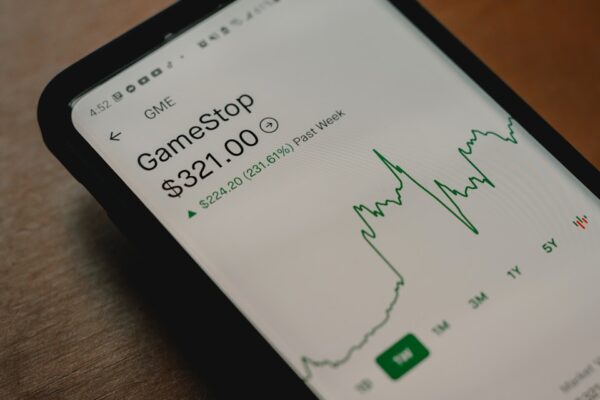
Perhaps best known in the post-pandemic ecosystem as the company that kicked off the meme-stock craze, GameStop (NYSE:GME)has, since its heyday, attempted to regain some of the lost magic. So far, though, circumstances haven't exactly favored GME stock. And to be quite blunt, the video game retailer's latest earnings results don't really help matters.
Table of Contents
For the third quarter, GameStop reported adjusted earnings per share of 24 cents, which did top the consensus view of 20 cents. Further, the latest tally comfortably exceeded the year-ago quarter's print of 6 cents. Unfortunately, investors appeared to take a dim view of the gaming retailer's revenue count, which landed at $821 million. This figure badly missed Wall Street's expectation, calling for $987.3 million.
If that wasn't bad enough, the sales figure represented a 4.6% year-over-year (YoY) decline. Fundamentally, softer demand in core retail operations appeared to have stymied GameStop's momentum. Following the disclosure, GME stock dipped about 6% during Tuesday's after-hours session. In the open market, the security had lost a bit more than 1%.
Since the start of the year, GME stock is down more than 26%. Thanks to the disappointing Q3 sales, it risks breaching the 30% down mark. Still, while GameStop represents a high-risk trade, there could be a speculative case for upside.
Applying the Right Mathematical Framework for GameStop Stock
If you look at any technical chart for GME stock, you'll notice that — irrespective of the provider — every chart is structured identically: price is plotted as a function of time. This is not surprising as it's the most intuitive way to visually describe past price behaviors.
However, this format distorts reality, largely because the underlying relationship is not epistemologically sound. Rather than being a function of time, price is actually a function of state.
However, no one has been able to identify exactly what this state is because a gazillion individual catalysts converge to influence price. What's more, even if we used the most advanced quantum computer to calculate this state, opportunistic investors would quickly run into Schrodinger's paradox of the financial markets.
Like it or not, the stock market is reflexive. So, if everyone knows how to calculate the driving state of GME stock, that knowledge would necessarily change how we would approach the security. Ironically, knowing the system changes the system, thus erasing whatever edge we would have otherwise gained.
Without going too deep down the quantum mechanics rabbit hole, it's safe to say that it's likely impossible to calculate the true driver of price. However, the next best solution is to calculate how likely certain prices will materialize given enough frequencies or trials.
In other words, we may calculate probability density as a function of price. This process acknowledges that, while we may not know what causes GME stock to move, we can estimate where it's most likely to end up at a fixed point in time.
Shifting Away from Time-Series Analysis to Distributional Insights
Immediately, one of the key problems tied to probabilistic analysis of the equities market is that technical charts are represented as a singular journey across time. Mathematically, it's incoherent to talk about odds when the underlying sample size is one. That's why we must break this long, continuous strand of pricing data and split it into hundreds (if not thousands) of rolling, discretized sequences.
This is perhaps one of the most controversial aspects of my quantitative model as it compresses individual candlesticks into up or down sessions. Further, rather than analyzing a stock chronologically, we would be analyzing it structurally. However, in order to reveal tradable patterns, this approach is a necessity.
Take a look at technical analysis, which is structured as an event-based methodology. The problem with this approach is that one-off events — such as the Federal Reserve dramatically cutting the benchmark interest rate — may carry a disproportionate impact on the share price. However, if we were analyzing hundreds of 10-week strands of data, one aberrant week is not going to materially influence the broader distribution.
Even more important, across multiple frequencies, certain patterns will emerge. As an analogy, public roads don't feature even wear across the pavement. Instead, certain areas see more wear and tear than others. It's the same principle with stocks.
Not only that, under certain conditions, the distributional outcome will change. Let's say that GME stock printed ten consecutive up weeks. This bullish pressure will likely have a much different influence than if GME had printed ten consecutive down weeks.
By measuring these frequencies, we can get a better idea of where GameStop stock will eventually land.
Applying Data Science to Actual Trading
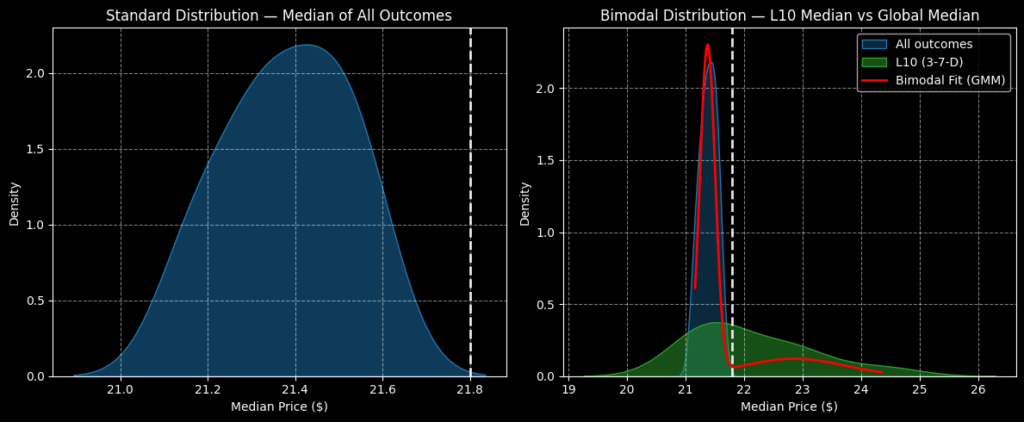
Using the probabilistic approach above, the forward 10-week returns of GME stock can be arranged as a distributional curve, with outcomes ranging between $20.85 and $21.85 (assuming an anchor price of $21.80). As such, GME suffers from a negative bias. Further, price clustering would likely occur at $21.45.
However, the above assessment aggregates all trials since January 2019. However, we're interested in the response to a specific signal, which is the 3-7-D sequence; that is, in the trailing 10 weeks through Tuesday's after-hours session, GME stock printed three up weeks and seven down weeks, with an overall downward slope.
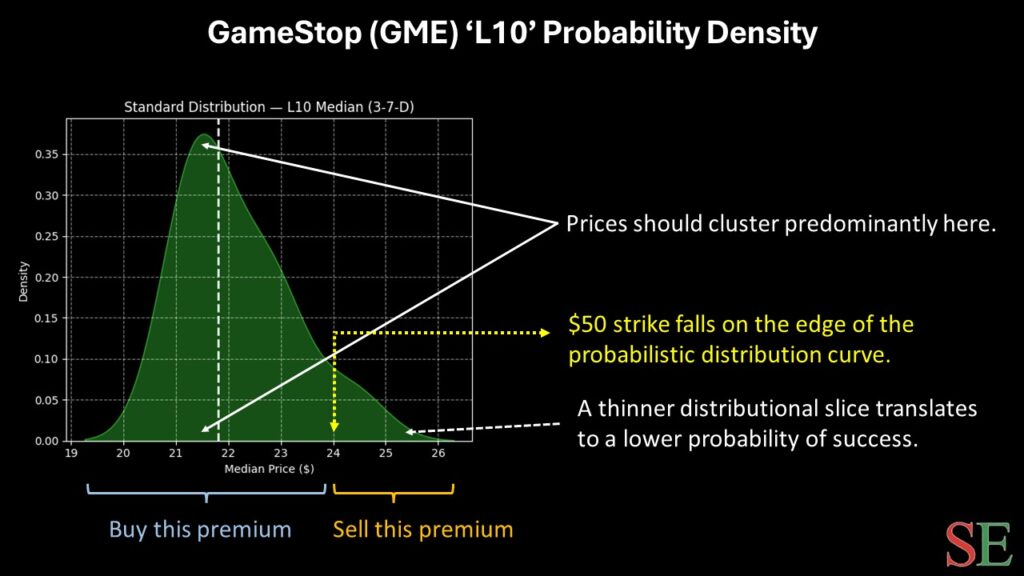
Under this setup, the forward 10-week returns shift quite dramatically, ranging between roughly $19 and a little over $26. To be fair, price clustering would likely be predominant at around $21.50, which still implies a slightly negative bias. Overall, however, probabilistic mass shifts more to the positive side of the spectrum, which means that there is a slight chance that GME stock may rise.
Still, given the geometry of risk, it may not be prudent to be ultra-aggressive on GME stock. In particular, the probability density between $23 and $24 drops by about 59.52%. From $24 to $25, there's another drop of 52.94%. That's a steep escalation of probability decay in my opinion.
All things considered, then, the 21/24 bull call spread expiring Jan. 16, 2026, may be the most aggressive trade to consider. GME stock will need to hit $24 at expiration for the trade to be fully profitable. It's arguably the best that can be hoped for without getting into irrational territory.
Disclosure: The author held a long position in GME stock at the time of writing.
This is a PAID ADVERTISEMENT provided to the subscribers of Daily Options Signals Free Newsletter. Although we have sent you this email, Daily Options Signals and StockEarnings does not specifically endorse this product nor is it responsible for the content of this advertisement. Furthermore, we make no guarantee or warranty about what is advertised above.
Your privacy is very important to us. If you no longer wish to receive email from DailyOptionsSignals.com, please click Unsubscribe.
StockEarnings, Inc 33 SE 4th St, Suite 100, Boca Raton, FL 33432 USA W: 877.6.STOCKS StockEarnings.com






No comments:
Post a Comment