Wednesday, December 17, 2025

Global coal use stalls

But don't call it a peak just yet |
View in browser
Bloomberg

Global demand for coal is stalling and will gradually decline over the next five years, according to a fresh report. Whether we've truly hit "peak coal," however, depends China. 

Today's newsletter brings you new data released by the International Energy Agency, which shows that use of the most polluting fossil fuel has hit a ceiling and will start falling in 2026. That broadly matches China's outlook to start reducing its reliance on coal before the end of the decade.

And we have a section on fire risk in the US. Four years ago, hurricane-force winds created a December firestorm that destroyed more than 1,000 buildings in Colorado. Eerily similar conditions are brewing again

Also, we offer a deeper look at why Ford is pulling its electric truck. And in less harrowing news, we have a green gift guide for last-minute shoppers. 

Subscribe to Green Daily for free climate reads delivered straight into your inbox six days a week.

Walking away from coal

By Stephen Stapczynski and Laura Millan

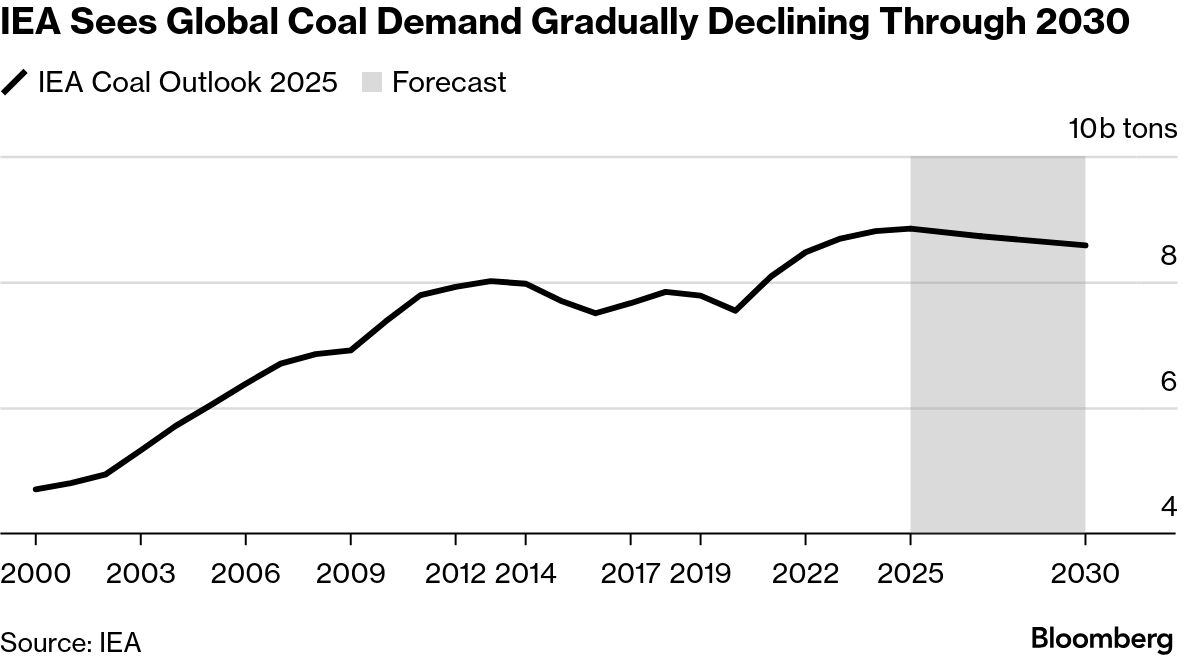
Global coal use has hit a ceiling and is set to begin a slow decline over the next five years as renewables and liquefied natural gas gain ground, the International Energy Agency said.

Demand is expected to edge up 0.5% this year to a record 8,845 million tons before slipping 3% by 2030, according to the IEA's annual coal report published earlier today.

"We expect global coal demand to plateau before edging down by 2030," said IEA director of energy markets and security Keisuke Sadamori. "That said, there are many uncertainties affecting the outlook for coal."

Coal is the most polluting of all fossil fuels and it remains the single largest source of carbon dioxide emissions globally. Burning it contributes to accelerating climate change and countries including the UK, France and Spain have eliminated or are about to phase out its use. But coal remains a cornerstone of electricity generation in many countries, with China consuming more than the rest of the world combined.

Coal use has reached a "plateau" as renewables scale up, the IEA said. Solar and wind are expanding fast enough to meet all new electricity demand globally, according to energy think tank Ember. Renewables including solar, wind, hydro and smaller sources such as geothermal generated more power than coal in 2025 for the first time, Ember analysts said.

Analysts have long struggled to call the moment at which peak coal will arrive, amid stubbornly strong consumption in China and India even as advanced economies shutter mines and ramp up solar and wind. The IEA cautioned that its five-year outlook "is subject to significant uncertainties that could impact it materially."

Much of the challenge in determining when the world will hit peak coal comes down to China, which makes up more than half of global consumption and production. The IEA sees a slight decrease in the nation's demand over the next five years, although "lower renewable energy dispatch or an acceleration in coal gasification projects could turn the slight drop into a small increase," it said.

Stockpiles of coal a port in China Photographer: Na Bian/Bloomberg

The uncertainties are underpinned by China's own approach to planet-warming pollution. There are signs that the country's overall emissions have peaked already, and under its upcoming Five-Year Plan the government will seek a peak in coal and oil use between 2026 and 2030. But in a subtle change of language in its latest communiqué, the Communist Party left room to increase use until the end of this decade. 

In India, meanwhile, a strong monsoon season depressed power demand and boosted hydropower production, the IEA said. As a result, annual coal power generation is expected to decline this year from 2024, halting an increase in production seen in recent years. 

In the European Union, coal demand will continue decreasing, but only by around 2% this year, compared to double-digit declines in 2023 and 2024, the IEA said. That's because lower hydropower and wind output pushed up coal power generation in the first half of the year.

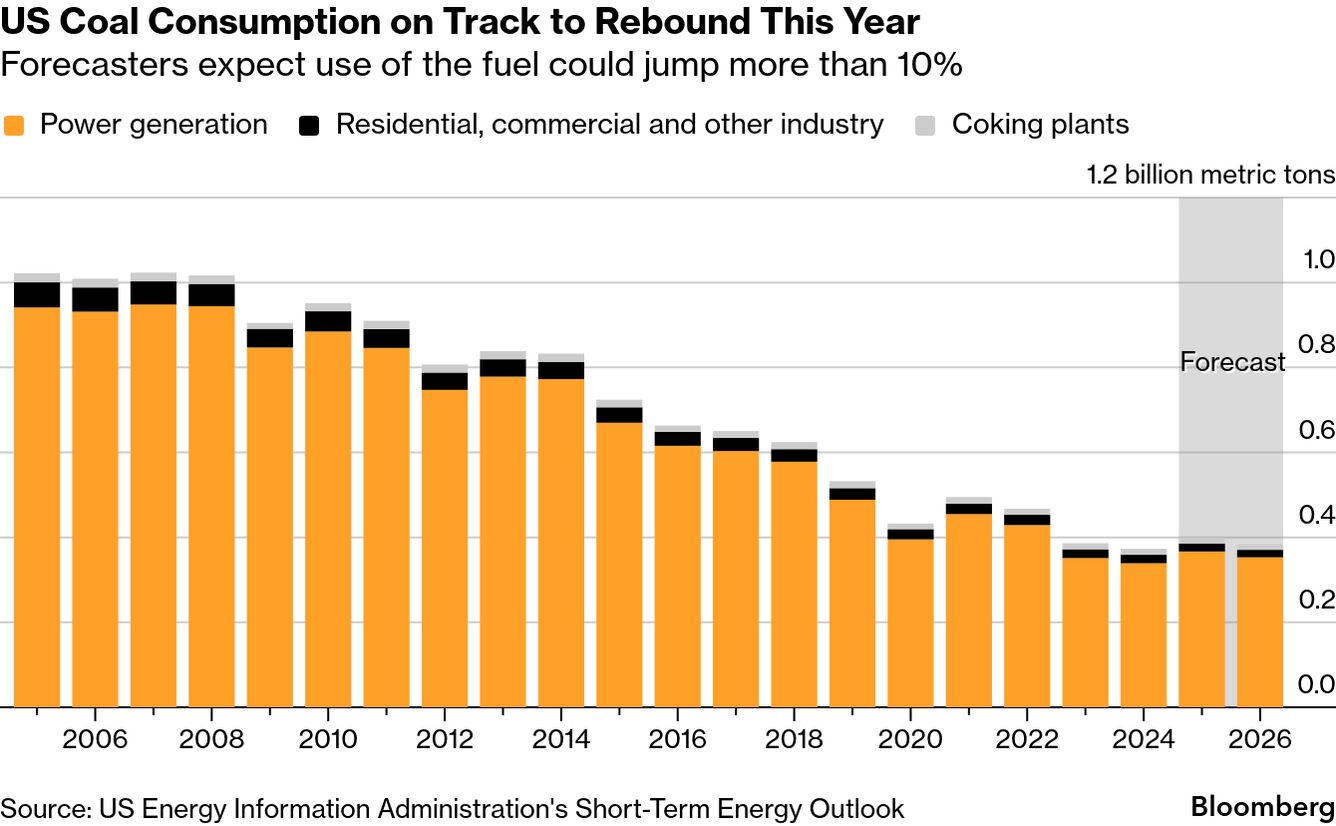
In the US, where coal demand has decreased an average of 6% annually for the past 15 years, the trend is expected to reverse in 2025 with an 8% jump in coal use, according to the IEA, although US authorities predict an even greater increase. Higher gas prices and slower coal-plant retirements, aided by federal policy support, are the main drivers of this trend.

Even so, natural gas overtook coal and became the largest source of electricity generation in the US this year, according to researchers at the World Resources Institute. 

But even with the support of the US administration, persistently low prices in international markets are undermining the economics of coal mining, according to the IEA. Coal prices remain relatively stable after rising during the coronavirus pandemic and the first years of the Russian invasion of Ukraine. Profits for coal miners are shrinking, with prices closer to supply costs. The trend is expected to continue through 2030 as higher emissions costs erode the fuel's competitiveness against gas, the IEA said.   

Subscribe to Bloomberg.com for unlimited access to more stories on global power trends and the clean energy transition.

Reversing course

8%
The percentage increase in coal consumption in the US in 2025, according to the IEA

Yes — but 

"We are making major efforts in developing new and clean energy. But to guarantee power is available, we're not totally giving up on coal"
Ren Yuzhi
Director general of development and planning at China's National Energy Administration
Chian is confronting the human and economic toll of dismantling the world's largest coal sector

Dangerous December weather

By Brian K Sullivan and Josh Saul

The remains of burnt homes in Colorado in January 2022.  Photographer: Chet Strange/Bloomberg

Xcel Energy is preparing customers in the Rocky Mountain region for preemptive blackouts to help reduce the risk of wildfires as strong, dry winds threaten to knock down power lines.

The utility said it would likely shut off power starting at about noon today to some customers in nine counties including Denver, according to the company's website. A stretch of near-record warm weather and dry conditions has created the potential for blazes in the area.

"It looks like a pretty formidable event," said Scott Kleebauer, a forecaster with the US Weather Prediction Center. "It is going to be a pretty windy day across Colorado, Wyoming and Montana."

An Xcel representative said Tuesday that the company is still determining the scope of the shutoffs.

Once a California phenomenon, utilities across the US are now increasingly opting to turn off electricity to prevent downed power lines and other equipment from sparking catastrophic wildfires. Power companies serving about 24 million homes and businesses across the fire-prone US West now have plans to proactively cut electricity at peak fire danger, according to a 2024 report from Stanford University researchers.

Read the full story on Bloomberg.com and subscribe to the Weather Watch newsletter for a weekly look at the market, business and economic impacts of extreme weather.

What the end of the F-150 means

By Kyle Stock

There are a crowd of electric pickup trucks to choose from these days, but Ford Motor's F-150 Lightning won't be among them very long. The company said on Monday it's canceling its electric truck and shifting production to a hybrid version. 

While the truck was supposed to convince Americans to climb into an electric vehicle, it didn't convince enough of them. 

"It didn't make sense to keep plowing billions into products that we knew would not make money," Jim Farley, Ford's chief executive officer, said in an interview on Bloomberg TV. "We had to make this choice."

A Ford F-150 Lightning Photographer: Kyle Grillot/Bloomberg

The Lightning didn't reinvent the F-150; it looks and feels largely like the gas model, right down to the massive gear selector that cleverly folds down into the center console. The major EV exceptions, like the yawning front trunk where the sparkplugs and cylinders used to be, were designed as value-adds.

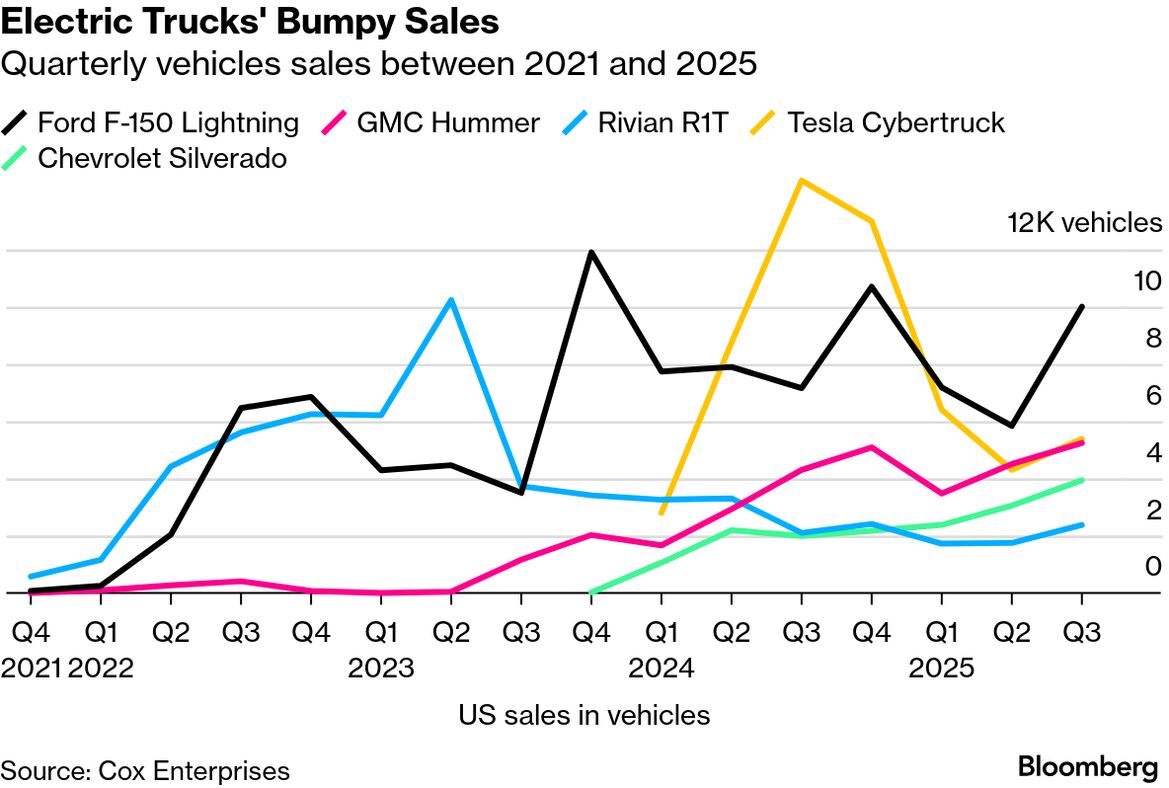
Ford's electric F-150 hasn't seen sales fall precipitously after an initial spike like some of its peers. Through the first three quarters of the year, only six electric models sold in greater volumes than the Lightning in the US — none of them large trucks or SUVs, according to Cox Automotive. Still, Ford is likely to sell fewer models of its e-truck this year than it did in 2024.

The Lightning never delivered on its promise to make the price competitive with gas models. The $40,000 window sticker trumpeted at the vehicle launch was quickly scrubbed off and replaced with $55,000. Even that number was seldom evident on dealership lots. 

In its first year of sales, the average transaction price on an F-150 Lightning – what buyers actually paid — was $77,000 and it has only dipped slightly to $72,000 this year, according to Edmunds.com. Meanwhile, gas F-150s were going for $11,000 to $17,000 less on average.

The persistent high prices come as Ford's EV division has struggled to turn a profit. It lost $5.1 billion last year, and Ford expects the division's losses could be even worse this year. Other companies have also taken hits to their EV divisions or scrapped plans to make electric models. That includes General Motors, which recently incurred $1.6 billion in charges tied to its EV division. Stellantis NV has cancelled plans for an electric Ram pickup.

The Trump administration's rolling back of incentives will only make it harder to sell electric models as will a proposed rollback of fuel economy standards. Farley has predicted that the administration's policies will cut the US EV market in half

But he also insisted the company isn't abandoning EVs and is instead focusing on lower-cost models that can compete with Chinese manufacturers. Ford has a new EV platform and has pledged to launch an electric truck priced around $30,000 sans incentives. Rivals like GM have also said they remain committed to electric models. 

Still, Monday's announcement comes with a warning sign for a speedy electric vehicle transition: Ford plans to convert a factory under construction that was set to churn out electric trucks into one that builds gas-powered models. 

Read more about how the global EV industry is faltering.

Green gift guide

The Bernina Express train in Filisur, Switzerland. Source: Eurail

By Laura Millan and Olivia Rudgard

In a world where almost anything can be ordered online, making sure your gift stands out this holiday season can be a challenge. One way to do that is by looking for something that treads lightly on the planet.

Some options include buying secondhand or gifting a fun experience. Alternatively, a well-chosen present could be a great way to spark an interest for green travel or cooking. Bloomberg Green put together an extensive gift guide for the climate conscious.

Whether you're looking for a low-carbon vacation (consider Europe's Interrail Pass), an ethical eater (consider a Michelin Green-starred dinner of invasive feral hog confit), or a gamer, we've got you covered.

Take a read to see all our recommendations!

Your Green watch

In one of the most earthquake-prone regions on Earth, where the Tibetan Plateau meets the Himalayas, China is building a colossal hydropower system, pushing engineering and geopolitics to the limit.

Watch the video and read the full story on Bloomberg.com.

More from Green

US money managers are working on private arrangements to stem a wave of defections by sustainability-focused clients in Europe's €6 trillion ($7 trillion) pensions market.

The industrial sector is the third-biggest source of carbon pollution in the US. While focus is often on steel and cement, dozens of industries, from ethanol to toilet paper and breakfast cereal, share a ready-made climate solution: electrification.

The Arctic got its annual physical. It's not goodThe last 10 years have been the Arctic's hottest 10 on record. Warm Atlantic waters have pushed into the central Arctic Ocean, hastening the loss of sea ice. 

More from Bloomberg

  • Business of Food for a weekly look at how the world feeds itself in a changing economy and climate, from farming to supply chains to consumer trends
  • Hyperdrive for expert insight into the future of cars
  • Energy Daily for a daily guide to the energy and commodities markets that power the global economy
  • CityLab Daily for top stories, ideas and solutions, from cities around the world
  • Tech In Depth for analysis and scoops about the business of technology

Explore all Bloomberg newsletters.

Follow Us

Like getting this newsletter? Subscribe to Bloomberg.com for unlimited access to trusted, data-driven journalism and subscriber-only insights.


Want to sponsor this newsletter? Get in touch here.

You received this message because you are subscribed to Bloomberg's Green Daily newsletter. If a friend forwarded you this message, sign up here to get it in your inbox.
Unsubscribe
Bloomberg.com
Contact Us
Bloomberg L.P.
731 Lexington Avenue,
New York, NY 10022
Ads Powered By Liveintent Ad Choices

No comments:

Post a Comment

(IN)SECURE Newsletter - December 17, 2025

...