| Welcome to Bw Reads, our weekend newsletter featuring one great magazine story from Bloomberg Businessweek. Today Samanth Subramanian writes about a popular 3D-printed gun designed by a German incel. The FGC-9 was created in a distinctly American spirit. You can find the whole story online here. You can also listen to it here. If you like what you see, tell your friends! Sign up here. Does any firearm announce its ideology as explicitly—and profanely—as the FGC-9 semiautomatic? The "9" refers, in millimeters, to the diameter of its bullets, but the "FGC" stands for "F--- gun control." The exact manner by which the FGC-9 aspires to f--- gun control is built into its very existence: It's a physible, a portmanteau from "physical" and "printable," meaning the gun can be 3D-printed into being (or much of it, anyway). When its designer, going by the online handle JStark1809, published his detailed 110-page guide to building the FGC-9 in March 2020, he explained in a foreword that he'd been "frustrated by not being able to acquire and bear firearms because of regulations and tyrannical laws." It was safe to assume that JStark1809 didn't live in the US, where the legal purchase of guns is easier than in almost any other country in peacetime, and where guns can be 3D-printed legally in many states. The FGC-9 was for the rest of the world—so much so that its manual used the metric system. The key thing was that it could be built surreptitiously, making it so untraceable that it was the ultimate "ghost gun." Many of its components are unregulated, unremarkable metal bits: springs, screws, nuts, washers. JStark1809 suggested places where they might be found, such as AliExpress, eBay or the hardware store McMaster-Carr. What couldn't be bought could be printed—the grip, say, or the stock—or, like the barrel and bolt, could be machined at home out of purchased metal parts. The finished product looks, as one commentator described it, "like if a kid's drawing of a pistol became a weapon." It has a long stock and a short barrel, and it can be printed using any color of plastic filament; in Australia three years ago, police seized an FGC-9 with a bright blue barrel and an orange stock and trigger. 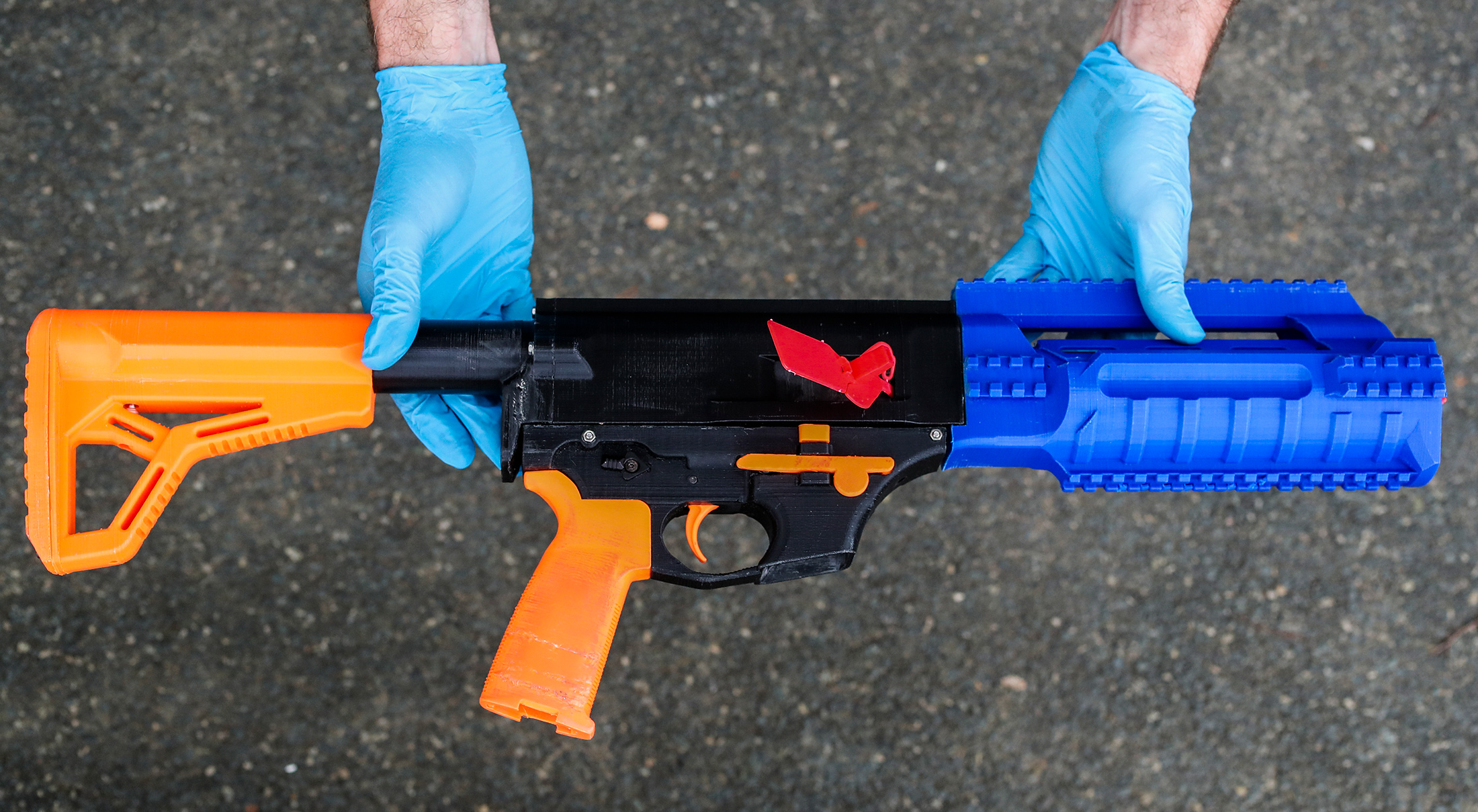 An FGC-9 seized by police in Australia in 2022. Photographer: The West Australian/WestPix To make that gun would have cost less than $1,000, including all the needed tools: vises, soldering irons, angle grinders, drills and the 3D printer itself. Subsequent builds would be even cheaper. Tuomas Kuure, a detective chief inspector in Finland, busted a neo-Nazi cell that was manufacturing FGC-9s in 2022, and he thinks each gun must have cost €400 or €500 to make. "Whereas if you had to buy a new, regular gun on the black market—even if you could—it would probably set you back thousands of euros," Kuure says. Well-printed FGC-9s look polished and feel substantial, their layers of plastic filament densely packed together. "You hold it," he says, "and you think, 'This is a serious piece of work.'" It's impossible to count the FGC-9s out there, but scholars and law enforcement officials run into them often enough to suggest that, outside the US, it's now the most popular 3D-printed gun in the world. They've encountered FGC-9s in the wild in more than a dozen countries across five continents, including in the hands of extremists in Sweden and the Netherlands and antigovernment rebels in Myanmar. Rueben Dass, a researcher of terrorism at Singapore's Nanyang Technological University, has built a database of 325 incidents involving 3D-printed guns around the world since 2013; they include discoveries during police searches of homes and workshops, raids of known weapons stashes, and arrests of the guns' owners. Half of these occurred outside North America, and the FGC-9 and its iterations popped up in almost a third. To anyone who pictures the core demographic here as American gun nuts sporting camo and "Don't Tread on Me" tattoos, the globalization of this movement may come as a shock. The FGC-9 helped make this happen; Covid-19 did too. JStark1809 published the FGC-9's design during the pandemic, when plenty of gun enthusiasts were stuck at home and online a lot. As the 3D2A—for "3D-printed" and "Second Amendment"—movement spread, it also diversified, developing fault lines, cliques and factions. Its political baseline is right-leaning libertarians, but it also includes trans rights groups, leftists, anarchists and those with somewhat blurred ideologies. One of the latter, Luigi Mangione, is alleged to have sourced a gun blueprint originally published by a collective called the Gatalog, built a Glock-style pistol and shot Brian Thompson, the chief executive officer of UnitedHealthcare, last year. (Mangione has pleaded not guilty.) One deep ideological division, over the ethics of profiting from gun designs, has resulted in a legal battle that began when a Floridian gun designer named Matthew Larosiere accused the 3D2A pioneer Cody Wilson of infringing copyright. Larosiere had published gun blueprints that were free to use and distribute, his suit claims, but not to commercialize, as Wilson is alleged to have done. In a countersuit, Wilson described Gatalog, to which Larosiere belongs, as a "criminal enterprise" and "a black market operator in the worst sense." (Wilson didn't respond to requests for comment. In response to the suit, he claimed that he and his companies comply with all federal and state laws, and he has argued elsewhere that copyright law covers only creative works and not functional objects. Larosiere did reply to a request for comment, but only to say that Wilson's countersuit had just been dismissed.) To the 3D2A movement, it's bad form for a journalist to draw inordinate attention to the assassins and crooks among them. Many of the people who swarm into the Reddit forums and Telegram and Rocket.Chat channels appear to be tech geeks at heart. It's just that the tech is a firearm, and they're geeking out over the minutiae of designing and building it. A typical Reddit post begins, "I am considering finally going a bit more advanced than PLA+ and trying out a build using some kind of carbon fiber nylon. I have also seen a lot of people anneal their nylon prints, so I have a few questions." That thread doesn't exist any more; in late September, Reddit banned the subreddit on which it was posted, on the grounds that users had failed to "avoid posting illegal content or soliciting or facilitating illegal or prohibited transactions." Regardless of the reason for their interest, their affiliation within the movement or their nationality, all these enthusiasts hold dear the right to bear arms, and their understanding of this right is purely American. One gun designer, a Brazilian who goes by Joseph the Parrot in English and Zé Carioca in Portuguese, co-authored a document called the New Second Amendment to go with the guide for his FGC-9 offshoot, the Urutau. "This right exists independently of need, though resisting tyranny is a key focus," Joseph says. (Like others in the 3D2A movement who were interviewed for this story, he wished to be referred to only by his handle; manufacturing guns without authorization is illegal in many countries, including Brazil.) To those who tend to be anxious about state control over their lives, a growing alarm about tyranny feels particularly justifiable during this global moment of deepening authoritarianism, says Rajan Basra, a researcher at the Department of War Studies at King's College London. "Their thinking is, 'We may not be living under a tyrannical government now, but maybe tomorrow—so we need a gun to defend ourselves,'" Basra says. What worries Kuure and other officials is that anyone who thinks attacking is the best form of defense can now print guns for themselves with ease. As yet, outside the US, no FGC-9 or other 3D-printed gun has been used to kill people in an act of terrorism. But Basra thinks it's inevitable. "You've got these designs floating around, you've got people making these designs. Eventually someone's going to use them in an attack," he says. "I don't even think it's alarmist to say that. It's just a matter of time." Keep reading: The Popular 3D-Printed Gun Globalizing the Second Amendment |










No comments:
Post a Comment