Sunday, August 31, 2025

The Forecast: The US Open is the future of sports

Plus, a political crisis in France.
View in browser
Bloomberg

Welcome back to The Forecast from Bloomberg Weekend, where we help you think about the future — from next week to next decade.

This week we're looking at what the US Open can tell us about the future of sports. Plus, a political crisis in France, more AI jobs data and the unsung success story of rice.

But, first: Do I hear wedding bells, er, bets? We love a good prediction market here at The Forecast, so readers may enjoy Matt Levine's recent newsletter about how Taylor Swift's engagement played out on platforms like Polymarket and Kalshi.

The US Open Is the Future of Sports

Step onto the grounds of the US Open this week and tennis is far from the first thing you'll see.

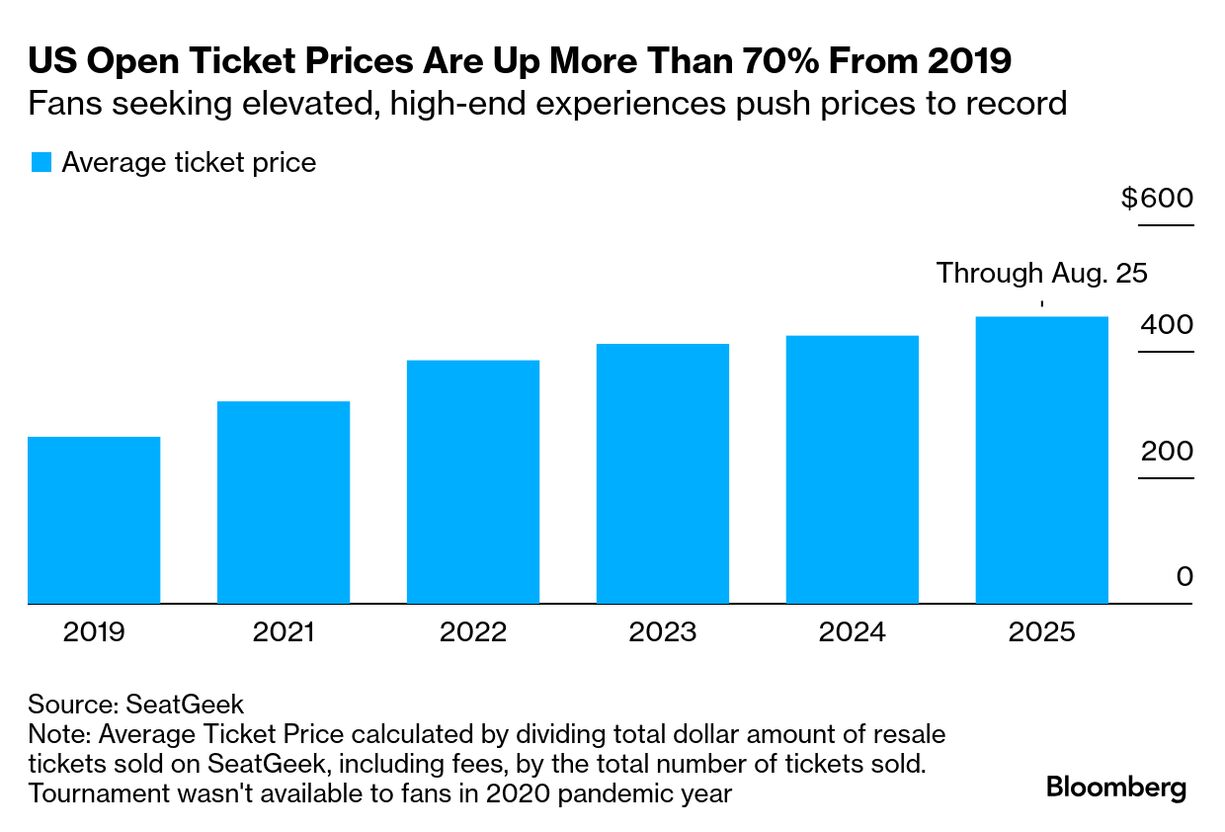
First there are the people — a lot of people, usually 70,000-plus a day. Then there are all the concession stands, whose offerings include a $100 box of chicken nuggets topped with caviar and a $23 Honey Deuce cocktail (which at least comes in a souvenir cup). Finally, nestled between the courts are myriad sponsor tie-ins, from the latest lineup of electric Cadillacs to complimentary skin checks courtesy of La Roche-Posay.

The US Open has always been about more than the game of tennis: It's an iconic New York event that draws celebrities, socialites and hundreds of thousands of fans. But as the United States Tennis Association (USTA), which owns and operates the event, focuses on expanding its reach, the Open is getting further and further away from the sport itself. What used to be two weeks of tennis with a few jazzy extras has over the past eight years morphed into three weeks of on- and off-court entertainment — complete with silent discos, a reality dating series, multiple DJ sets and endless brand "activations."

As private equity pours into sports leagues, and pro football and basketball franchises fetch record sums, investors and media partners are hunting for new sports to sell — from US soccer to women's basketball to Formula 1 to UFC. Leagues, in turn, are rushing to grow their fan bases and demonstrate their profitability. But as they do so, they risk turning off — or pricing out — longtime fans.

The USTA says it's still creating traditions for core tennis fans while following a broader sports trend: selling the event as much as the game. The upcoming Formula 1 Grand Prix in Las Vegas will look like a concert as much as a race, featuring artists including MGK and T-Pain. The Kentucky Derby is known for serving "the most exciting two minutes in sports," but spans a full week of parties and galas, even offering fashion tips for opening night.

Tennis has surged in popularity since the pandemic, with about 26 million players in the US, and the USTA's first chief growth officer has set a goal of 35 million by 2035. ESPN, which holds the broadcast rights for the US Open, sees expansion as "a rising tide that lifts all boats," said Tim Bunnell, who leads the network's global programming efforts in tennis, among other sports. "The bigger the event gets, it's good for everyone."

That's not how some avid tennis players see it. Kay Krane, who's attended the US Open since 1999, decided to skip this year's tournament in large part because of its increasing commercialization. Instead, she bought a round-trip ticket to Cincinnati, where a smaller US Open warm-up still featured all the top players. "Overall, I paid more," she said. "But I got more tennis."

— Molly Smith, Bloomberg News

Read the full story: The US Open Has Become About Everything But Tennis

For more like this, check out Bloomberg's subscriber-only Business of Sports newsletter

Predictions

AI will supercharge cybercrime: "A single user can operate like an entire cybercriminal team," and it's already starting. — Emily Forgash, Bloomberg Tech

Utility bills are the new gas prices: Oil prices don't respond to geopolitical shocks as they once did. Meanwhile, electricity prices are rising in the US – partly due to AI. That means "pain at the plug is the new pain at the pump — and it may be just as politically potent." — Ari Natter, Bloomberg News 

For markets, "2025 could prove more akin to 1997… than 1999." If the economy can weather the tariff transition, we may still be in the early days of a stock-market bubble. But if the big tech companies ever cut back on AI, "watch out." — Ed Harrison, The Everything Risk

Millions of Europeans will die of extreme heat by the end of the century "if planet-warming carbon emissions continue to rise," according to a new study. Also, the World Health Organization estimates that for every 1C increase in temperatures, "worker productivity drops between 2% and 3%." — Olivia Rudgard and Magdalena Del Valle, Bloomberg Green (Worth noting: Outside the US, the green revolution continues apace.)

Forget college applications; "at age 18 you'll choose your country," predicts former Coinbase Inc. executive and The Network State author Balaji Srinivasan, who is testing his vision of "startup societies" on a campus in Malaysia. — Ryan Weeks, Bloomberg CityLab

The most overlooked technological advance of our age is… rice. "Over the last century, crop yields have exploded… And those gains can be sustained." — Javier Blas, Bloomberg Opinion

Coffee is going to get more expensive due to tariffs. — Ilena Peng, Bloomberg News

What Are the Chances...

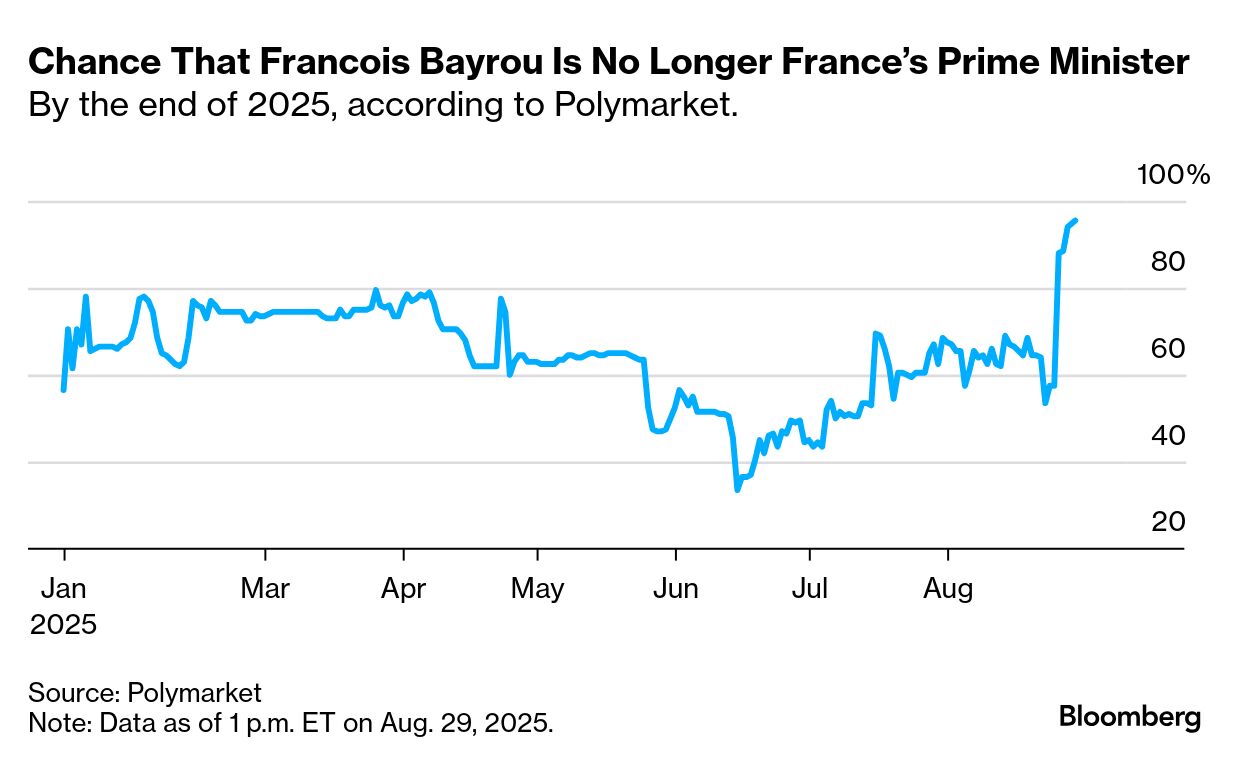
France's Prime Minister Francois Bayrou called this week for a confidence vote aimed at securing his budget, but it could end up toppling his government. 

Traders on Polymarket do not like Bayrou's odds. Right now, they put a 92% chance on his ouster by the end of September. That market is new, though. So here's a chart of a longer running prediction market — still with less than $100,000 in total trading volume — on the chance that he's out as PM by the end of the year. As of 1 p.m. ET on Friday that's trading at 96%.

Keep an Eye On

AI Is Taking Entry-Level Jobs

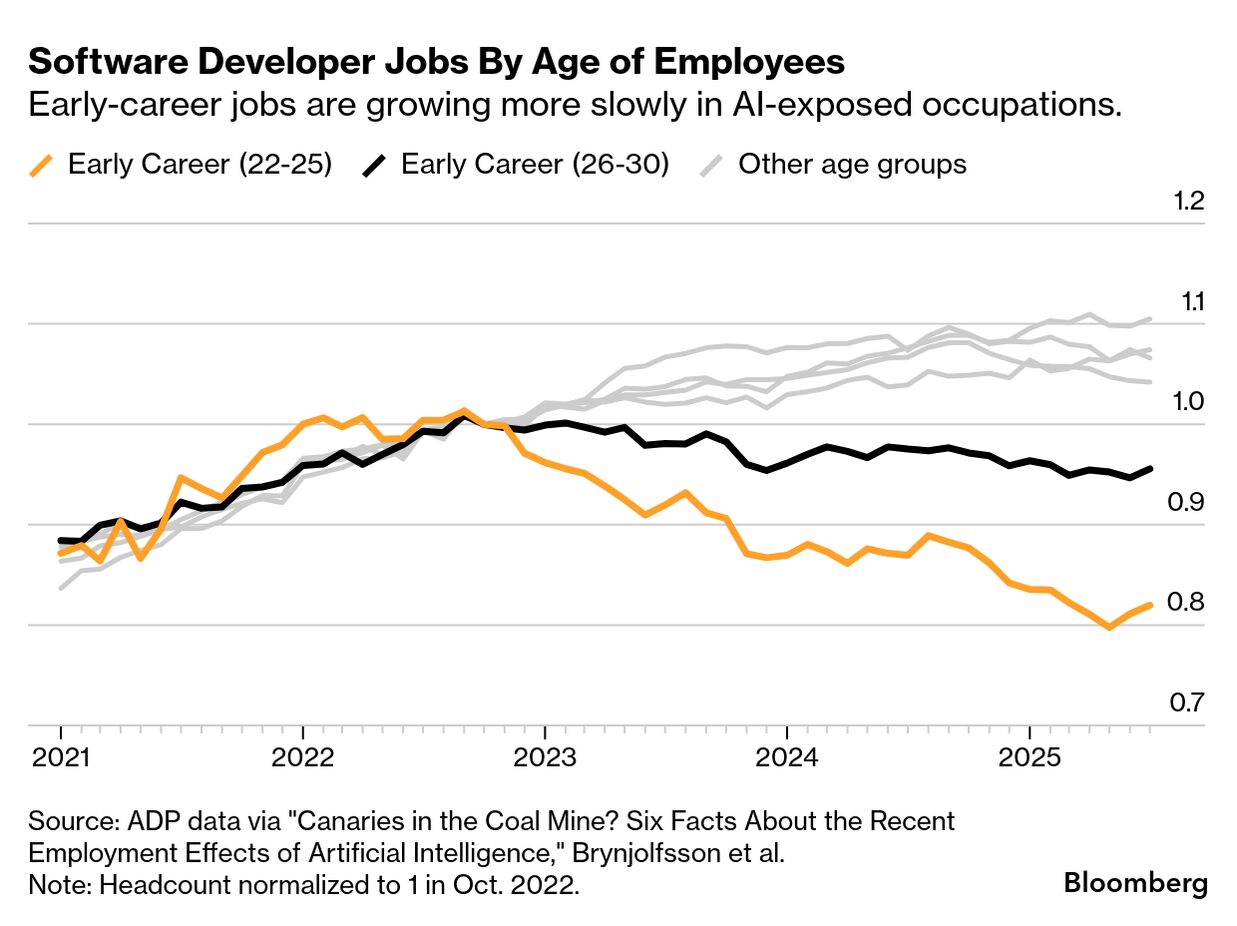
Another week, another interesting study on AI and the labor market. Recall the story so far, from The Forecast three weeks ago

Enter a new study from economists at Stanford that offers a detailed look at how AI is affecting younger workers in the US. It's not good: Employment in "AI-exposed" jobs like coding and customer service has continued to grow for older workers but shrunk for workers aged 22-25. By contrast, employment of younger workers in less AI-exposed fields like home health aid continues to grow.

The researchers used data from payroll provider ADP, which meant larger sample sizes to slice by age and occupation than is possible with some government sources. They tried to rule out other explanations — you can read more about their results here — and noted that they can't fully untangle cause and effect. Nonetheless, it's the best evidence to date that AI is already affecting the job market for entry-level work. 

— Walter Frick, Bloomberg Weekend

Week Ahead

Sunday: The Shanghai Cooperation Organization summit begins in Tianjin.

Monday: US markets closed for Labor Day; Guyana holds a general election.

Tuesday: Brazil reports GDP; the Eurozone and South Korea report CPI.

Wednesday: Australia and South Korea report GDP; US publishes job openings; the Fed releases its Beige Book.

Thursday: Malaysia's central bank is expected to cut a quarter-point; Switzerland and Sweden report CPI.

Friday: US and Canada publish August jobs data.

Weekend Reads

The Cracks in America's Rule of Law Are Getting Deeper
Can China's Green Revolution Be Replicated?
The US Disaster Agency Was Breaking Long Before Trump
A Sudden Order to Round Up Delhi's Street Dogs Is Dividing India
Shonda Rhimes: 'America Is Not a Reality TV Show'

Have a great Sunday and a productive week.

— Walter Frick and Kira Bindrim, Bloomberg Weekend; Molly Smith, Bloomberg News

More from Bloomberg

Enjoying The Forecast? Check out these newsletters:

Explore all newsletters at Bloomberg.com.

Follow Us

Like getting this newsletter? Subscribe to Bloomberg.com for unlimited access to trusted, data-driven journalism and subscriber-only insights.

Before it's here, it's on the Bloomberg Terminal. Find out more about how the Terminal delivers information and analysis that financial professionals can't find anywhere else. Learn more.

Want to sponsor this newsletter? Get in touch here.

You received this message because you are subscribed to Bloomberg's The Forecast newsletter. If a friend forwarded you this message, sign up here to get it in your inbox.
Unsubscribe
Bloomberg.com
Contact Us
Bloomberg L.P.
731 Lexington Avenue,
New York, NY 10022
Ads Powered By Liveintent Ad Choices

No comments:

Post a Comment

🌴 Luau Kits Are Here!

The mystery officially begins 🌺 ͏  ͏  ͏  ͏  ͏  ͏  ͏  ͏  ͏  ͏  ͏  ͏  ͏  ͏  ͏  ͏  ͏  ͏  ͏  ͏  ͏  ͏  ͏  ͏  ͏  ͏  ͏  ͏  ͏  ͏  ͏  ͏  ͏  ...